

Why ‘AI for business’ matters now and how to read the signal from the noise
In 2026, it feels like everyone is talking about AI. You see news about new AI tools and changes every single day. This can be exciting, but it also means a lot of information. For business leaders and people who run companies, it’s hard to tell what’s truly helpful and what’s just hype.

You need to find the real "signal" that helps your business grow, not just more "noise" that confuses you. Many experts agree that AI is moving from just being a buzzword to something truly practical this year, changing how we work and solve problems across many industries [news.microsoft.com/source/features/ai/whats-next-in-ai-7-trends-to-watch-in-2026].
Actually, it’s a big challenge to know which AI tools for work are right for your team. You might ask yourself:
- How do I pick the best AI tools?
- How do I make sure they fit into how we already do things?
- How do I know if they are truly making money or saving time for my business?
- How do I keep our company safe while using new AI?
This article is here to help you cut through all that noise. We will give you a clear and simple way to think about AI for business. We’ll show you how to pick the right AI analysis tool, put these tools into your daily business steps, measure if they are really helping your bottom line (that’s called ROI), and make sure you manage any risks. Our goal is to give you a framework to thoughtfully scale artificial intelligence in your company. You can also explore how to gain a deeper understanding of these technologies with our guide on Unlock AI Mastery: The Strategic Guide to Study AI Effectively.
To help you stay informed and get those clear daily updates, we invite you to subscribe to The AI Newsletter Worth Reading.
In 2026, companies are moving fast to use AI. Almost all businesses, about 91%, use AI in some way today AI Adoption Statistics: Business & Enterprise Data 2026.
This shows that AI for business is not just an idea anymore; it’s real work. To make smart choices, business leaders need to understand the different kinds of AI tools out there. It’s like knowing what tools are in a toolbox before you start building.
Here are the main types of AI tools for work that are helping companies today:
- Foundational Models: Think of these as the main brains of AI. They are very powerful and can do many different tasks, like writing text or making images. Companies use these models as a starting point to build their own special AI tools.
- Verticalized Platforms: These are AI tools made for a very specific job or industry. For example, there are AI tools just for doctors to help find problems in X-rays, or for banks to spot fraud. These platforms understand the special needs of their field.
- Automation Suites: These AI systems help make many steps in a process happen automatically. For example, an AI automation suite might handle customer questions, sort emails, or manage orders. This helps businesses save time and money.
- MLOps and Data Platforms: These tools help businesses build, run, and keep their AI models working well. They make sure the AI has good data to learn from and that it keeps working properly over time. Getting your data ready for AI is a big part of making AI work, as you can learn more about in our guide on AI-ready Data: Your Strategic Priority for Enterprise AI in 2026.
When you are looking to bring AI into your company and truly scale artificial intelligence, there are important things to think about, not just what the AI can do right now. Experts suggest that business leaders consider a bigger picture when picking an AI analysis tool Enterprise AI Vendor Map: What CIOs Must Know in 2026.
Here are some key points for choosing AI tools:
- Total Cost of Ownership (TCO): This is more than just the price tag. It includes all the costs over time, like setting up the AI, keeping it running, training your staff, and making sure it’s safe. A cheaper tool at first might cost more later.
- Vendor Lock-in: This means being stuck with one company for all your AI needs. If you rely too much on one vendor, it might be hard or costly to switch later if you find a better option.
- Interoperability: This is about how well new AI tools can work with the computer systems and programs your company already uses. You want everything to play nice together, not create more problems.
- Product Roadmaps: Think about what the company that made the AI tool plans to do in the future. Are they always making their tools better? Does their plan fit with your company’s long-term goals for AI?
Looking at these points helps you make sure the AI tools you pick will truly help your business grow and not just be a quick fix. You might even want to create an AI model comparison chart to weigh all your options clearly.
Making an AI model comparison chart is a smart step to help pick the right AI tools for work. It lets you see clearly how different options stack up. To truly choose well and make sure you can scale artificial intelligence in your company, you need to think about how each tool fits your business.
Here is a simple table to help you match AI tools to what your business needs and how much risk they might carry:
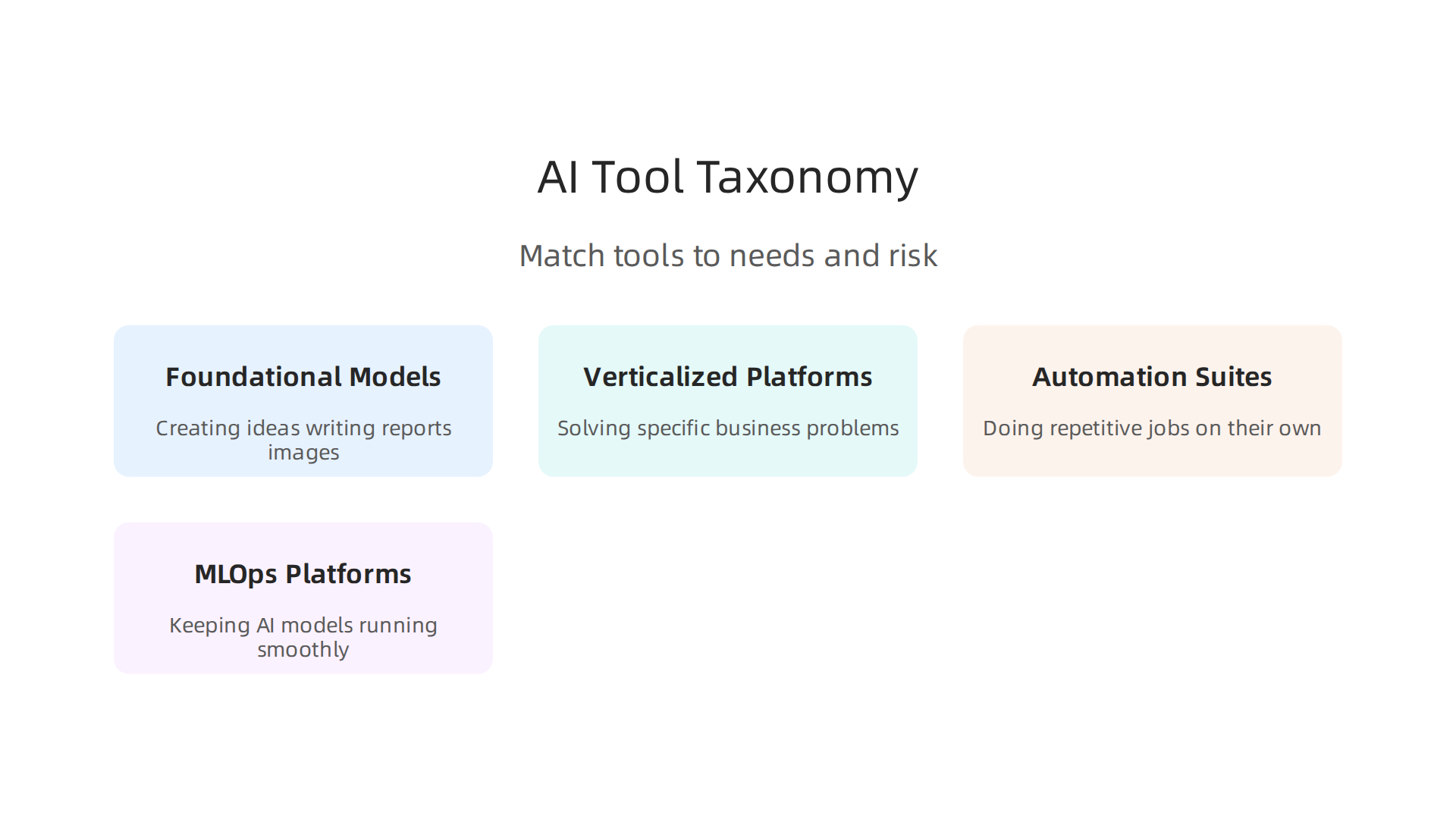
Practical Tool Taxonomy and Selection Matrix
| AI Tool Type | What It Helps With (Business Functions) | How Risky It Can Be (Risk Profile) | Key Things to Look For (Selection Criteria) |
|---|---|---|---|
| Foundational Models | Creating new ideas, writing reports, making images, starting new projects with broad AI help. | Higher (can be complex to set up, needs careful ethical thinking). | Vendor maturity, how well your data is ready, how easy it is to grow. |
| Verticalized Platforms | Solving very specific problems for one type of business, like checking medical scans or stopping fraud. | Medium (needs good linking with your current systems, might be hard to change later). | Data readiness, how much it costs to connect, vendor’s experience, specific features. |
| Automation Suites | Doing repetitive jobs on their own, like answering common customer questions or sorting emails. | Lower (often shows clear savings, usually easier to add to your tools). | How much it costs to connect, how quickly you see value, how simple it is to use. |
| MLOps and Data Platforms | Keeping your AI models running smoothly, making sure the data AI learns from is good and reliable. | Medium to Higher (needs skilled people to run, requires strong data rules). | Data readiness, connection costs, vendor’s reliability, plans for future growth. |
When you are picking an AI analysis tool, it’s important to look at more than just what the tool can do. Think about these four key points to make sure your AI for business choice is a good one for the long run:
- Data Readiness: Can the AI tool easily use the information your company already has? If your data isn’t ready for AI, it might cost a lot of time and money to get it there. Good data is the fuel for any successful AI.
- Integration Costs: How much will it truly cost to make the new AI tool work with all your existing computer systems? Sometimes, the price of the tool itself is small compared to the cost of getting it to talk to everything else.
- Vendor Maturity: How long has the company making the AI tool been around? Do they have a good track record? A strong vendor means better support and a tool that is more likely to improve over time. Many reports, like the AI Vendor Landscape, 2026, help show which vendors are doing well.
- Value Velocity: How quickly will the AI tool start giving your business real benefits and showing its worth? You want to see results fast, not wait years for the investment to pay off.
Considering these points helps ensure that you not only pick a powerful AI tool but one that truly fits your company’s way of working and helps you grow smarter.
Get clear daily AI updates from The Deep View Newsletter.
When you pick an AI tool, that is just the start. The next big step is to make sure it gets fully set up and works well for your whole company. This journey from a small test to full use, or from pilot to production, needs careful planning to avoid problems.
Here are the main steps to follow and things to keep in mind:
Stages to Bring AI to Life
- Problem Discovery: Before anything else, you must be clear about what problem you want the AI to solve for your business. Don’t just use AI because it is new. Really dig in to find the core issue. What is the goal? How will you know if the AI is helping? This clear start makes sure your efforts with AI for business are pointed in the right direction.
- Pilot: Once you know the problem, start small. Run a pilot program where you test the AI tool in a limited way. This helps you see if it actually works in your real company setting. Think of it as a small trial run. Experts say it’s important to start small and then slowly grow if things go well. It is also very helpful to use real company data from the start, not just perfect test data. This gives you a true picture of how the AI tool will perform. Many companies find success by creating pilots that act like miniature production environments from day one, setting clear goals and using real data to test the waters effectively, as discussed in the 2026 AI Innovation Playbook: From Pilots to Production.
- Productionization: If your pilot works well and shows good results, it is time to set up the AI tool for everyone to use. This step is about making the AI a full part of your company’s daily work. It means making sure the AI tool can handle a lot of tasks, connect smoothly with other computer systems, and work without problems all the time. This is where you truly start to scale artificial intelligence across your business.
- Monitoring and Iteration: You can’t just set up an AI tool and forget it. You need to keep a close eye on it to make sure it is still working as it should. Does it still give correct results? Is it creating any new, unexpected problems? You should also keep making it better over time. This means checking its performance regularly and updating it as needed. It is a never-ending cycle of making things better for your AI tools for work.
Getting Everyone on Board
For AI to work well in your business, people and teams need to work together. This is called organizational alignment.

- Data Ownership: This is very important. Someone needs to be clearly in charge of the data that the AI uses. If the data is messy or wrong, the AI will also give messy or wrong results. Knowing who owns the data and making sure it is ready for AI is a key step, as highlighted in guides like AI Ready Data your strategic priority for enterprise AI in 2026.
- Cross-functional Champions: Bring together people from different parts of your company. These "champions" believe in the AI project and help other teams understand and use the new AI tool. They make sure everyone works together towards the same goal.
- Engineering Trade-offs: Sometimes, making an AI tool perfect takes a lot of time and money. Your teams might need to make smart choices. They must find a good balance between how good the AI is and how fast and cheaply it can be put into use. This means making practical decisions to move forward with your AI for business projects.
By following these steps and making sure everyone is aligned, you can smoothly bring your ai analysis tool from a small test to a valuable part of your everyday business, without causing a lot of trouble.
Moving an AI tool from a small test to everyday use is great, but it also brings up important questions about safety and fairness.

This is where thinking about risks, compliance, and governance for your ai for business tools comes in. It’s like having a clear set of rules and checks to make sure your AI works well and doesn’t cause problems for your company or its customers.
4) Risk, compliance, and governance: A pragmatic checklist
When you pick and set up an AI tool, you must look closely at any dangers it might bring. These dangers can be legal, like breaking privacy laws, or regulatory, meaning you might not follow new rules about AI. There are also risks to your company’s good name if the AI acts unfairly or makes mistakes.
In 2026, new rules for AI are popping up all over the world. For example, the EU AI Act has parts that are becoming enforceable, especially for "high-risk" AI systems. Companies need to be ready to follow rules about what their AI does and how clear it is to users. In the US, states like Colorado have passed their own laws that demand careful risk management for AI systems that make important decisions, as noted in the US AI regulations 2026: the state laws you must comply with.
It’s very important to know about these rules and make sure your AI tools for work fit within them. If you want to dive deeper into building ethical AI, consider how to develop AI Ethics for Leaders.
To handle these risks well, you need a strong plan. Here’s a simple checklist for how to manage your AI tools:
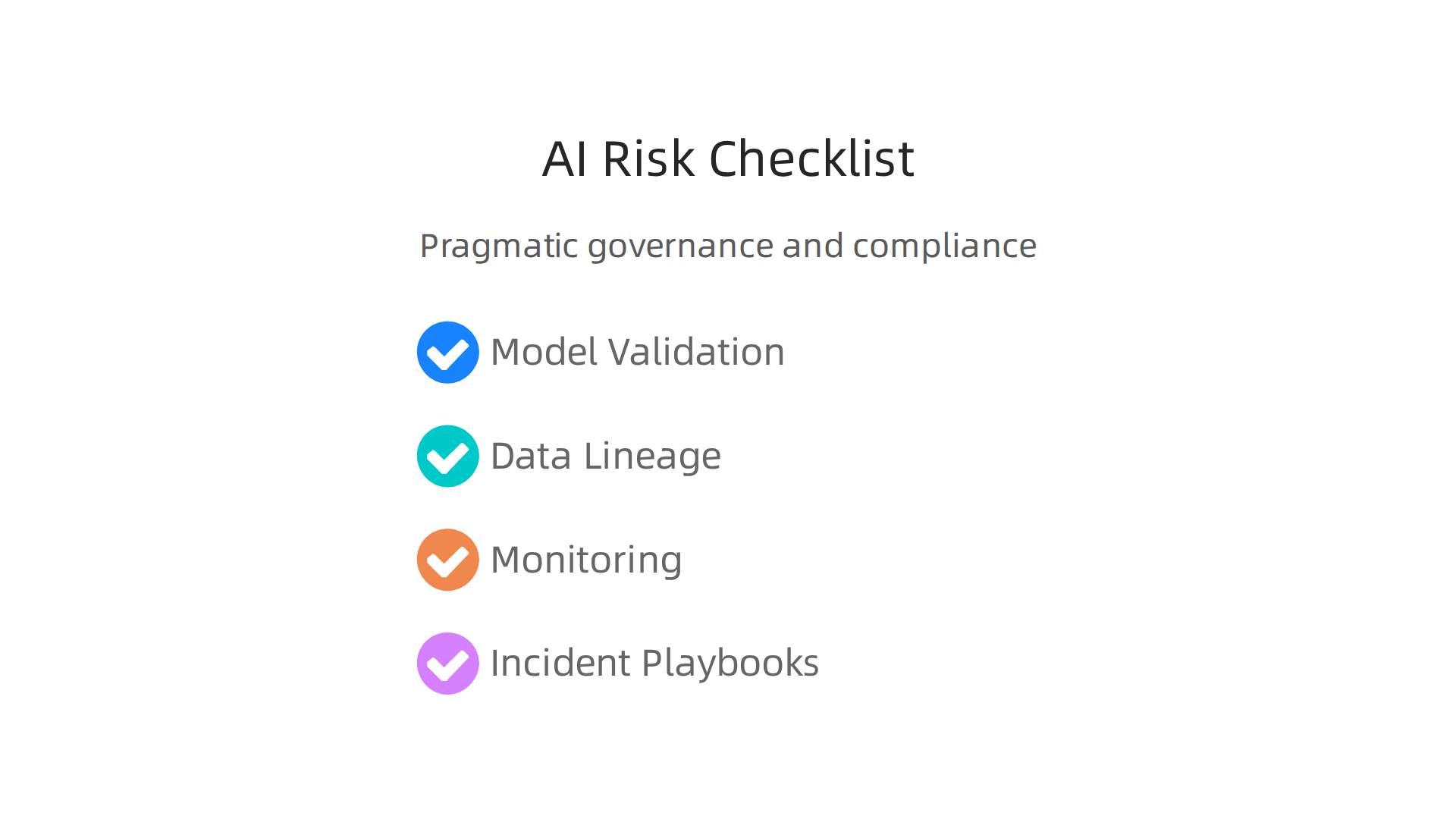
- Model Validation: This means regularly checking that your AI model is working exactly as it should. It’s like checking a car engine to make sure it’s still running smoothly. You need to make sure the AI gives correct and fair results over time. If not, it could lead to bad decisions or even unfair treatment, hurting your business and its customers. Many companies now use frameworks like the NIST AI Risk Management Framework to guide this process, which is seen as a key standard for AI governance, as outlined in An Ultimate Guide to AI Regulations and Governance in 2026.
- Data Lineage: You need to know exactly where the data your AI uses comes from. Think of it as a clear family tree for your data. This helps you trust the data and fix problems if it’s found to be wrong or biased. Without clear data lineage, your AI could be making decisions based on faulty information.
- Monitoring: After you launch your AI, you can’t just leave it alone. You need to constantly watch its performance. Is it still accurate? Is it using too much power? Is it causing any unexpected side effects? Keeping an eye on your AI helps you catch issues early and keep it running at its best. This ongoing watch helps your ai analysis tool stay effective and trustworthy.
- Incident Playbooks: Even with careful planning, things can sometimes go wrong. An AI might make a bad decision, or a system might crash. An "incident playbook" is a clear step-by-step guide for what to do when problems happen. It helps your team react quickly and smartly to fix issues and lessen any harm. Building a global AI governance framework that includes these steps is key to handling regulatory complexity, a point emphasized in AI Regulation 2026: Turning Regulatory Complexity into ….
By taking these steps, your business can use AI with more confidence, knowing that you’re managing the risks and staying compliant with the rules. This careful approach protects your company and helps build trust in your AI solutions.
Ready to stay ahead of the curve on AI developments?
The AI Newsletter Worth Reading
After making sure your AI tools are safe and follow all the rules, the next big question is: Are they actually helping your business? This means looking at how much value your AI brings and if it’s worth the money and effort you put into it. Measuring the return on investment (ROI) for your AI projects helps you see if your new smart tools are really making a difference.

5) Measuring ROI: Metrics that matter and how to attribute value
It’s really important to know if your ai for business is paying off. In 2026, almost all businesses, about 91%, use AI in some way, and over 70% have at least one AI project actively running, according to AI Adoption Statistics: Business & Enterprise Data 2026. With so many companies investing, checking the value is key. To do this, we look at different kinds of numbers, often called "metrics."
Leading Indicators: Early Signs of Success
Think of leading indicators as early clues that your AI is working well.
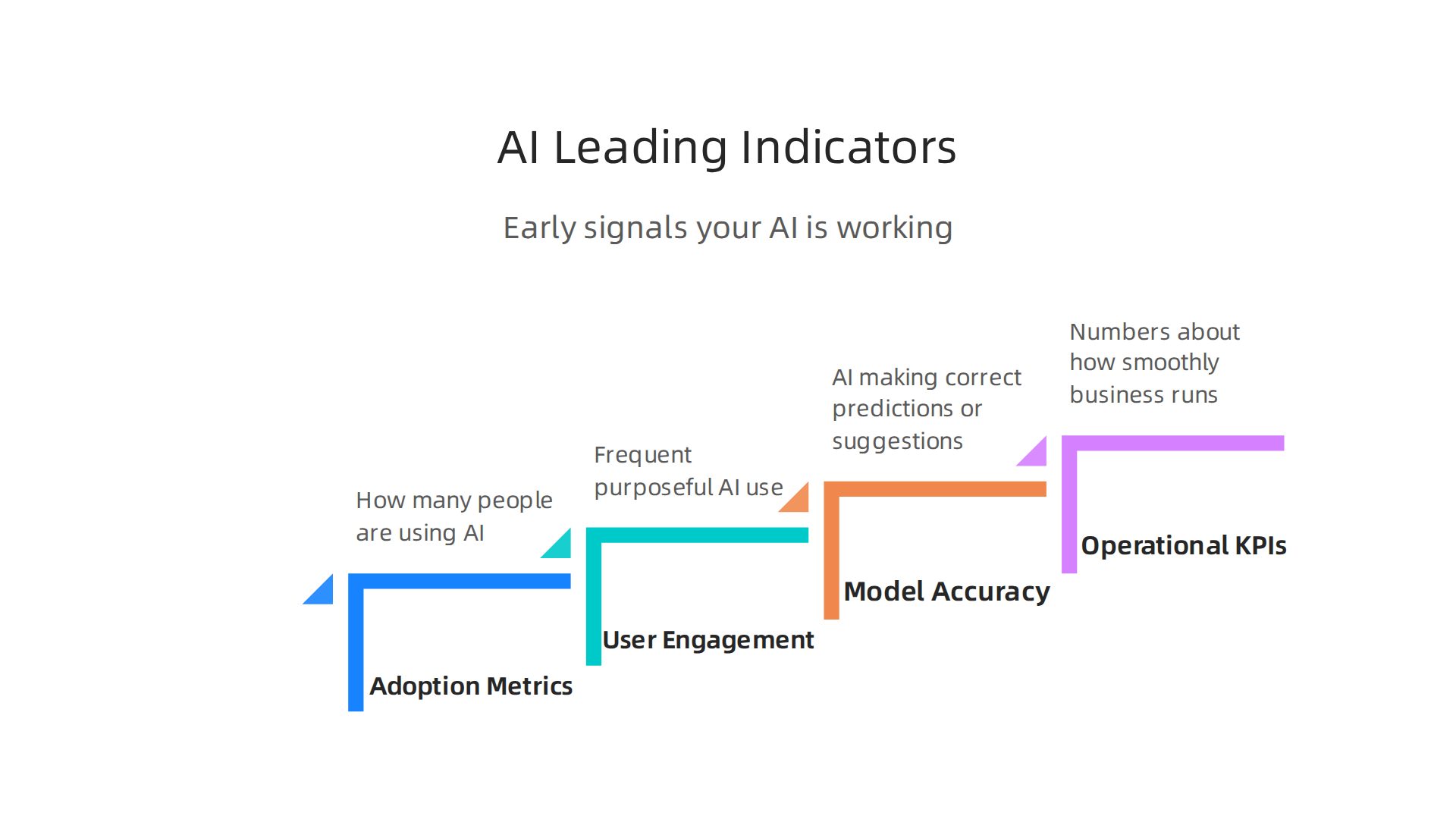
They don’t show the final money saved or made, but they tell you if things are moving in the right direction.
- Adoption Metrics: How many people or teams are actually using the AI tool? If many employees start using a new AI helper, that’s a good sign it’s helpful. For example, in 2026, enterprise AI adoption doubled to 24% of companies using it full-scale. This shows more companies are bringing AI into their daily work.
- User Engagement: Are people using the AI tool often and for what it’s meant for? High engagement means people find it useful.
- Model Accuracy: Is the AI making correct predictions or suggestions? For an ai analysis tool, getting the right answers most of the time is a strong leading indicator.
- Operational KPIs (Key Performance Indicators): These are numbers about how smoothly your business runs. For example, if an AI helps customer service, a leading indicator might be shorter call times or faster response rates.
Lagging Indicators: The Real Business Impact
Lagging indicators show the actual, final results of your AI efforts. These are the numbers that directly tell you about your business’s health and money.
- Cost Savings: Did the AI help your company spend less money? Maybe it automated a task that used to need many hours of human work.
- Revenue Increase: Did the AI help you make more money? Perhaps it suggested products that customers were more likely to buy, or it helped sales teams close more deals.
- Efficiency Impact: Did the AI make processes faster or smoother? This could mean your employees can do more in less time, helping you to scale artificial intelligence projects.
- Customer Satisfaction: Are your customers happier because of the AI? This might show up in better survey scores or fewer complaints.
Attribution Approaches: Knowing AI Did the Work
It can be tricky to know for sure if a change in your business happened because of AI or for other reasons. This is called "attribution." Here are some ways to figure it out:
- Controlled Experiments: Imagine you have two groups of people. One group uses the AI tool, and the other doesn’t. If the group using AI shows better results, you can be more sure the AI caused it. This is like a science experiment for your business.
- Incremental Lift Studies: This means looking at the extra benefit the AI brought. For example, if your sales went up by 10% after using an AI, but they would have gone up by 3% anyway, the AI caused an "incremental lift" of 7%.
- Proxy Metrics: Sometimes, it’s hard to directly measure the big impact of AI. So, you use a "proxy" or a stand-in. For example, if an AI helps find problems in data, instead of directly measuring how much money saved from fewer errors (which is hard), you might measure how quickly the AI can spot issues. Having good, AI-ready data makes this process much easier and more reliable.
By carefully looking at both leading and lagging indicators and using smart ways to connect results to your AI, businesses can truly understand the value their ai tools for work are creating. This helps make better choices about where to invest next and how to get the most out of these powerful technologies.
After looking at how well your AI tools are doing right now, it’s smart to think about what’s coming next. This helps you make even better choices about where to put your energy and money. In the next few years, say the next 18 to 36 months, some big changes will shape how businesses use AI.
New Ways AI Will Be Built and Used
Just like how phones changed from simple ones to smartphones, AI is always changing too. Here are some big shifts we expect to see:
- Platform Changes: AI is moving from being about huge, general models to being more practical and fitting into everyday tools. Think of it like AI getting "smarter" in how it works with other programs and devices you already use. Experts say that by 2026, AI will move from just hype to being really useful in daily tasks, making it more practical for everyone. This means AI will become a partner in work, not just a fancy tool, as mentioned in What’s next in AI: 7 trends to watch in 2026.
- Composability (Like LEGO Bricks): Soon, businesses will be able to build AI tools by picking and choosing different AI parts, like building with LEGO bricks. Instead of buying one big AI system, they’ll mix and match smaller, specialized AI pieces. This makes it easier to create exactly what your business needs. This also links to "agentic AI" where smart programs work together to get things done, a major trend in 2026 that could see up to 40% of business apps using these smart agents, according to The Future of AI in 2026: Major Trends and Predictions.
- Specialized AI Models (Verticalized LLMs): Imagine an AI language model that knows everything about health care, or one that’s an expert in finance. These are called "verticalized LLMs" because they are made for specific industries. They will be much better at tasks for those fields than general AI models. In 2026, many experts believe that specialized foundation models made for certain data types will be key for valuable business AI tasks, as noted in AI in 2026: Five Defining Themes. This helps businesses in specific areas like healthcare or finance move AI projects from testing to real use.
Rules and How AI Is Sold
As AI grows, so do the rules and how companies get these tools to you.
- More Rules (Regulation): Governments around the world are making more rules for AI. These rules help make sure AI is used safely and fairly. Companies using AI need to keep up with these new laws to avoid problems. Thinking about AI ethics is becoming very important for leaders as they build trustworthy AI.
- New Ways to Sell AI: The way companies sell and deliver AI tools will also change. Instead of just selling software, they might offer AI as a service that grows with your needs, or even as pre-built "AI agents" that do specific jobs for you. This means businesses will have more choices and easier ways to get the AI help they need. The world market order is being reshaped by AI and new ways of selling and using it.
How to Spot What’s Important for Your Business
With so many changes, how do you know what to pay attention to?
- Watch for Practical Use: Don’t just look at the newest, flashiest AI. Instead, see if the AI is actually solving real business problems or making things easier for people. If it’s practical, it’s likely important.
- Look for AI that Works Well Together: If different AI tools can easily connect and share information, that’s a good sign. This helps your business grow and makes AI more useful across different teams.
- Ignore the Hype: Many new AI tools get a lot of buzz, but not all of them will last. Try to look past the excitement and see if the AI offers real, long-term value.
- Test Your Ideas: When you think an AI trend might be big, try to prove yourself wrong. Ask tough questions. Does it really save money? Does it really make customers happier? This helps you avoid bad investments. For more guidance, you can also look at Top 6 AI Trends That Will Define 2026 (backed by data) to help stress-test your assumptions.
By keeping an eye on these trends and thinking carefully about new AI, your business can stay ahead. To ensure you’re always informed about the latest movements and deeper analysis in the AI and tech world, consider staying updated. Get clear daily AI updates from The AI Newsletter Worth Reading.
Summary
This article explains why AI is no longer just hype and how business leaders can separate useful signals from distracting noise. It maps the main AI tool types—foundational models, verticalized platforms, automation suites and MLOps/data platforms—and shows how each fits different business needs and risk profiles. You’ll learn a practical selection framework that looks beyond price to TCO, vendor lock-in, interoperability and product roadmaps, plus how to assess data readiness and integration costs. The piece also walks through the stages to scale AI from problem discovery and pilots to production and ongoing monitoring, and it offers a pragmatic checklist for governance, model validation and incident playbooks. Finally, it covers how to measure AI value with leading and lagging indicators and attribution methods so you can prove ROI and make smarter investment decisions.