

Why ‘AI-Ready Data’ Is the Strategic Priority for 2026
In 2026, businesses everywhere are talking about artificial intelligence. But here’s the thing: AI systems are only as good as the data they use. This is where ai-ready data becomes incredibly important. For leaders and investors, making sure your data is "AI-ready" isn’t just a tech buzzword; it’s a strategic must-have that drives real business decisions and growth.

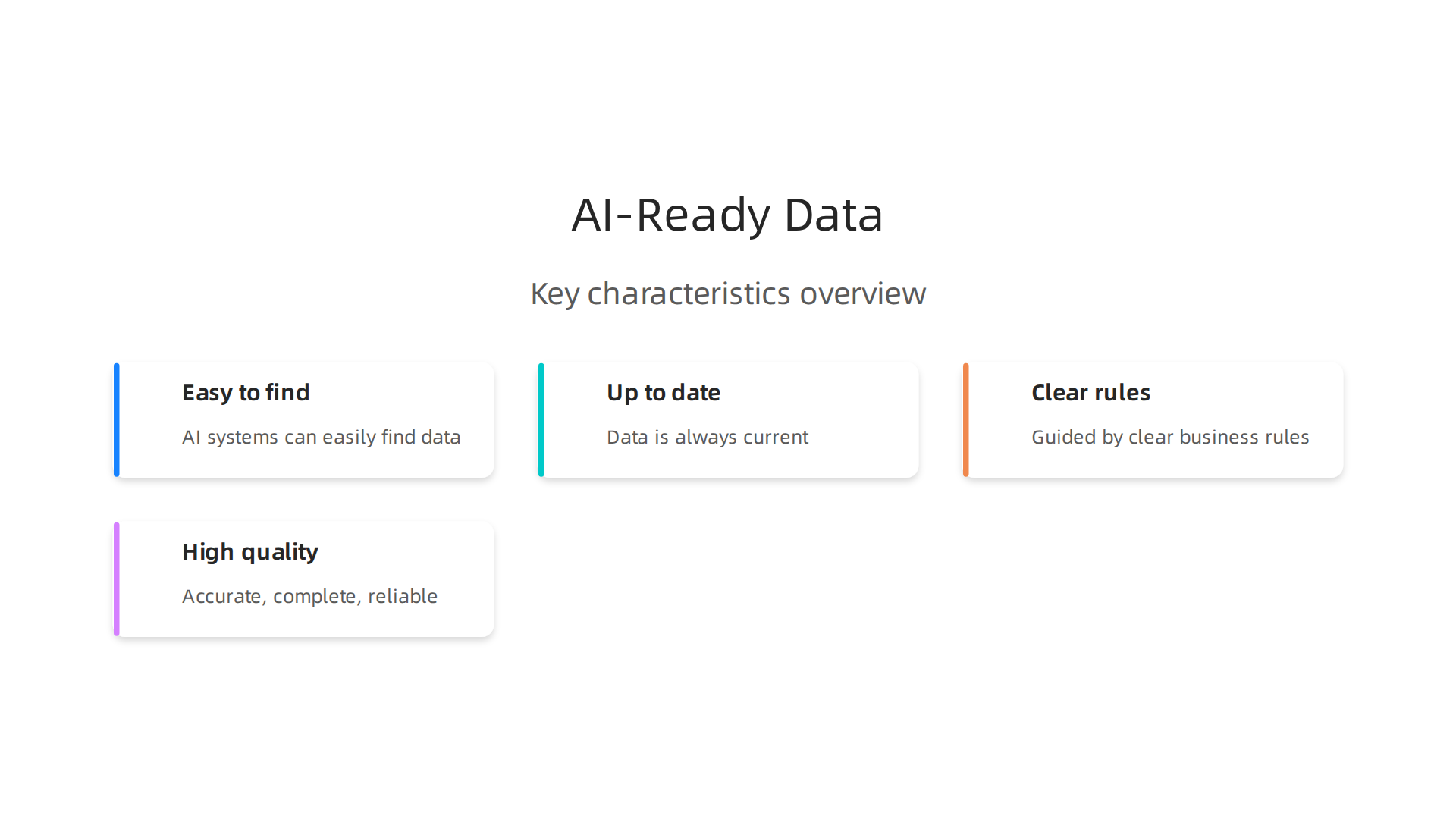
So, what exactly does ai-ready data mean? Simply put, it’s enterprise data that is cleaned up, well-organized, and set up so that AI systems can easily find, understand, and use it safely and effectively. Think of it as data that is ready for prime time with AI. It needs to be easy to find, always up-to-date, guided by clear rules, and of high quality.
This kind of data can be used by AI tools and smart assistants across all your systems, whether they are in your office or in the cloud, without needing to be moved or copied constantly The 2026 Enterprise Guide to AI-Ready Data.

It also means the data comes with clear business meanings and rules that AI can understand, instead of having to guess What Is AI-Ready Data? Definition, Benefits.
Without ai-ready data, companies face several big problems. First, there’s the issue of data quality. If data is messy, incomplete, or wrong, any AI built on it will give bad results. Imagine trying to make smart choices based on faulty information; it just won’t work. Next is data provenance, which means knowing exactly where your data came from and how it was collected. This helps build trust and makes sure data is used fairly and legally A framework for AI-ready data.
Another challenge is properly labeling data. AI models, especially large language models (LLMs in AI), need data that is clearly tagged so they can learn correctly. If data isn’t labeled well, the AI can get confused. There’s also a growing need for an artificial intelligence detector to identify manipulated content or "deepfakes," which means data must be trustworthy and traceable. For executives and investors, getting valuable insights from LLMs depends on having high-quality, contextualized, and organized ai-ready data. This allows for clear ai data visualization and better decision-making.

For more deep insights into how AI is shaping the technology sector, consider checking out The AI Newsletter Worth Reading. Staying informed on these trends is key to navigating business technology in 2026. To explore broader strategies, you can learn more about navigating business technology in 2026 with AI strategies for growth and compliance.
For executives and investors, getting valuable insights from LLMs depends on having high-quality, contextualized, and organized ai-ready data. This allows for clear ai data visualization and better decision-making.
So, what exactly makes data truly "AI-ready" for your business? It boils down to a few key qualities that ensure AI systems can do their best work. Think of these as the ingredients for a powerful AI engine. When we talk about ai-ready data, we’re looking for these core attributes:
Core Attributes of AI-Ready Data
- Completeness: This means your data has all the pieces it needs. No missing parts or gaps that could confuse an AI model. Incomplete data can lead to wrong guesses by the AI.
- Representativeness: The data should truly show the real world or the problem you’re trying to solve. If you’re building an AI to understand customer behavior, your data needs to represent all kinds of customers, not just a small group. This helps avoid bias in the AI’s learning AI-Ready Data 2026: The Enterprise Knowledge Playbook for ….
- Labeling Fidelity: For AI models, especially those using large language models (LLMs in AI), data needs clear and correct labels. Imagine trying to sort toys without knowing which is a car and which is a truck; AI needs these tags to learn properly. Good labeling helps the AI understand the context and meaning.
- Schema Stability: This sounds technical, but it simply means your data is organized in a consistent way that doesn’t change often. If the way your data is structured keeps moving around, AI systems will struggle to find and use it reliably. A stable structure makes data easier for AI to process.
- Traceable Provenance: You need to know where your data comes from, how it was collected, and how it was changed over time. This creates a clear history for the data. Knowing the source helps ensure trust and makes sure the data is used fairly and legally, which is important for things like an artificial intelligence detector that verifies content. According to Gartner’s 2026 framework, understanding data lineage is critical for alignment and governance Gartner D&A Summit 2026: Key Takeaways on Context & AI.
Quick Checklist for Executives
To quickly check if your data is on its way to being AI-ready, ask yourself these simple questions:
- Is our data complete and free of big holes? AI needs all the facts.
- Does our data truly show the full picture, or is it biased? A balanced view leads to smarter AI.
- Is our data clearly labeled so AI can understand it? Clear tags help AI learn fast.
- Is our data organized in a steady, reliable way? Consistent setup makes AI’s job easier.
- Can we track where our data came from and how it changed? Trustworthy data is key for responsible AI.
- Is data quality a continuous effort? AI-ready data isn’t a one-time fix but an ongoing practice What Is AI-Ready Data? A Guide to Scalable, Trusted AI.
Thinking about these points can help leaders guide their teams in preparing data for the powerful AI tools of 2026. For further insights on how to prepare your organization for the AI future, you might want to explore the AI Readiness Assessment.
Getting your data ready for AI isn’t just about what it looks like in the end. It’s also about how you build the paths that bring that data in and clean it up. These paths are called data pipelines. They are like assembly lines that turn raw, messy information into valuable, AI-ready "gold." In 2026, smart pipelines are key to making sure your AI systems, especially large language models (LLMs in AI), have the best data to work with.
How Data Moves: Ingestion Patterns
First, data needs to enter your systems. There are two main ways this happens:
- Batch Processing: This is like collecting a big pile of data and then processing it all at once, maybe once a day or once a week. It’s good for large amounts of data that don’t need to be updated moment by moment.
- Streaming Processing: This is like a constant flow, where small bits of data are processed as soon as they arrive. Think of it like a live video feed. This is crucial when you need to react to information right away.
No matter how data comes in, it needs checks. Automated checks should look for mistakes, missing parts, and make sure the data fits the right format before it moves forward MLOps Pipeline for Enterprise AI: 2026 Guide. This is the very first step to ensuring you have truly reliable data.
Making Data Shine: Cleaning and Organizing
Once data is ingested, it goes through more steps to become truly AI-ready.
- Canonicalization: This means making sure similar pieces of information are written the same way. For example, if some data says "U.S." and other data says "United States," canonicalization makes them both "United States." This helps AI understand everything consistently.
- Normalization: This process makes sure data values are consistent, often by scaling them to a standard range. Imagine if one part of your data measures temperatures in Celsius and another in Fahrenheit. Normalization would convert them all to one type, so AI doesn’t get confused.
- Metadata Capture: This is like adding a detailed tag to every piece of data. It includes information about where the data came from, when it was collected, and who changed it. This "data about data" is super important for proving data history and building trust, especially if you ever need an artificial intelligence detector to verify content.
Designing for Multiple AI Uses
The best pipelines don’t just create data for one purpose. They design data to be reused in many ways. This reusability is what turns good data into "gold."
- LLM Fine-tuning: High-quality, processed data is perfect for teaching large language models (LLMs in AI) to be better at specific tasks, like writing in your company’s tone or answering industry-specific questions.
- Retrieval-Augmented Generation (RAG): This is when AI models get extra, up-to-date information to give more accurate answers. Well-built data pipelines feed these systems with the right context.
- Analytics and AI Data Visualization: The same clean, organized data can be used to create clear charts and reports. These reports help people see trends, understand customer behavior, and make smarter decisions for their business.
In 2026, pipelines that deliver structure, freshness, validation, and reliability are essential for building AI-ready data pipelines. By focusing on these steps, businesses can ensure their data not only works for AI today but can also adapt to new AI challenges tomorrow. It’s all about building a strong foundation for your AI efforts.
If you’re an executive or investor keen on staying on top of the rapidly changing AI landscape, it’s vital to have a clear understanding of these developments. Get clear daily AI updates from The AI Newsletter Worth Reading. You’ll find that understanding these robust data strategies is part of navigating business technology in 2026 with AI strategies.
After data has been cleaned and organized, the next big step is giving it labels. Labels are like tags that tell the AI what each piece of data means. For example, if you have pictures of cats and dogs, labels would tell the AI which picture is a "cat" and which is a "dog." This step is super important for creating truly AI-ready data, because without good labels, your AI might learn the wrong things.
How We Label Data: Different Ways to Tag Information
There are a few main ways to add these labels, and each has its own good and bad points:
- Manual Annotation: This is when people look at each piece of data and add the label themselves. It’s very accurate because humans can understand tricky situations. However, it takes a lot of time and money, especially for big amounts of data. Even with human help, it’s a challenge to label everything quickly and cheaply. Actually, recent studies show that new ways are needed to speed up labeling and lower costs while keeping human oversight where it matters most arXiv:2411.04637v3 [cs.CL] 27 Jan 2025.
- Programmatic Labeling: Here, you create computer rules to add labels automatically. For example, a rule might say, "If a message contains the word ‘refund,’ label it as ‘customer service issue.’" This is much faster than manual work but can miss things that don’t fit the rules.
- Synthetic Augmentation: This is a newer method where powerful AI models, like a large language model (LLM in AI), create new data or even labels for existing data. Imagine an LLM making up examples for a certain category. This can greatly speed up the process and create huge amounts of training data quickly Synthetic Data Generation Using Large Language Models. However, data from LLMs might not always be as perfect as data labeled by humans. Some research suggests that models trained on LLM-generated data can perform almost as well as those trained on real, human-made datasets Supervised Text Classification with LLM-Generated …. The trick is finding the right balance between speed and quality.
Making Sure Labels Are Good: Quality Controls
No matter how you label your data, you need to check its quality. Bad labels can lead to "silent failures," meaning your AI seems to work but gives wrong answers without you knowing why.
Here’s how to keep data quality high:
- Inter-Annotator Agreement: If you have multiple people labeling data, you can have them label the same pieces and see how often they agree. If they agree a lot, the labels are likely good. If they disagree, you might need better rules or training for your labelers.
- Gold Sets: These are small, very carefully labeled sets of data that are known to be perfect. You use these "gold standard" sets to test how well your other labeling methods are doing. If your AI-generated labels match the gold set, you know you’re on the right track Synthetic vs. Gold: The Role of LLM Generated Labels and ….
- Continuous Validation: This means always checking your data, even after your AI is up and running. As new data comes in, you keep an eye on its quality and make sure the labels are still accurate. This is especially important for LLM in AI systems, as they rely on up-to-date and correct information to perform well. Keeping up with these checks helps avoid unseen problems and ensures your AI remains trustworthy.
By paying close attention to both how data is labeled and how those labels are checked, you build a stronger foundation for all your AI projects in 2026. This focus on clear, clean, and well-labeled data is key to having effective AI that you can trust.
Even with carefully labeled data, it’s super important to make sure the information itself is real and hasn’t been changed in any way. In 2026, this is a big deal because there’s a lot of fake stuff out there, often called synthetic content or deepfakes. These can look very real, but they are made by computers, sometimes to trick people. Making sure your data for AI is trustworthy means being able to spot these fakes and know exactly where your data comes from.

How We Spot Bad Data
There are a few ways that data can be problematic, and we need smart tools to find them:
- Synthetic Content: This is data that was completely made by an AI, like pictures or videos that look real but never happened. It can also be text that an LLM in AI created. We need special tools, like an artificial intelligence detector, to figure out if content is truly human-made or if an AI system created it.
- Manipulated Data (Poisoning): Sometimes, bad actors might try to put wrong or harmful data into your system on purpose. This is like trying to "poison" your AI’s learning so it makes bad choices later. Finding these tricky pieces of data is key to keeping your AI safe.
- Provenance Gaps: This means you don’t know the full story of your data. Where did it come from? Who created it? Was it changed? If you can’t answer these questions, your
ai-ready dataisn’t truly ready for important tasks, because you can’t trust its history.
Many countries are now making rules about this. For example, the EU AI Act asks for AI-generated content to be easy to spot starting in August 2026 AI content labeling rules: Article 50 AI Act, 2026. The US also has rules like the Deepfake Federal Regulation Act 2026 to help deal with fake content.
Keeping Track of Data’s Journey: Provenance Practices
To build trust in AI, we need clear ways to track data. This is called "provenance," and it’s like keeping a detailed logbook for every piece of data.
- Immutable Logs: Think of these as super secure diaries that record every change made to your data. Once something is written down, it can’t be changed or erased. This helps create a clear history that you can always look back at.
- Content Fingerprinting and Watermarking: This is like giving each piece of digital content a special, hidden mark or signature. Standards like C2PA and techniques like SynthID help embed information directly into images, videos, and audio. This way, even if the content is copied, you can still trace its original source and see if it was made or changed by AI The PM’s Guide to C2PA and SynthID.
- Chain-of-Custody Metadata: This means attaching little tags of information to your data. These tags tell you who created it, when they created it, what tools they used, and any changes that were made. It’s like a detailed family tree for your data.
By putting these practices in place, you can better understand where your data comes from and if it has been tampered with. This makes your AI projects much more reliable and trustworthy. Learning about these steps helps leaders make sure their AI systems are ethical and sound. To dive deeper into making your AI systems more ethical, check out our guide on AI ethics for leaders.
Staying on top of these fast-changing rules and technologies can be hard.
Get clear daily AI updates from The AI Newsletter Worth Reading.
After making sure your data is true and trustworthy, the next step is to use it wisely with large language models, or LLMs. This helps turn your good, ai-ready data into real business insights. It’s like having a helpful assistant that can sort through a lot of information and tell you what’s important.
Turning AI-Ready Data into Actionable LLM Insights
To get the best insights from an llm in ai, you need to guide it well. Think of it like giving clear instructions for a task.
Here’s how to do it:
- Smart Prompts: This means writing very clear questions or commands for the LLM. You tell the
llm in aiexactly what kind of information you need and how to present it. For example, you might tell it to find certain facts and then explain them in a simple list. Giving clear definitions in your prompts and showing examples helps the LLM understand better. This helps make sure the answers are reliable and useful, not just random information or "noise" Designing Reliable Strategic Analysis with LLMs. - Good Retrieval Sources: When an LLM gets information, it needs to pull from trusted places. This means connecting your
llm in aito your own specialai-ready datathat you know is clean and correct. This stops the LLM from making things up or pulling facts from untrustworthy public sources. - Fine-Tuning: Sometimes, you can "train" an LLM a little more using your specific
ai-ready data. This helps it become an expert in your company’s unique information or industry. It’s like teaching your assistant exactly how you like your reports to be done. For example, if you want to understand how different technologies are shaping the world market, you can help yourllm in aifocus on this area. You can learn more about howaichanges the world market order and how to apply these insights.
Making Sure the Insights Are Right
It’s not enough to just get answers from an LLM. You also need to know if you can trust them.
- Checking Reliability: A good way to do this is to make the LLM show you where it found each piece of information. This is like asking for proof. If the LLM can point back to the exact sentences or documents in your
ai-ready datawhere it got its answers, you can be more sure it’s correct. This is called "evidence spans" and helps you rethink how much confidence you place in the data the LLM extracts Rethinking Confidence in LLM Data Extraction. - Connecting to Business Goals: The best LLM insights are those that help your business directly. This means making sure the LLM’s outputs help you understand important company numbers or goals, also known as KPIs. For instance, an
llm in aimight help you see trends in sales data or understand what customers are saying, which you could then show with simpleai data visualization. This helps leaders make better choices that lead to real success.
For your business to truly trust the insights from an llm in ai, the data it uses must be solid and follow all the rules. This means thinking about how data is managed, what laws apply, and keeping personal information safe. Building these trustworthy data foundations is very important in 2026.
Governance, Compliance, and Privacy: Building Trustworthy Data Foundations
As we use more AI tools like LLMs, new rules and laws are popping up everywhere to keep things fair and safe. These rules make sure that your ai-ready data is not just clean but also handled properly.
-
Understanding the Rules: In 2026, many places have new rules for AI. For example, the EU AI Act has specific transparency rules that started on August 2, 2026. These rules say that AI-made content, like deepfakes or important text, must be clearly marked so people know it was created by AI AI content labeling rules: Article 50 AI Act, 2026. India also has new rules called the Information Technology (Intermediary Guidelines and Digital Media Ethics Code) Amendment Rules, 2026, which focus on deepfakes and misinformation IT Rules Amendment 2026: Deepfake Regulation Explained. There’s even a Deepfake Federal Regulation Act 2026 in the US, which requires digital watermarking for AI-generated media to make its origin traceable Deepfake Federal Regulation Act 2026 – New AI Laws. All these laws mean that businesses need to be careful about how they use AI to create content and process information.
-
Protecting Privacy: Keeping data private is key. When you prepare
ai-ready data, you need ways to protect sensitive information. This often means using techniques like watermarking, where hidden codes are put into AI-generated content. These codes act like a special stamp, showing where the content came from. Companies are looking at ways to embed these "provenance" details directly into images, videos, or documents to show which AI system was used and how the content was made Code of Practice on Transparency of AI-Generated Content. This helps users identify real content from AI-generated content, especially important when dealing with "deepfakes." Some solutions even act like anartificial intelligence detector, making sure you can tell if something is truly human-made or not. -
Good Management Practices: Beyond the laws, your business needs its own clear rules for managing data. This includes:
- Data Access Controls: Who can see or use your
ai-ready data? Not everyone needs access to everything. - Audit Trails: Keeping a clear record of who accessed the data and what they did with it. This is like a logbook for your data.
- Risk-Based Review Cycles: Regularly checking your data and AI models for any risks. This helps find problems before they get big.
- Data Access Controls: Who can see or use your
By setting up these strong governance practices, businesses can make sure their AI efforts are not just smart, but also safe and trusted. It’s about building responsible llm in ai systems that respect both laws and privacy.
To stay on top of the latest changes in AI, especially regarding regulations and strategic movements, it’s helpful to have a reliable source. The AI Newsletter Worth Reading provides clear daily updates. Learning about these practices is a big part of building trustworthy AI in 2026.
For your business to truly trust the insights from an llm in ai, the data it uses must be solid and follow all the rules. This means thinking about how data is managed, what laws apply, and keeping personal information safe. Building these trustworthy data foundations is very important in 2026.
Governance, Compliance, and Privacy: Building Trustworthy Data Foundations
As we use more AI tools like LLMs, new rules and laws are popping up everywhere to keep things fair and safe. These rules make sure that your ai-ready data is not just clean but also handled properly.
-
Understanding the Rules: In 2026, many places have new rules for AI. For example, the EU AI Act has specific transparency rules that started on August 2, 2026. These rules say that AI-made content, like deepfakes or important text, must be clearly marked so people know it was created by AI AI content labeling rules: Article 50 AI Act, 2026. India also has new rules called the Information Technology (Intermediary Guidelines and Digital Media Ethics Code) Amendment Rules, 2026, which focus on deepfakes and misinformation IT Rules Amendment 2026: Deepfake Regulation Explained. There’s even a Deepfake Federal Regulation Act 2026 in the US, which requires digital watermarking for AI-generated media to make its origin traceable Deepfake Federal Regulation Act 2026 – New AI Laws. All these laws mean that businesses need to be careful about how they use AI to create content and process information.
-
Protecting Privacy: Keeping data private is key. When you prepare
ai-ready data, you need ways to protect sensitive information. This often means using techniques like watermarking, where hidden codes are put into AI-generated content. These codes act like a special stamp, showing where the content came from. Companies are looking at ways to embed these "provenance" details directly into images, videos, or documents to show which AI system was used and how the content was made Code of Practice on Transparency of AI-Generated Content. This helps users identify real content from AI-generated content, especially important when dealing with "deepfakes." Some solutions even act like anartificial intelligence detector, making sure you can tell if something is truly human-made or not. -
Good Management Practices: Beyond the laws, your business needs its own clear rules for managing data. This includes:
- Data Access Controls: Who can see or use your
ai-ready data? Not everyone needs access to everything. - Audit Trails: Keeping a clear record of who accessed the data and what they did with it. This is like a logbook for your data.
- Risk-Based Review Cycles: Regularly checking your data and AI models for any risks. This helps find problems before they get big.
- Data Access Controls: Who can see or use your
By setting up these strong governance practices, businesses can make sure their AI efforts are not just smart, but also safe and trusted. It’s about building responsible llm in ai systems that respect both laws and privacy.
To stay on top of the latest changes in AI, especially regarding regulations and strategic movements, it’s helpful to have a reliable source. The AI Newsletter Worth Reading provides clear daily updates. Learning about these practices is a big part of building trustworthy AI in 2026.
Operationalizing AI-Ready Data: Teams, Metrics, and Roadmaps
After setting up strong rules for data and privacy, the next big step is putting your ai-ready data to work. This means moving your AI projects from just ideas or small tests to real, working systems that help your business every day.

It’s about getting everyone on the same page and making sure your AI efforts truly deliver.
Building Smart Teams and Processes
To make AI projects happen, you need the right people and the right way of working. Teams usually include data engineers, data scientists, and AI experts. They work together to build, test, and run AI models. This often involves using a framework called MLOps, which helps manage the entire life cycle of machine learning models. MLOps ensures that ai-ready data is collected, validated, and used to train models smoothly. In fact, truly effective AI pipelines in 2026 need things like centralized data storage and ways to track models as they change What AI-Ready Pipelines Actually Mean in 2026. This helps you build and scale your AI systems effectively, as many companies are doing today MLOps in 2026: How AI and Data Strategy Companies Build, Deploy, and Scale AI.
Measuring Success and Planning the Journey
How do you know your AI is actually helping? You need clear ways to measure success. For llm in ai systems, this often means looking at things like how accurate the model’s predictions are, how well it finds what you’re looking for, and how correctly it labels things Multi-Class Data Labeling through Large Language Models and Weak. But it’s not just about the AI model itself. You also need to check the quality of your ai-ready data. Is it fresh? Is it complete? Having a clear roadmap helps move projects from a small test to a full-blown part of your business. This roadmap often starts with defining goals, getting data ready, training models, putting them to use, and then watching them closely MLOps Services: 2026 Strategies for Scaling AI. It’s also important to gather and prepare data that is needed to train these models Navigating MLOps: Insights into Maturity, Lifecycle, Tools, and Careers. For a broader understanding of how AI is shaping business technology, consider reading about navigating business technology in 2026 with AI strategies for growth and compliance.
Avoiding Common Pitfalls
Even with the best plans, things can go wrong. Two common problems are:
- Brittle Pipelines: These are like weak links in a chain that break easily. If your data pipeline isn’t strong, any small change can stop your AI system from working. To prevent this, you need automated checks that make sure data is valid before it’s used.
- Stale Datasets: This happens when your
ai-ready datagets old and doesn’t reflect what’s happening now. If your AI model learns from old information, it might make bad predictions. Regularly updating and checking your data is key. This is where continuous monitoring comes in handy, like having anartificial intelligence detectorthat flags when data or model performance starts to slip. Prioritizing data quality from the start is crucial for AI success MLOps & Data Quality: AI Success in 2026.
By paying close attention to your teams, how you measure success, and building strong systems, you can avoid these problems and make your AI projects truly shine.
Summary
This article explains why making your enterprise data "AI-ready" is the strategic priority for 2026 and what practical steps leaders must take to get there. It defines AI-ready data as clean, well-organized, well-labeled, traceable information that AI systems—especially LLMs—can find and use reliably, and it describes the core attributes such as completeness, representativeness, schema stability, labeling fidelity, and provenance. The piece walks through the end-to-end pipeline: ingestion patterns (batch vs streaming), canonicalization and normalization, metadata capture, and reusable outputs for fine-tuning, RAG, and visualization. It covers labeling strategies (manual, programmatic, synthetic), quality controls like gold sets and inter-annotator agreement, and methods to detect synthetic or poisoned content. The article also details provenance practices (immutable logs, fingerprinting, chain-of-custody), governance and privacy needs under new 2026 rules, and how to operationalize AI-ready data with teams, MLOps practices, metrics, and roadmaps. Readers will come away able to assess their data readiness, prioritize fixes, design robust pipelines, and put governance and measurement in place to turn trustworthy data into reliable AI-driven insights.