

Every morning, professionals across finance and tech open their feeds to a flood of headlines. AI breakthroughs. New regulations. Shifting trade policies. Between macro news today, Bloomberg Treasuries updates, and S&P 500 futures, it is easy to feel lost in the noise.
But beneath the daily chaos, a deeper transformation is taking place. Big Tech companies now hold economic power that rivals entire nations.

The old world market order is giving way to something new. Firms like Apple, Microsoft, and Nvidia each boast market caps larger than the GDPs of most countries, and their investment decisions reshape global supply chains, labor markets, and even geopolitical alliances.
To understand this shift, you need more than headlines. For example, a recent analysis of global R&D investment shows that U.S. and Chinese tech firms dominate, with U.S. firms investing $142 billion in 2024 alone. This kind of spending directly shapes the world market order in ways most daily news misses.
In this article, we cut through the clutter to give you a structured look at the forces driving this transformation. We connect the dots between AI, regulation, geopolitics, and capital flows so you can see the big picture. If you feel overwhelmed by daily news, our guide on how to filter Yahoo Finance news for big tech market insights can help you focus on what really matters.
For daily analysis that cuts through the noise, consider subscribing to The AI Newsletter Worth Reading. It delivers clear AI updates to your inbox every day.
The New Multipolar Tech Economy: US, China, and Europe Compete for Primacy
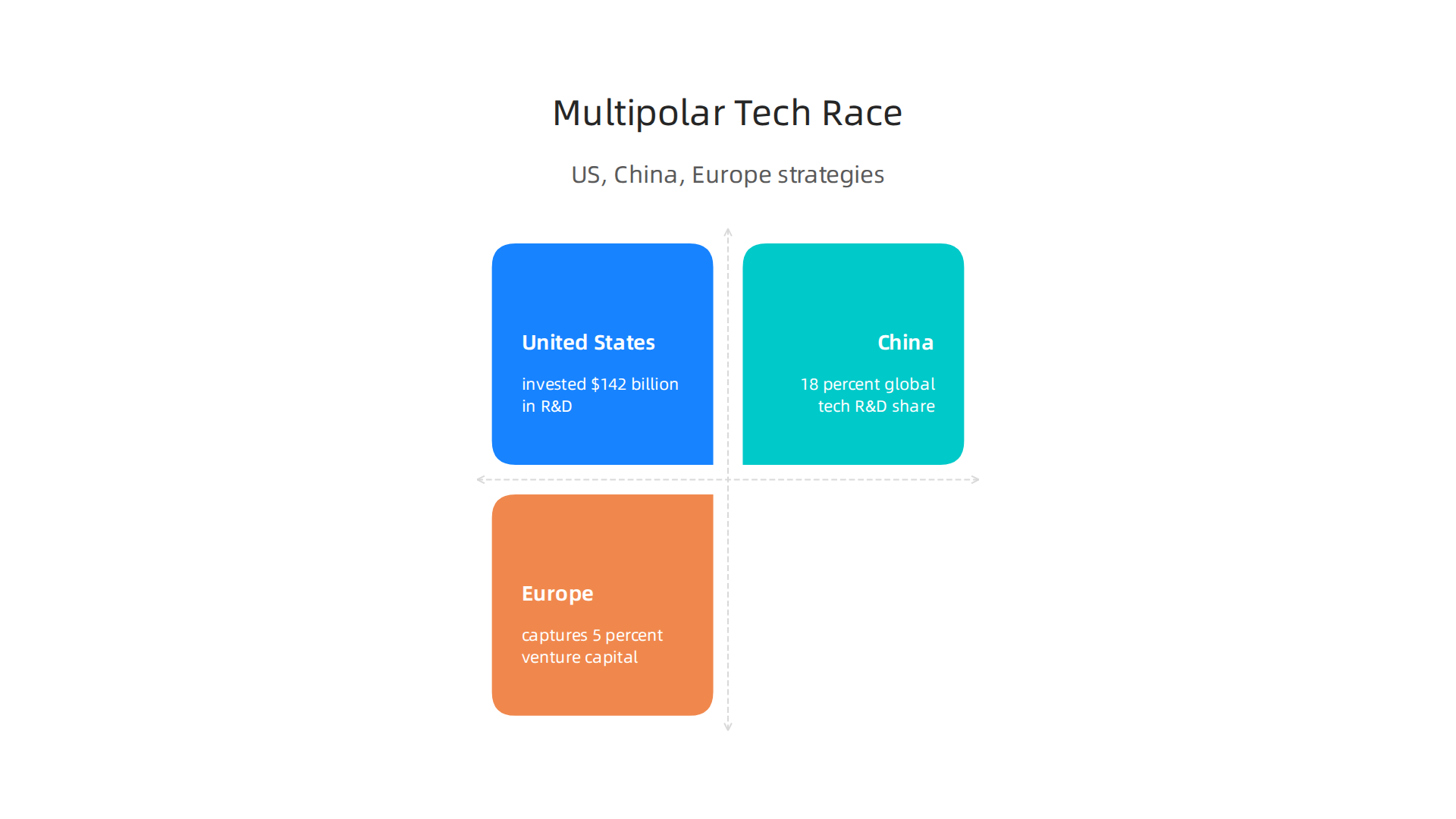
The old world market order that centered on American dominance is giving way to a multipolar tech landscape. Three major players — the United States, China, and Europe — now compete for technological primacy, each with distinct strategies.
Understanding these power shifts is essential for executives making global investment and partnership decisions.

Take research spending. In 2024, U.S. firms invested $142 billion in R&D, but China has been closing the gap. According to the Information Technology and Innovation Foundation, U.S. firms’ share of global tech R&D has declined while China’s has grown from 5 percent in 2014 to 18 percent in 2024.
This is detailed in a report on Tracking R&D Leadership: US Advantage Narrowing as China Gains Ground. China is building its own industrial fortress, dominating critical raw materials and manufacturing more than 30 percent of all goods worldwide.
Meanwhile, Europe is asserting its own path. The European Union generates about one-sixth of the global economy, but its tech sector faces a venture capital gap. The EU captures only 5 percent of global venture capital compared to 52 percent in the U.S. and 40 percent in China, as noted in the Economy of the European Union. Still, Europe is pursuing digital sovereignty with regulatory frameworks like the AI Act and investments in research. EU R&D expenditure stood at 2.24 percent of GDP in 2024, according to Eurostat data on R&D expenditure.
These dynamics affect everything from supply chains to S&P 500 futures. A policy move in Beijing or a new regulation in Brussels can ripple through macro news today and move Bloomberg Treasuries. For investors tracking these shifts, a framework to monitor markets is crucial. You can learn how to cut through the noise with futures news for big tech and stay ahead of the new world market order.
The competition is not just about GDP numbers. It is about who sets the standards, controls the data, and leads the next wave of innovation. In this multipolar era, mixed market countries like China combine state direction with market forces, while the U.S. and Europe lean more on private enterprise. Each approach has strengths and weaknesses, and the outcome will define the global economy for decades.
AI as the Central Economic Battleground: Market Size, Investment, and Strategic Control
But no technology is reshaping this competition faster than artificial intelligence. AI has become the primary driver of competitive advantage and economic value creation in the 2020s. The numbers tell the story clearly.
The global AI market is already huge and growing fast. According to the Artificial Intelligence (AI) Market | Global Report 2034 from Fortune Business Insights, the market is projected to grow from $375.93 billion in 2026 to $2.48 trillion by 2034, a compound annual growth rate of 26.6%. Other forecasts are even more aggressive. Grand View Research’s Artificial Intelligence Market Size & Share Report, 2026-2033 puts the 2026 market at $539.45 billion, with a CAGR of 30.6% to reach $3.5 trillion by 2033. Either way, we are talking about trillions of dollars of new value over the next decade.
Where is that money going? North America currently leads, capturing about 32% of the global AI market in 2025. But Asia Pacific is close behind and growing fast. The real story is in venture capital. A 2026 report on the State of AI 2026 – AI Market Size, Investment, and Industry Data from VentionTeams reveals that global AI investments reached $225.8 billion in 2025, more than double the previous record. Here is a striking fact: AI companies made up 48% of total equity funding in 2025, even though they represent only 23% of total deals. That means one in five venture deals and one in two invested dollars went to AI.
Governments are not sitting back. The U.S. and China are pouring billions into AI research and development. Europe is pushing its own agenda with the AI Act and funding programs. The race to control the next phase of the world market order is really a race to lead in AI.
For investors, this creates both opportunity and confusion. How do you separate the real winners from the hype? That is where having the right information flow matters. If you want clear, daily updates on AI developments that actually matter, you should check out The AI Newsletter Worth Reading. It cuts through the noise and gives you the essential AI news every day.
Also, understanding how AI investments affect specific stocks is key. For example, you can read about how Cisco stock and AI infrastructure orders drive earnings growth in 2026 or how IBM stock shows steady growth through AI and cloud transformation. These companies are directly riding the AI wave.
The U.S. dominates AI venture funding, capturing 87% of all capital raised in 2025, according to the VentionTeams report. Europe got 8%, Asia just 4%. Yet China leads in areas like large language model production and manufacturing scale. The multipolar competition we described earlier is playing out in real time through AI.
The bottom line: AI is the central economic battleground. Whoever wins this race will shape the world market order for decades. For investors and executives, staying informed is not optional. It is survival.
The Rise of Platform Economies and Digital Trade: New Rules for a Borderless Market
While AI reshapes production, a quieter revolution is already changing how goods and services move across borders. Platform economies built on Amazon, Alibaba, and Shopify have created digital trade ecosystems that bypass traditional economic structures entirely. A small business in Vietnam can now sell directly to a customer in Brazil without going through any of the old supply chain intermediaries. This is not just convenient. It is redefining the world market order.
The numbers behind this shift are massive. According to the eCommerce Sales & Size Forecast from the International Trade Administration, the global B2B ecommerce market is valued at $36 trillion by 2026. B2C ecommerce is expected to reach $5.5 trillion by 2027. And much of this trade is digitally delivered. The OECD reports that digital trade accounted for 25% of global trade as early as 2020, or nearly $5 trillion. That share has only grown since then. Services like streaming, software, and cloud computing now make up 56% of global services exports, and this number climbs to 61% in developed economies.
But as digital trade booms, governments are pushing back in two key ways. First, data localization laws force companies to store data within a country’s borders. This creates friction for platforms that rely on free data flows. Second, digital services taxes are spreading. Countries like France, the UK, and India have imposed taxes on revenue from digital services, targeting the profits of Big Tech giants. These moves are direct responses to the new borderless market. The UNCTAD Global Trade Update (January 2026) notes that since 2020, around 18,000 new discriminatory trade measures have been introduced, and technical regulations now affect roughly two-thirds of global trade. These rules are fragmenting what should be a seamless digital marketplace.
What does this mean for investors? Platform companies that can navigate this regulatory maze will thrive. Those that get stuck in compliance battles will lose ground. The battle over data localization and digital taxes is really a battle over who controls the next phase of the world market order. Understanding which companies are adapting well is key. For example, you can read about how a fintech company like Affirm navigates these dynamics in our analysis of AFRM stock financial performance and growth drivers.
The bottom line: digital trade is growing fast, but the rules are getting tighter. Platforms are creating new value, and governments are trying to grab their share. This tension will define trade for years to come.
Regulatory Fragmentation and Market Access: GDPR, DMA, DSA, and Beyond
The world market order is no longer shaped by trade deals alone. It is increasingly defined by a patchwork of national and regional regulations

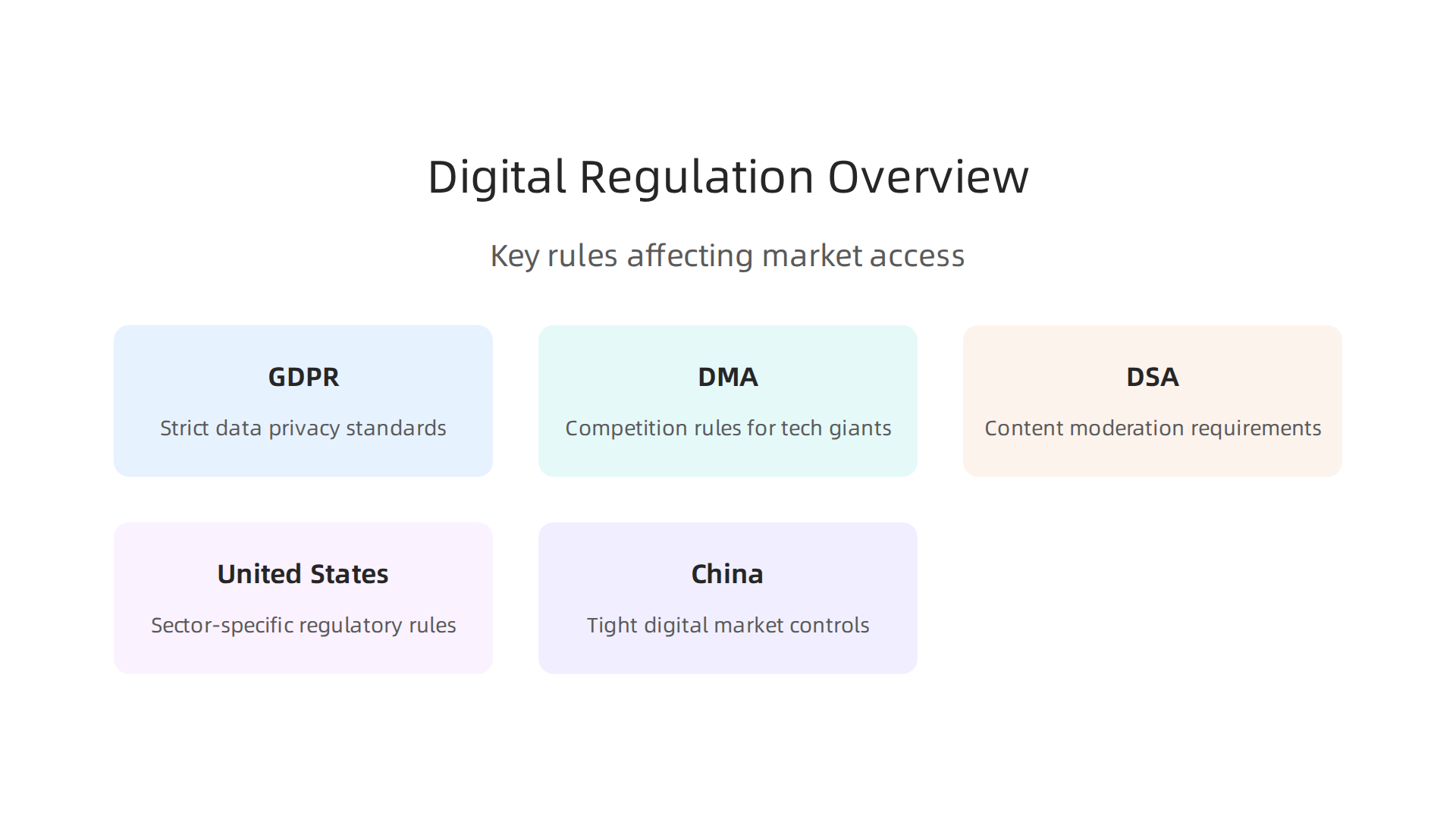
that tech companies must navigate to access markets. The European Union leads this trend with its ambitious digital rulebook. Laws like the General Data Protection Regulation (GDPR), the Digital Markets Act (DMA), and the Digital Services Act (DSA) set strict standards for data privacy, competition, and content moderation.
Any company selling in Europe must comply or face heavy fines.
The United States takes a different path. Instead of one big law, the US uses sector-specific rules, like those for health data or children’s privacy. There is no federal privacy law yet, though some states have their own. This creates a complex landscape for companies operating across state lines. And in China, the government controls digital markets tightly. Foreign companies often need local partners and must follow strict data localization rules.
The impact on tech company operations is huge. Compliance costs eat into profits. A company may need different versions of its product for the EU, the US, and China. Market access becomes a strategic puzzle. Investors tracking macro news today should watch how companies adapt. Those that build compliance into their strategy early often gain an edge. The McKinsey analysis of the future of global trade in 2026 highlights that regulatory differences are reshaping trade flows and investment decisions.
For example, fintech companies face especially tight scrutiny. If you want to understand how one company is handling this, read our deep dive into SoFi Technologies stock analysis. It shows how regulatory strategy can affect financial performance.
As rules keep multiplying, staying informed is critical. That is why we recommend The AI Newsletter Worth Reading. It gives you clear daily updates on AI and tech regulation, helping you spot trends before they become problems.
The bottom line: regulatory fragmentation is here to stay. The world market order now has many rulebooks. Companies and investors that understand this new reality will be better positioned to succeed.
Capital Flows and Tech Investment Trends: Where the Money Is Going
So where is all the world money actually going right now? The answer tells you a lot about the future of the world market order. Investors are making big bets on the technologies they believe will define the next decade. And the numbers are staggering.
Artificial intelligence is the top priority. In 2025, global AI investments hit a record $225.8 billion, according to the State of AI 2026 report. That is more than double the previous high. Big Tech companies like Amazon, Meta, Nvidia, Google, and Microsoft alone poured over $90 billion into AI startups during the first half of 2025. This flood of capital shows that the world market order is shifting toward intelligence-driven industries.
When you check your macro news today, you see the same pattern. S&P 500 futures and Bloomberg treasuries react to every AI earnings call and product launch. The market is pricing in years of growth for AI hardware, software, and infrastructure. Venture capital firms are also piling in. In 2025, AI companies captured about 48% of all equity funding, even though they made up only 23% of total deals. That means one in every two dollars invested went to AI.
But AI is not the only game in town. Semiconductors are getting massive attention too. The chips that power AI models are in short supply, so countries and companies are racing to build factories. Climate tech is another hot sector. Sovereign wealth funds, especially from Europe and the Middle East, are allocating billions to renewable energy, battery storage, and carbon capture. These investments shape the world market order by creating new supply chains and reducing dependence on fossil fuels.
For investors trying to make sense of all this movement, it helps to focus on the companies that sit at the center of these trends. Our Stock Advisor top 10 picks for big tech investors highlights firms that are leading the charge in AI, cloud, and infrastructure.
The bottom line: capital flows reveal where the smart money believes the world market order is heading. AI leads the pack, but semiconductors and climate tech are close behind. If you are tracking macro news today, these three sectors will keep driving the headlines for years to come.
Geopolitical Risk and Supply Chain Security: The Semiconductors and Data Infrastructure Crunch
One of the biggest threats to the world market order right now is hiding in plain sight. It is not a stock market crash or a recession. It is the fragile supply chain behind the chips that power everything you use.

Think about it. Your phone, your car, your laptop, and every AI model running in the cloud all depend on a handful of factories located in just a few countries. About 75% of global semiconductor manufacturing is concentrated in East Asia. And 100% of the most advanced chips are made in Taiwan and South Korea. That is a single point of failure. A natural disaster or a military conflict in that region could bring whole industries to a halt. That is a major vulnerability for the world market order.
The semiconductor shortage of 2026 is not a temporary blip. It is a deep structural problem. According to a recent analysis from Moody’s, supply chain readiness is the real bottleneck right now. It is not just about making more chips. It is about having the materials, equipment, and factory capacity to produce them. And that takes years to build.
The most critical choke points have shifted. Advanced packaging and high-bandwidth memory are now the main bottlenecks for AI chips. The demand from AI data centers has created an "unprecedented" shortage of HBM that experts predict will last through 2026 and beyond. As the AI Chip Supply Chain Risk 2026 guide explains, enterprise success in 2026 depends on securing these physical resources, because AI has become a physical, not virtual, domain.
Geopolitical tensions add another dangerous layer. Export controls between the US and China keep shifting. Rare earth materials are becoming a crisis of their own. China controls about 79% of global tungsten production. When it added tungsten to its export control list, prices soared by 557% in just over a year. You can read more about how geopolitical forces are reshaping semiconductor supply chain risk in 2026.
For everyone watching the world market order, the takeaway is clear. Supply chain security is now a national security issue. Countries are spending billions to build their own chip factories and data centers. Companies that rely on these components are racing to secure multiple suppliers and stockpile inventory.
This is not just a niche concern for hardware nerds. It affects s&p 500 futures, bloomberg treasuries, and the entire macro news today landscape. When a chip shortage hits, it ripples through car prices, gadget costs, and even AI product launches.
If you track macro news today and pay attention to these trends, you already know how fast things change. Staying informed is key. For clear daily updates on AI and the tech shifts that impact global supply chains, try The AI Newsletter Worth Reading. It cuts through the noise and gives you the insight you actually need.
Understanding the risks in the semiconductor supply chain helps you see where the world market order is most fragile. And that knowledge is the first step toward making smarter investment and business decisions.
The Role of Data and Digital Infrastructure: The New Backbone of the World Market Order
Data has become the most valuable resource on the planet. But raw data is useless without the infrastructure to move, store, and process it. That is why the world market order is now being reshaped by a quiet but intense race to build the physical pipes of the digital economy.
Think undersea cables, satellite constellations, massive data centers, and edge computing nodes. Whoever controls these systems controls how information flows. And information flow equals market influence.
Data sovereignty is driving much of this change. Countries are passing laws that require citizen data to stay within their borders. That means tech giants like Amazon, Microsoft, and Google cannot just run everything from a few mega data centers in the US or Europe anymore. They have to build local cloud regions everywhere from India to Brazil. The demand is so huge that the global semiconductor industry is expected to hit $975 billion in sales in 2026, according to the 2026 Global Semiconductor Industry Outlook from Deloitte, fueled almost entirely by AI and data infrastructure.
At the same time, a new undersea cable race is underway. Tech companies are investing billions to lay private cables that bypass public networks. These cables give them faster, more secure connections between continents. Satellite networks like Starlink are filling the gaps in remote areas. And edge computing is bringing processing power closer to users so that autonomous cars, smart factories, and AI apps can react instantly.
Control over these data flows translates directly into market power. A company that owns the cloud infrastructure and the network pipes can prioritize its own services, set pricing, and control access for competitors. That is a massive advantage in the world market order.
Companies like Cisco are seeing major growth from AI infrastructure orders, as we covered in our Cisco stock AI infrastructure earnings analysis. The demand for routers, switches, and networking gear has exploded as data centers scale up.
So when you hear about macro news today or check s&p 500 futures, remember that the real action is happening under the ocean and inside data centers. The world market order of tomorrow will be built on who owns the pipes.
Future Scenarios for World Market Order: What Comes Next?
So where is all this heading? Nobody has a crystal ball, but smart people are thinking hard about what the world market order might look like by 2030. The future is not set in stone. It depends on a few big variables that are playing out right now.
The first variable is AI regulation. Will governments around the world agree on common rules, or will we see a patchwork of different laws? The second is trade wars. Tariffs and export controls are already reshaping supply chains. The third is the sheer pace of technological change. It keeps accelerating, and that makes everything harder to predict.
Experts disagree about the outcome. Some think we are heading toward fragmentation. In that world, mixed market countries would have to pick sides. Others believe a new stable equilibrium will emerge, one where international cooperation finds a new footing.
The World Economic Forum recently explored these questions in a report called Global Economic Futures: Competitiveness in 2030. It lays out four different futures based on how geopolitical tensions and business regulations interact. One scenario, called "Fortress Economics," imagines a world of protectionist competition where countries weaponize resources and rules. Another, "Negotiated Order," assumes geopolitical stability and stricter regulations create a more predictable environment. A third, "Fluid Order," sees stability plus fewer barriers leading to rapid innovation. The fourth is more fragmented and uncertain.
I want to simplify that into three plausible paths for the world market order by 2030.
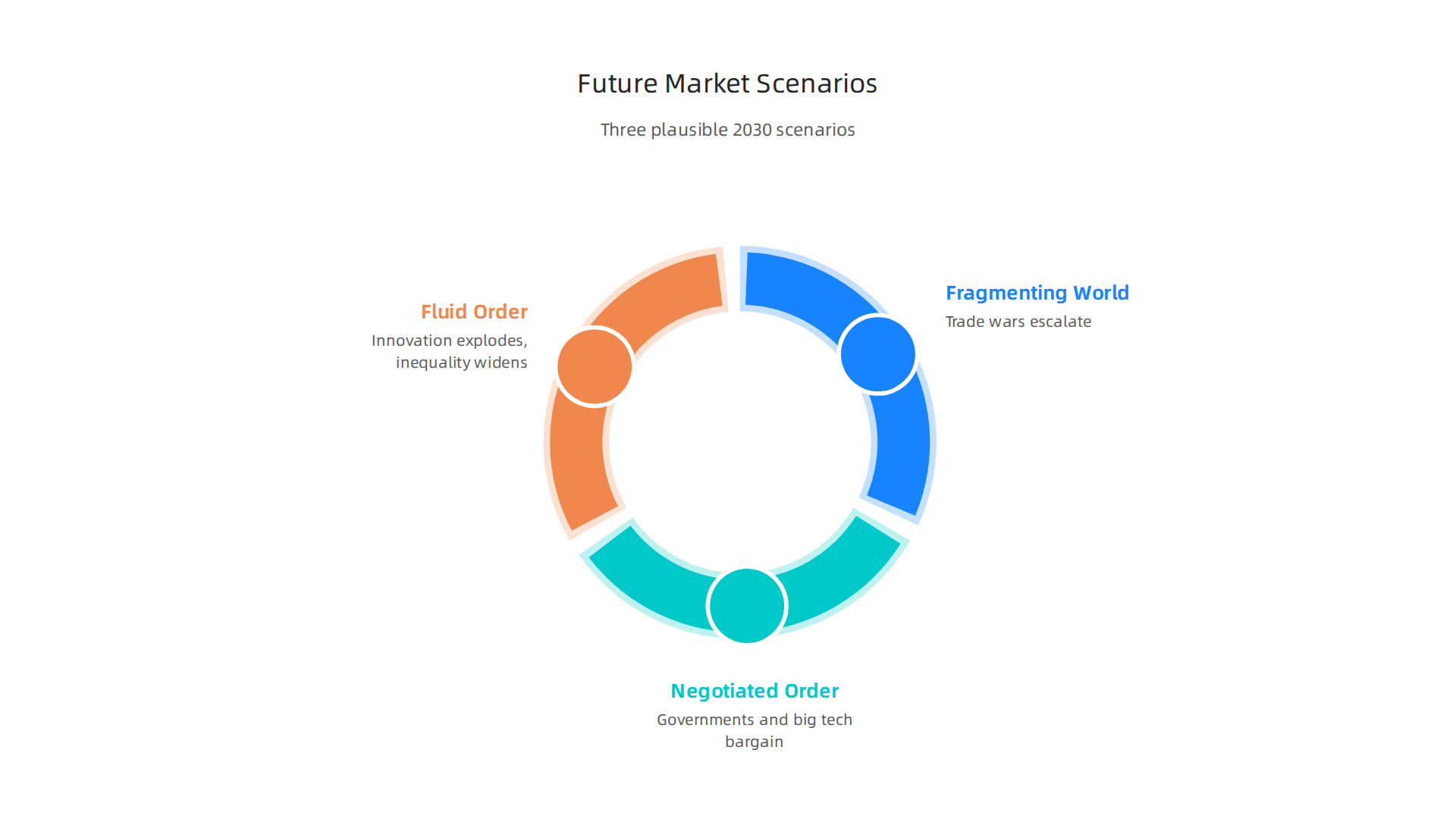
Scenario 1: The Fragmenting World. Trade wars escalate. Countries form exclusive blocs. Data flows get blocked at borders. Global growth slows further. The World Bank’s Global Economic Prospects already projects global growth slowing to 2.5 percent in 2026. This scenario makes that slowdown permanent. Investors watching macro news today would see constant volatility in s&p 500 futures.
Scenario 2: The Negotiated Order. Governments and big tech companies strike a grand bargain. AI gets regulated globally. Trade rules get updated. Things stabilize, but growth is modest. This feels less exciting but more stable. To cut through the noise and understand where the smart money is going in this scenario, you might want to learn how to filter Yahoo Finance news for big tech market insights.
Scenario 3: The Fluid Order. Geopolitical tensions ease. Regulation stays light. Innovation explodes. AI and cloud infrastructure drive a new wave of productivity gains. But inequality widens, and the benefits are not shared evenly. This is the upside case.
No matter which scenario plays out, one thing is clear. You need to stay informed about how these forces are reshaping markets. That is why we recommend The AI Newsletter Worth Reading to get clear daily updates on the technology trends that will define the world market order in the years ahead.
Summary
This article explains how Big Tech and digital technologies are reshaping the traditional world market order, turning market power away from nation-states and toward firms that control data, chips, and infrastructure. It walks through the key forces—AI investment, R&D leadership, platform-enabled digital trade, regulatory fragmentation across regions, capital flows into semiconductors and climate tech, and fragile supply chains—that together determine who wins in this multipolar era. You will learn concrete facts and metrics (R&D and VC shares, AI funding, semiconductor concentration), the regulatory and geopolitical risks to watch, and why data infrastructure now equals strategic power. The piece also lays out three plausible scenarios for 2030 and gives practical guidance for investors and executives on where to focus monitoring and research. After reading, you’ll be able to prioritize signals (AI spending, export controls, data laws, HBM shortages) and use targeted news filters and analysis to make better strategic and investment decisions.