
Introduction
The global semiconductor market is projected to reach $1 trillion by 2030, and Infineon Technologies is carving out a critical role in power management, automotive, and IoT sectors.
Headquartered in Munich, Germany, Infineon has built a reputation as a dominant force across these categories. In 2025, the company secured its position as the world’s leading automotive semiconductor supplier for the sixth year in a row according to TechInsights, with Infineon further extending its global leadership in the automotive semiconductor market.
But Infineon’s influence goes well beyond cars. The company is making a strategic pivot toward silicon carbide (SiC) and gallium nitride (GaN) technologies, two advanced materials that are becoming essential for AI infrastructure and electric vehicles. These moves are drawing serious attention from both industry observers and investors who track companies like Luminar Technologies, iRhythm Technologies, and Century Tech for their exposure to next-generation tech trends.
This article provides a data-driven analysis of Infineon’s market position, financial health, product innovation, and competitive landscape for 2026.

Whether you are an investor, analyst, or simply trying to understand how the top industries in the world 2026 are evolving, Infineon is a name worth knowing. And if you want clear daily updates on AI and the technology sector, The AI Newsletter Worth Reading delivers concise insights to your inbox.
Infineon’s Strategic Position in the Global Semiconductor Landscape
Infineon Technologies doesn’t just make chips for cars. It holds a top-10 spot in the entire global semiconductor market. But its real strength lies in two specific areas: automotive and industrial power semiconductors. In 2023, Infineon’s market share in automotive chips hit around 14 percent, making it the world leader in that space, according to Infineon’s position in the automotive semiconductor market further expanded. That kind of dominance doesn’t happen by accident.
So how does Infineon stay on top? It starts with a wide product lineup. The company sells power management chips that control electricity flow in everything from phone chargers to factory robots. It also makes embedded controllers — tiny brains that run appliances, tools, and medical devices. On top of that, Infineon produces RF chips for wireless communication and security chips that protect credit cards and passports.
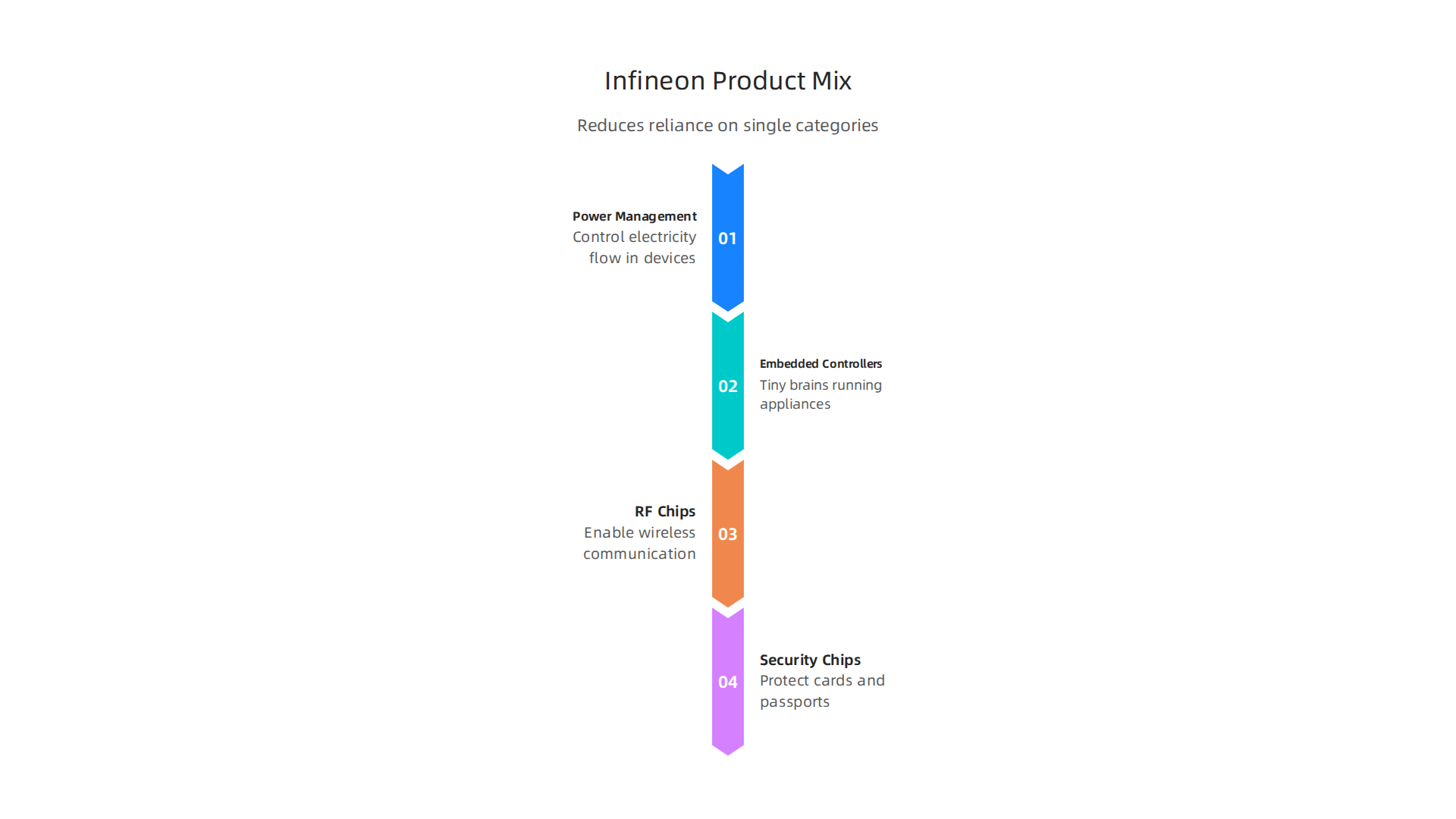
Having all these pieces under one roof means Infineon doesn’t rely on a single product category. When one market slows down, another often picks up.
But Infineon didn’t build this moat alone. A big part of its strategy has been smart acquisitions. Buying Cypress Semiconductor in 2020 brought in PSoC technology — a type of programmable chip that blends microcontrollers with analog circuits. That deal gave Infineon a stronger foothold in the IoT and industrial sectors. Partnerships with other tech leaders have also helped the company expand its reach. These moves have tightened Infineon’s grip on the semiconductor supply chain and made it harder for competitors to catch up.
The bigger picture matters too. The semiconductor market is shifting fast, with AI and electric vehicles driving demand. Infineon’s position in power chips puts it right in the middle of those trends. If you want to understand how major tech companies are positioning themselves for this shift, you can check out how global market order is reshaped by AI and geopolitical competition. Infineon is a clear example of a company building long-term competitive strength through focus and smart bets.

The AI and Data Center Revolution: Infineon’s Role
You might not think about what happens behind the scenes when you ask an AI to generate an image or analyze a document. But inside a data center, thousands of GPUs and TPUs are running at full speed. These chips eat up massive amounts of power. They also create a lot of heat. That’s where Infineon Technologies comes in.
Infineon makes the power management chips that keep AI accelerators running smoothly. Think of it like the electrical system in a house. You need the right wires, breakers, and transformers to make sure everything works without overheating or shorting out. Infineon provides those parts for AI servers. In fact, Infineon has joined the NVIDIA MGX AI Factory ecosystem to develop power management solutions for next-generation server racks.
You can read more about Infineon joining NVIDIA’s MGX AI Factory ecosystem and how it supports power delivery from the grid all the way down to the processor core.
How SiC and GaN Cut Energy Loss by Almost a Third
The biggest challenge in AI data centers isn’t just delivering power. It’s doing it without wasting energy as heat. Traditional silicon chips lose a fair amount of electricity. Infineon’s silicon carbide (SiC) and gallium nitride (GaN) chips change that. These materials let power flow with much less resistance. That means cooler servers, smaller power supplies, and lower electricity bills.
Some of Infineon’s newer power supplies cut energy losses by up to 30 percent. That’s a huge deal when you consider a single large data center can use as much electricity as a small town. The impact adds up fast. According to an article on Infineon’s SiC solutions for data center power, switching to Infineon’s SiC chips in data centers worldwide could save about 2.9 terawatt-hours over five years. That’s like taking nearly 300,000 cars off the road.
Demand for CoolGaN and CoolSiC Is Climbing Fast
As more companies build AI tools, the need for efficient power chips keeps growing. Infineon’s CoolGaN and CoolSiC product lines are seeing strong demand. Analysts expect the market for these chips to grow at a rate of more than 25 percent each year through 2026. That makes sense. Every new AI data center needs better power delivery to handle the load.
This trend isn’t just good for Infineon. It also signals a shift in how the whole tech industry thinks about energy. If you want to understand how other companies are investing in AI infrastructure, check out this analysis of AI infrastructure orders driving earnings growth. The race to build smarter, more efficient data centers is only speeding up.
Staying on top of these changes can feel overwhelming. That’s why many professionals turn to a daily source that cuts through the noise. If you want clear, simple AI updates delivered to your inbox, consider The AI Newsletter Worth Reading. It helps you follow the big shifts without wading through endless headlines.
Automotive Semiconductor Leadership
While data centers are a fast-growing piece of Infineon’s business, the company’s strongest position is in a different industry entirely: automotive. Cars today are basically computers wrapped in metal and glass. And Infineon is the invisible force powering that shift.
Infineon is the world leader in automotive power semiconductors. It supplies nearly 30 percent of the total market. Every time an electric vehicle accelerates, brakes, or recharges, an Infineon chip is likely managing that flow of energy. The company’s automotive portfolio covers traction inverters, battery management systems, and advanced driver-assistance systems (ADAS).
A big part of that leadership comes from Infineon’s complete system approach. It doesn’t just sell one type of chip. It provides the full set of components needed to make an EV drivetrain work. According to a detailed breakdown of Infineon’s solutions for EV traction inverters, the company offers SiC MOSFETs, automotive microcontrollers, and safety power management ICs all designed to work together.
Infineon also locks in long-term relationships with the world’s biggest automakers.

Companies like Tesla, Volkswagen, and BMW rely on Infineon’s chips for their electric platforms. These aren’t one-off orders. They are multi-year design wins that tie Infineon into vehicle architectures for the life of a car model.
A key example of Infineon’s automotive technology is the HybridPACK Drive CoolSiC power module. It is designed for the main traction inverter in an EV, the component that converts battery power into motion. This module can handle up to 250 kilowatts of power. That translates to longer driving range and smaller batteries. Infineon has already shipped more than one million of these modules across over 20 different electric vehicle platforms. You can read more about the latest automotive SiC power module for EVs and how it supports 800-volt battery systems for faster charging.
The shift toward autonomous driving is another major opportunity. Infineon makes specialized microcontrollers and radar sensors that help cars see the road and make decisions in milliseconds. As vehicles move from basic cruise control toward full self-driving, the number of chips per car goes way up.
For investors tracking these trends, understanding how the biggest auto players are adapting is essential. If you are following this space, you might also find this analysis of deciphering Tesla stock insights helpful for understanding the broader electric vehicle market.
Industrial IoT and Smart Infrastructure
While cars are getting smarter, so are factories, buildings, and even homes. This is where a different side of Infineon Technologies comes into play. The company is a quiet power behind the Industrial Internet of Things (IIoT) and smart infrastructure. Think of it this way: every connected device needs to sense, think, and communicate. Infineon provides the chips that make all three happen.
First, let’s talk about sensing. Infineon’s XENSIV sensor family includes magnetic, pressure, radar, and even CO₂ sensors. These tiny components give machines basic senses. A factory robot can "feel" pressure when gripping a part. A smart building can "see" if a room is empty using radar and save energy automatically. At embedded world 2026, Infineon demonstrated how its next-generation 60 GHz radar sensor enables this kind of awareness. You can read more about how Infineon presents microcontroller and sensor solutions for these advanced applications.
Second, Infineon offers the XMC microcontroller family. These are the brains of industrial automation. An XMC chip in a motor drive can control speed and torque with high precision. The same chip family is used in programmable logic controllers and industrial robots. This makes Infineon a one-stop shop for factory automation.
Third, there is security. This is a big deal for smart factories and critical infrastructure. Infineon’s OPTIGA security platform provides hardware-based trust. It protects connected devices from hacking and data tampering. Without this kind of security, a smart factory is a weak link. With OPTIGA, each device has a unique digital identity that can’t be copied. This is essential as more factories connect to the cloud.
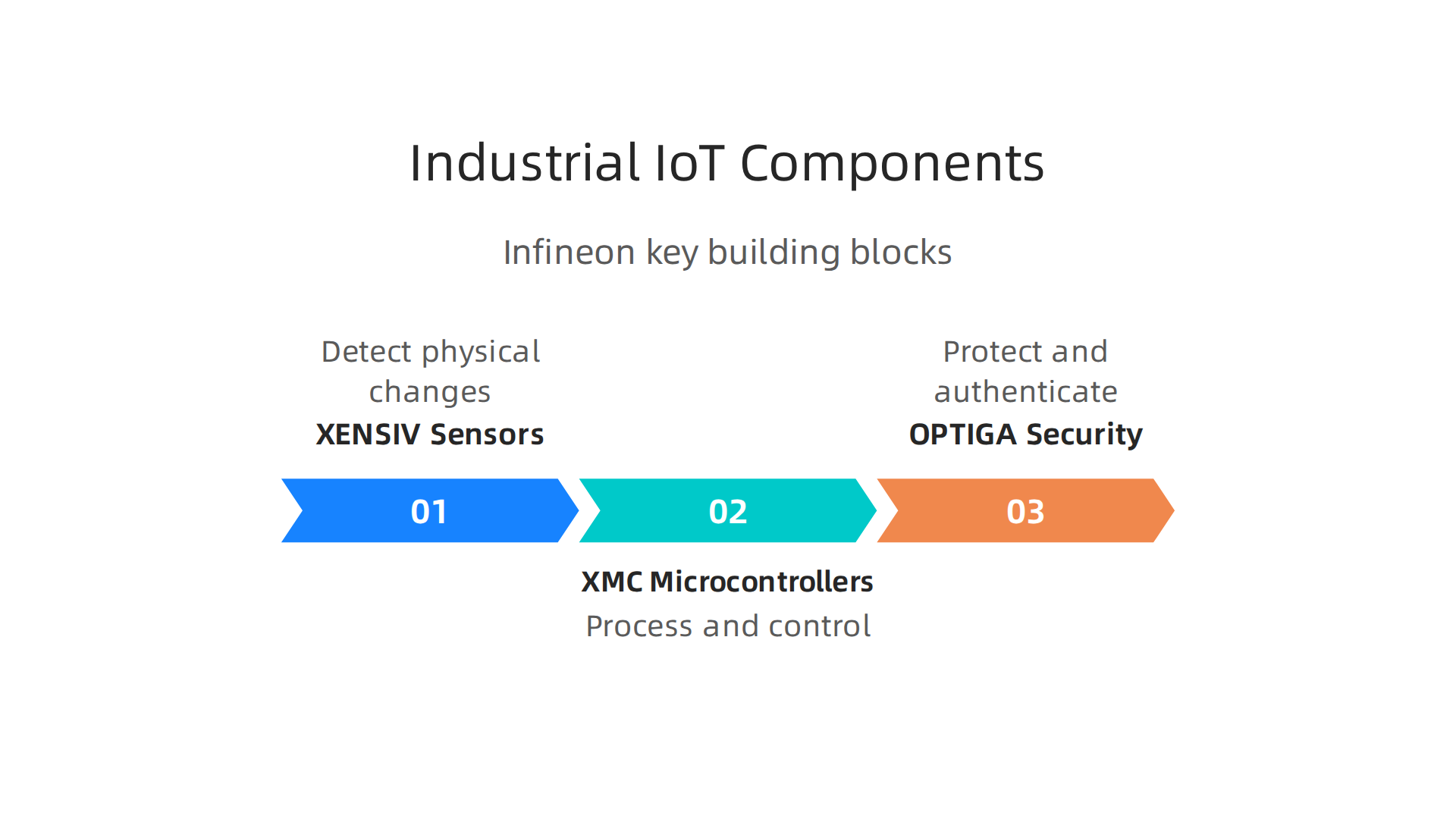
Here is a quick look at how these pieces fit together:
| Component | Purpose | Example Application |
|---|---|---|
| XENSIV Sensors | Detect physical changes | Radar for presence detection |
| XMC Microcontrollers | Process and control | Motor speed regulation |
| OPTIGA Security | Protect and authenticate | Secure device identity |
For investors, the industrial semiconductor segment is a steady growth driver. The world is installing more IoT nodes every year. Each one needs sensors, a microcontroller, and security. Infineon is well positioned to capture this demand. As you look at the broader picture of which sectors are reshaping the economy, understanding how top industries reshaping the global economy rely on these chips is important.
Here is the thing: all these connected devices generate massive amounts of data. That data needs to be processed and understood. AI is the natural partner to IoT. If you want to stay ahead of how these trends connect, The AI Newsletter Worth Reading delivers clear daily updates on exactly this kind of technology shift.
Financial Health and R&D Investment
You might wonder if Infineon has the financial muscle to keep up with the fast pace of technology. The short answer is yes. The company consistently generates strong free cash flow, often over €2 billion each year.

This cash gives Infineon room to invest, pay down debt, and weather market downturns.
Infineon also keeps a healthy balance sheet. At the end of fiscal 2025, the company reported total assets of about €30.5 billion and total equity of €17 billion. That is a solid foundation. With ample liquidity, Infineon does not have to worry about running out of money when it needs to build new factories or buy new equipment.
Now let’s talk about research and development. Infineon spends roughly 15% of its revenue on R&D. That is a big commitment. In fiscal 2025, revenue was about €14.7 billion, according to the company’s 2026 press release on global leadership. So R&D spending comes out to over €2 billion. Where does that money go? It goes into three main areas: silicon carbide (SiC) and gallium nitride (GaN) power chips, AI-capable power management, and advanced packaging. These are the technologies that will power the next generation of electric vehicles, data centers, and industrial robots.
Revenue at Infineon is not just one lump. It comes from three big buckets. Automotive makes up about 45% of sales. Industrial accounts for about 30%. And the AI and data center segment is growing fast. As more companies build server farms and AI training clusters, they need Infineon’s power management and security chips. This third bucket could become much bigger in the next few years.
For investors, this mix matters. A company with strong cash flow, high R&D spending, and growing end markets is usually a safer bet. If you are looking at technology investments, you can use a repeatable framework for tech investors to evaluate companies like Infineon.
The bottom line is simple: Infineon has the money to keep innovating, and it is spending that money on the right things. That is a good sign for the long term.
Challenges and Competitive Threats
No company is immune to risk, and Infineon Technologies faces several real challenges in 2026. Even with strong finances and market leadership, the road ahead has some bumps.
The biggest wild card is geopolitics. Infineon runs factories in both the United States and China. That gives it access to two huge markets, but it also makes the company vulnerable when tensions rise. Trade restrictions, export controls, or new tariffs could disrupt its supply chain overnight. As the competition between Washington and Beijing heats up, companies with operations on both sides must constantly adjust. For a deeper look at how geopolitical shifts are changing global markets, check out this analysis of how the world market order is being reshaped by AI and geopolitical competition.
Then there is competition. Infineon is not the only player in the semiconductor space. Rivals like NXP, STMicroelectronics, Texas Instruments, and Renesas are all fighting for the same automotive and industrial customers. According to recent market research, the key market participants in automotive semiconductors include these global giants. And new challengers from China are emerging fast, often backed by government support and aggressive pricing. That pressure can squeeze margins and force Infineon to innovate faster or lower its prices.
Cyclical downturns are another concern. The semiconductor industry has always been boom and bust. When demand drops, chipmakers often end up with too much production capacity and too many unsold parts. Commodity chips like basic microcontrollers and power transistors are especially prone to overcapacity. If the global economy slows down or if electric vehicle sales cool off, Infineon could see its revenue dip for a year or two. The power semiconductor market, where Infineon leads, is not immune to these cycles.
Despite all this, Infineon has weathered downturns before. Its strong balance sheet and diverse customer base give it a cushion. But investors should not ignore the risks. The key is to watch how the company manages its exposure to geopolitics, stays ahead of competitors, and navigates industry cycles.
To keep up with the fast-moving tech landscape and understand how AI, trade policy, and new competitors are reshaping industries, you might want a resource that cuts through the noise. Get clear daily AI updates from The Deep View Newsletter. It is a simple way to stay informed without the hype.
Future Outlook and Strategic Recommendations
Despite those challenges, the future of Infineon Technologies looks bright. The company is set to benefit from three big trends: electrification, digitalization, and artificial intelligence. These forces are reshaping whole sectors like automotive, industrial automation, and data centers. For example, electric vehicles need more power chips, smart factories require advanced sensors, and AI servers demand ultra efficient power supplies. Infineon sits right in the middle of all this growth. If you want to understand which industries are driving the global economy in 2026, this overview of the industries reshaping the global economy is a useful starting point.
One of Infineon’s biggest strengths is its lead in silicon carbide (SiC) and gallium nitride (GaN) technologies. These materials let chips handle higher voltages and run much more efficiently than plain silicon. As EVs move to 800 volt systems and data centers push power density higher, SiC and GaN become essential. That gives Infineon a multi year competitive advantage. The company’s recent work on 30 kilowatt power supply units for AI servers shows how fast they are innovating. Their power solutions combine Si, SiC, and GaN to hit the highest efficiency and smallest size.
But good technology alone is not enough. Infineon needs to keep expanding its production capacity. One smart move would be to deepen partnerships with foundries like TSMC. By working with top manufacturers, Infineon can scale up output without building every new fab on its own. Another key step is to strengthen its software ecosystem. Its partnership with NVIDIA’s MGX AI Factory ecosystem is a perfect example. By integrating power management with NVIDIA’s platform, Infineon becomes a go to supplier for next generation AI racks. Finally, targeted mergers and acquisitions could fill gaps in the product lineup. Buying a company with strong software or sensor know how could speed up growth into new areas.
Infineon already raised its 2026 outlook due to surging AI demand. The company now expects revenue to grow significantly this year and raised its profit margin target. That shows the strategy is already paying off.
To stay on top of all these changes, you need reliable information. The tech world moves fast, and one newsletter can help you keep up. Get clear daily AI updates from The Deep View Newsletter. It cuts through the noise so you can focus on what matters.
Summary
This article analyzes Infineon Technologies’ strategic position in 2026, showing why the Munich-based chipmaker is central to electrification, digitalization, and AI infrastructure. It reviews Infineon’s product breadth—from power management and SiC/GaN devices to automotive microcontrollers, sensors, and security ICs—and explains how those products serve data centers, EVs, and industrial IoT. The piece covers recent wins, partnerships (including NVIDIA’s MGX ecosystem), and the company’s leadership in automotive power semiconductors and traction in EV platforms. Financially, Infineon generates strong free cash flow, spends about 15% of revenue on R&D, and has the balance-sheet strength to fund expansion. The article also outlines competitive and geopolitical risks, cyclical industry dynamics, and recommended strategic moves such as scaling capacity, partnering with foundries, and building software ecosystems. After reading, you will understand Infineon’s growth drivers, where efficiencies from SiC/GaN matter most, the major risks to watch, and how to think about the company as a long-term technology and investment story.