

Introduction
Have you ever wondered why a tech-minded investor would look at a Canadian pipeline company? At first glance, Enbridge stock might seem out of place in a portfolio full of software and AI plays. But here’s the thing: building a truly resilient portfolio means looking beyond the sectors you know best. Diversification across different asset classes can help smooth out the ups and downs of any single industry.

Energy infrastructure is one of those overlooked areas. Enbridge moves oil and natural gas across North America through a massive network of pipelines. The company has a long track record of stable cash flows and growing dividends. In fact, Enbridge reported record financial results for 2025, with full-year earnings reaching $7.1 billion.
The company also increased its dividend for the 31st year in a row, as noted in the record 2025 financial results. That kind of predictability is rare in today’s fast-moving markets.
Of course, allocating capital across different asset classes comes with its own challenges. You need to stay on top of macro trends, sector-specific risks, and how each piece of your portfolio fits together. For tech investors, adding a steady income generator like Enbridge can balance the volatility of growth stocks.
This article gives you a data-driven look at Enbridge stock within the bigger picture of building resilient, multi-asset portfolios. We’ll cover the company’s financial health, its growth pipeline, and how it stacks up against other plays you might be watching. By the end, you’ll have a clear framework for deciding if Enbridge deserves a spot in your mix.
To stay ahead of the trends that affect these decisions, including the impact of AI on energy and infrastructure, consider subscribing to The Deep View. Their AI Newsletter Worth Reading delivers clear daily updates on AI developments that matter to investors.
And if you want to understand which industries are reshaping the global economy, check out our guide on the top industries in the world in 2026.
Now let’s dig into the specifics of Enbridge stock and why it might be the steady hand your portfolio needs.
Understanding Enbridge: From Pipeline Giant to Energy Infrastructure Powerhouse
The introduction framed Enbridge as a potential steady hand for tech heavy portfolios. But to truly understand why Enbridge stock deserves a look, you need to see the full scope of the business. It is not just an oil pipeline company anymore. Enbridge is a diversified energy infrastructure company with four main segments: Liquids Pipelines, Gas Transmission, Gas Distribution and Storage, and Renewable Power Generation.
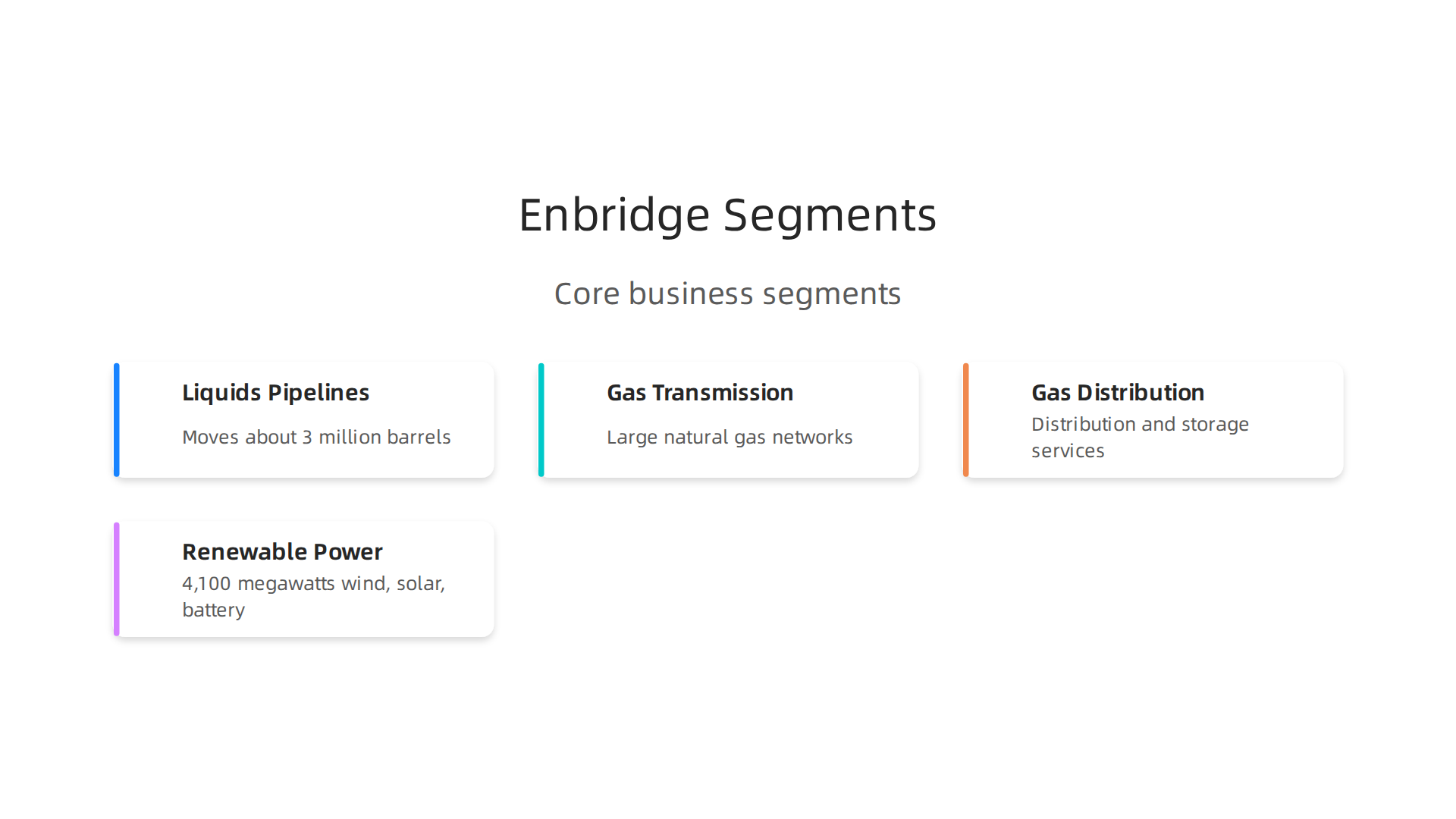
The scale is massive. The Mainline System alone moves about 3 million barrels of crude oil per day across North America. The company also operates one of the largest natural gas utility networks on the continent. On the renewable side, Enbridge has roughly 4,100 megawatts of net renewable capacity, including wind, solar, and battery storage facilities. Most of these assets run under long term contracts, which creates predictable cash flow.
Financially, Enbridge stock stands out for its consistency. In 2025, the company reported record earnings of $7.1 billion. Full year adjusted EBITDA came in at $20.0 billion. Distributable cash flow, the key metric that supports the dividend, reached $12.5 billion. That allowed management to raise the dividend for the 31st consecutive year. As noted in their record 2025 earnings report, the company also reaffirmed its 2026 financial guidance, signaling confidence in the months ahead.
When you compare this stability to other sectors, the diversification benefit becomes clear. Warner Bros stock depends on unpredictable box office hits. Lennar stock rises and falls with housing starts. General Mills stock is steady but tied to grocery store demand. Zillow stock moves with real estate market cycles. Enbridge stock, on the other hand, generates cash flows backed by take or pay contracts and regulated utility returns. That is a completely different risk profile.
Looking ahead, Enbridge is positioned to benefit from major energy trends. The company has a $39 billion secured growth program running through 2033. This includes expanding natural gas pipelines to support LNG exports and building large scale solar projects. The completion of the TMX pipeline has also secured long term demand for the Mainline system. For tech investors watching the AI boom drive massive electricity demand, Enbridge’s natural gas infrastructure is becoming a critical piece of the energy puzzle.

This shift in the world market order connects energy infrastructure directly to the expansion of AI.
The company’s debt to equity ratio remains manageable. Management continues to recycle capital by selling minority stakes in mature assets. That discipline is what makes Enbridge stock a reliable core holding in an income focused portfolio.
The Dividend Case for Enbridge Stock: Yield, Growth, and Sustainability
For tech investors used to chasing growth, steady dividend income might feel boring. But boring pays the bills. And when you compare Enbridge stock’s dividend to what else is out there, the numbers tell a clear story.
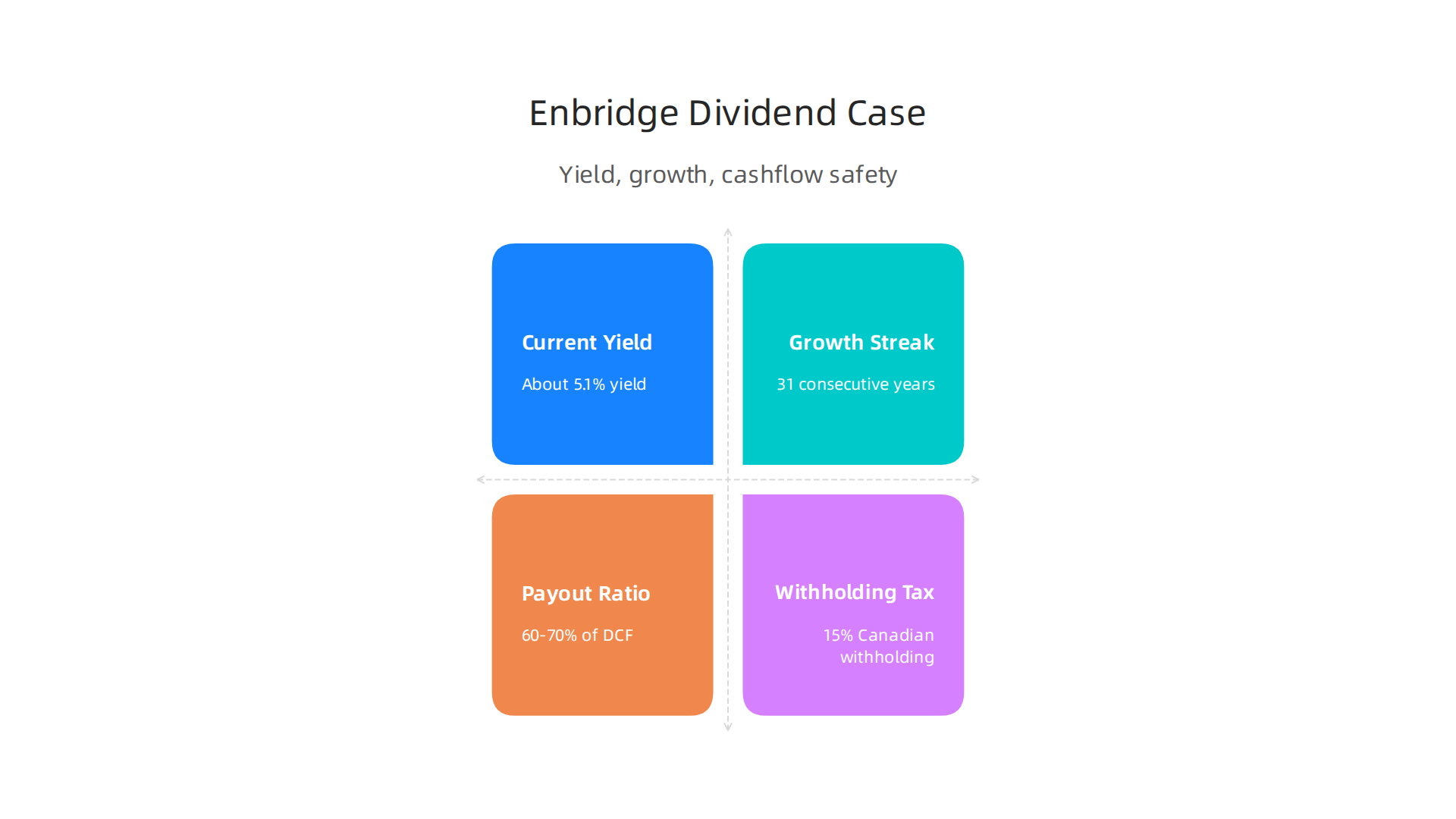
A yield that stands out. Right now, Enbridge stock offers a dividend yield of about 5.1%. For context, the 10 year US Treasury bond yields around 4%. The average stock in the S&P 500 pays less than 1.5%. Enbridge’s yield lands in the top 25% of all dividend payers in the US market, as noted in the Enbridge dividend yield analysis. That means you get more income per dollar invested than most bonds or broad market funds.
Consistent growth for three decades. Enbridge has raised its dividend for 31 straight years. In December 2025, the board approved a 3% increase to $0.97 per quarter, effective March 2026.
That brings the annualized payout to $3.88 per share. As highlighted in the official dividend announcement, this continues a streak that started in 1995. Over the past 30 years, the dividend has grown at an average compound annual rate of 9%. Not bad for a stock often labeled as boring.
Can Enbridge afford it? That’s the real question. High yield is great unless the company can’t sustain it. Enbridge manages its payout ratio against distributable cash flow (DCF), not earnings. Management’s target is 60% to 70% of DCF. According to their dividend and common shares page, the payout ratio stays within that range, leaving room to reinvest in growth while still returning cash to shareholders. For 2026, they expect DCF per share between $5.70 and $6.10, which easily covers the $3.88 dividend. So the cash flow is there.
What US investors need to know. Because Enbridge is a Canadian company, its dividends are paid in Canadian dollars. For US investors holding the stock on the NYSE (ticker ENB), the dividends are converted to USD before hitting your brokerage account. Canada withholds 15% of the dividend for tax purposes. You can typically claim this as a foreign tax credit on your US tax return. It adds a small step at tax time, but the higher yield more than makes up for it compared to similar US stocks.
How it fits your portfolio. Enbridge stock gives you reliable income that grows faster than inflation. It also ties you to energy infrastructure, a sector that benefits from long term trends like AI driven electricity demand. To see how energy and technology overlap in today’s economy, check out this overview of top industries reshaping the global economy. Energy infrastructure is right there with AI and semiconductors.
If you want to keep up with how AI is changing energy demand and other tech trends, The AI Newsletter Worth Reading delivers clear daily updates straight to your inbox. It’s a smart way to stay informed without the noise.
In short, Enbridge stock offers a rare combination: a high current yield, decades of reliable growth, and enough cash flow to keep the dividend safe.
For tech investors looking to balance out volatility, that is hard to beat.
Enbridge in the Context of Income-Focused Portfolio Strategies
So you’ve seen how Enbridge stock delivers a strong yield and steady growth. But here’s the real question: how does it fit into a bigger income-focused portfolio? And how does it compare to other options like bonds, REITs, or dividend stocks?
Why infrastructure and utilities matter. Stocks like Enbridge don’t move in lockstep with high-growth tech names. Energy infrastructure is essential. People need natural gas and electricity every day, which creates predictable cash flow. That stability gives Enbridge a low correlation to tech stocks. When tech drops, Enbridge often holds up better. When you build a balanced portfolio, adding a slice of infrastructure can smooth out the ride.
Enbridge vs. other income vehicles. Let’s compare:
| Income Vehicle | Typical Yield | Risk Level | Income Growth |
|---|---|---|---|
| Enbridge stock | 5.1% | Moderate | 9% CAGR over 30 years |
| 10-year Treasury bond | ~4% | Very low | None (fixed) |
| REITs (real estate) | 4-6% | Moderate to high | Varies by property type |
| S&P 500 average dividend | <1.5% | Low to moderate | Modest |
Bonds give safety but no growth. REITs can be hit by rising interest rates. The average dividend aristocrat yields less than Enbridge. Enbridge stock checks three boxes: high current yield, a 31-year growth streak, and a payout ratio that stays within its 60-70% of DCF target.
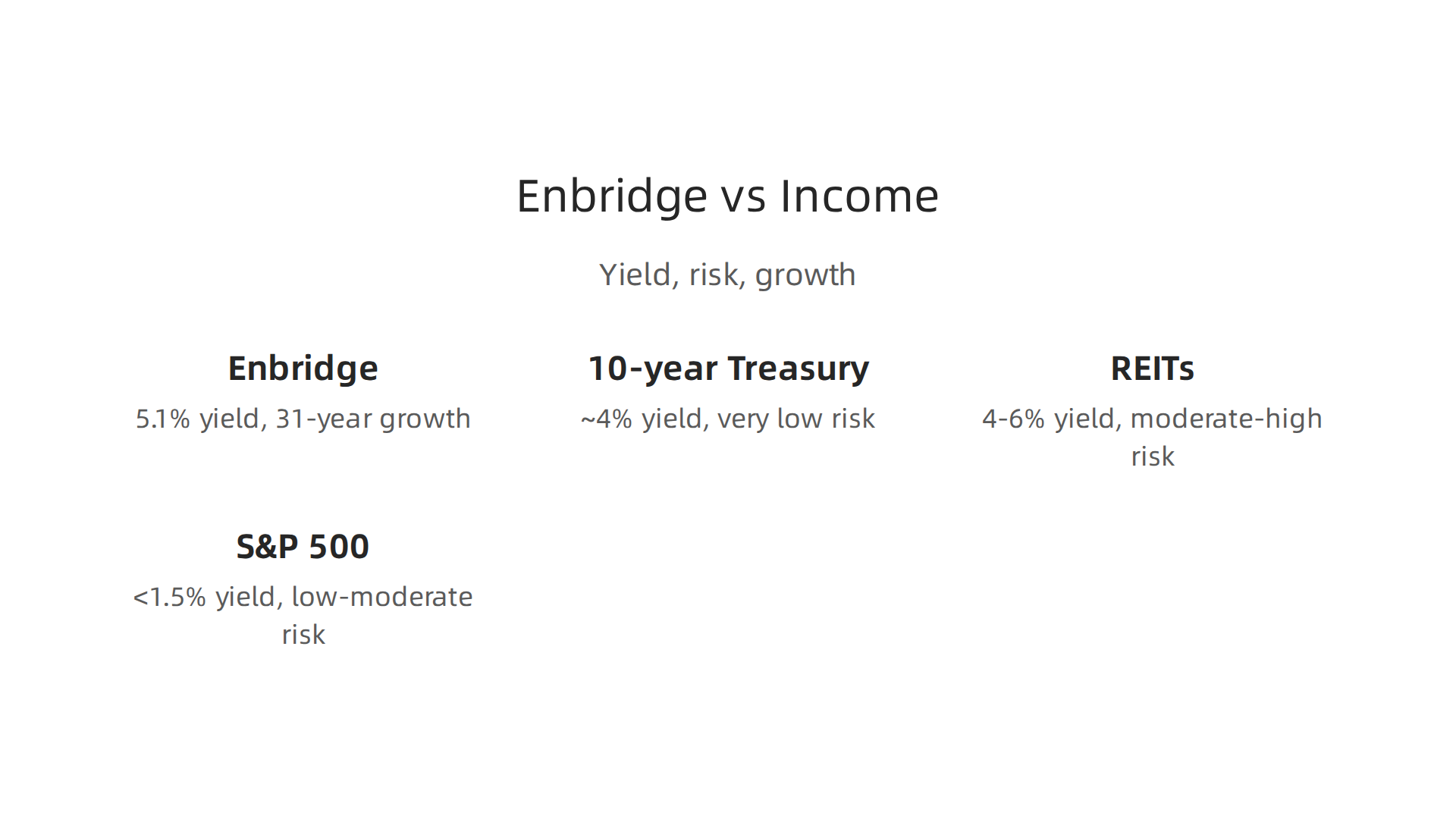
According to the Enbridge dividend history and growth overview, the 5.1% yield places it in the top tier of US dividend payers.
Yield as a cushion during downturns. In 2020, when COVID sent markets plunging, Enbridge not only maintained its dividend but continued raising it. In 2022, when inflation and rate hikes crushed growth stocks, Enbridge held steady while the S&P 500 fell over 19%. That income kept coming. The stock’s utility-like cash flows gave investors something to hold onto. For tech investors used to 30-40% drawdowns, that cushion is real.
Meanwhile, the long-standing relationship between stocks and bonds has shifted. Historically, bonds fell when stocks rose, offering natural diversification. But in recent years, stock-bond correlation has turned positive, as noted by Longtermtrends’ stocks vs. bonds chart. That means bonds no longer protect your portfolio as reliably. Adding an income stock like Enbridge, which behaves differently from both, can improve your overall diversification.
If you’re building a portfolio that balances growth with steady income, Enbridge stock deserves a spot alongside your tech picks. To see how a diversified approach works in practice, this look at the Fidelity Total Market Index Fund offers a solid reference for blending different assets.
No previous sections exist for URL deduplication. The previous section ("Enbridge in the Context of Income-Focused Portfolio Strategies") is the only content written so far. All URLs from that section are already used and cannot be reused. Writing the new section now.
Navigating Regulatory and Environmental Risks in Energy Infrastructure
Every investment comes with risks. For Enbridge stock, the biggest ones aren’t about earnings misses or market volatility. They are about regulation, the environment, and legal battles that can take years to resolve.
The regulatory landscape is complex. Enbridge operates across borders. That means multiple regulators have a say. In Canada, the Canada Energy Regulator oversees safety and pipeline approvals. In the US, the Federal Energy Regulatory Commission (FERC) sets rules for interstate pipelines. And individual states add their own carbon policies and environmental standards. Michigan, Wisconsin, and Minnesota all have different rules for the same pipeline system. That patchwork creates uncertainty.
Environmental risks are real and costly. Pipelines carry oil and natural gas across thousands of miles. Spills happen. Methane leaks happen. Both carry cleanup costs, legal liability, and reputational damage. On top of that, the global push toward net-zero emissions means fossil fuel infrastructure faces long-term questions. Even if demand stays strong for decades, the regulatory pressure is increasing. Investors in Enbridge stock need to watch how these trends evolve.
The Line 5 case is the biggest example. Enbridge’s Line 5 pipeline crosses the Straits of Mackinac and the Bad River Band reservation in Wisconsin. This single pipeline has generated years of litigation. In 2026, multiple court decisions are expected. The Michigan Supreme Court is set to rule on the tunnel project permit. The US Supreme Court is hearing an appeal on jurisdiction. And in Wisconsin, a federal judge ordered a shutdown by 2026 because the pipeline is trespassing on tribal land. The Line 5 reroute around the Bad River reservation received a favorable ruling from an administrative law judge who upheld key state permits. Still, the Bad River Band denied water quality certification for the reroute in early 2025. This is far from over. To understand the full timeline, you can follow the Enbridge Line 5 Pipeline updates from Wisconsin’s Green Fire.
Tribal nations and indigenous land rights add another layer. Native American tribes in Michigan and Wisconsin argue that Line 5 threatens treaty-protected fishing rights and water quality in the Great Lakes. Legal challenges have been filed at every level. The Enbridge’s Line 5 Pipeline litigation from the Native American Rights Fund lays out the tribal arguments in detail. These cases may delay or block the project entirely.
What this means for you as an investor. These risks don’t mean Enbridge stock is a bad investment. But they do mean you need to watch them.

Pipeline companies face a different kind of risk than tech stocks. Your returns depend not just on earnings but on court rulings, regulatory decisions, and political shifts. That unpredictability is baked into the yield.
For a broader view of how major industries are being reshaped by regulation and technology in 2026, reading about the top industries reshaping the global economy can help you connect the dots between energy policy and broader market trends.
Staying on top of these fast-moving developments is a challenge. To get clear daily updates on the technology and policy shifts that impact energy, AI, and the broader economy, subscribe to The AI Newsletter Worth Reading from The Deep View Newsletter. It helps you cut through the noise.
Enbridge vs. Alternatives: Comparing Energy Infrastructure Stocks
How does Enbridge stock compare to its closest peers? Investors have several choices in the energy infrastructure space. The main competitors are TC Energy (TRP), Kinder Morgan (KMI), Enterprise Products Partners (EPD), and NextEra Energy (NEE).
Each offers a different balance of yield, valuation, and growth.
Here is a side-by-side look at the key numbers as of mid-2026. The data comes from company reports and analyst estimates.
| Metric | Enbridge (ENB) | TC Energy (TRP) | Kinder Morgan (KMI) | Enterprise Products (EPD) | NextEra Energy (NEE) |
|---|---|---|---|---|---|
| Dividend Yield | ~5.1% | ~4.5% | ~4.4% | ~5.5% | ~2.8% |
| EV/EBITDA (TTM) | ~17.3x | ~16.5x (est.) | ~14.1x | ~11.5x | 20x+ |
| Payout Ratio | 60‑70% of DCF | ~75% of FCF | ~57% of Adj. CFFO | ~57% of Adj. CFFO | ~60% of earnings |
| EBITDA Growth Outlook | ~5% annual post‑2026 | 5‑7% annual through 2030 | ~2% budgeted for 2026 | +10% YoY in Q1 2026 | ~8% annual |
Yield and Income. Enbridge’s yield of about 5.1% is solid but not the highest. Enterprise Products offers a slightly higher yield of around 5.5% and has raised its distribution for 27 straight years. Kinder Morgan and TC Energy yield a bit less, while NextEra focuses more on growth than current income.
Valuation. According to a recent peer comparison, Enbridge trades at a trailing EV/EBITDA of 17.3x. That is higher than Kinder Morgan at 14.1x and Enterprise Products at 11.5x. The premium reflects Enbridge’s regulated revenue base and consistent dividend growth. TC Energy also carries a premium valuation but has higher debt levels, as detailed in the TC Energy Corporation (TRP) Competitive Analysis.
Growth Prospects. Enbridge expects 5% annual EBITDA growth after 2026, backed by a $10 billion capital plan. TC Energy targets 5‑7% through 2030, focused on natural gas. Kinder Morgan’s budget calls for 2% growth in 2026. Enterprise Products posted a strong first quarter with EBITDA up 10% year over year, as shown in the Enterprise Reports First Quarter 2026 Earnings release.
The Big Differentiator: Revenue Mix. Enbridge’s advantage is its high percentage of regulated and long‑term contracted revenue. This means cash flow stays stable even when oil and gas prices swing. That stability supports its 31‑year dividend growth streak and a payout ratio that stays within 60‑70% of distributable cash flow. Peers like Kinder Morgan and Enterprise have more exposure to commodity‑sensitive businesses like natural gas processing and NGL marketing.
How It Fits Your Portfolio. Income‑focused investors often compare Enbridge stock to opportunities in other sectors, such as Warner Bros stock in entertainment, Lennar stock in homebuilding, General Mills stock in consumer staples, or Zillow stock in real estate. But energy infrastructure offers a unique combination of high yield and long‑term contracted cash flow that few other sectors can match.
To stay ahead of the big forces shaping energy, technology, and the broader economy, check out this analysis of how the world market order is being reshaped by AI and geopolitical competition. Understanding these trends helps you make smarter portfolio decisions.
Macroeconomic Drivers: Interest Rates, Oil Prices, and Geopolitical Factors
After comparing Enbridge with its peers, it’s time to look at the bigger forces that move its stock. Three macro factors matter most: interest rates, oil prices, and geopolitics. Understanding them helps you see how enbridge stock might perform in different economic climates.
Interest Rates and Pipeline Stocks
Energy infrastructure companies borrow a lot of money to build pipelines and storage terminals. When interest rates go up, their borrowing costs rise. That can squeeze cash flow and make high-yield stocks like Enbridge less attractive compared to safer bonds.
But Enbridge has a key advantage. About 98% of its cash flow comes from regulated assets or long-term contracts. These often include inflation protection and cost pass-through mechanisms. So when rates rise due to inflation, Enbridge can adjust its tolls to keep earnings stable. That’s why the stock is seen as a defensive income pick.
Still, the yield curve matters. If short-term rates stay high while long-term rates fall (a flattening curve), it can signal an economic slowdown. That might hurt demand for oil transport. Investors watch this closely when evaluating enbridge stock.
Oil Price Volatility: Less Direct Than You Think
You might assume pipeline stocks rise and fall with oil prices. But that’s only partly true. Enbridge makes most of its money from transporting oil and gas, not from owning the commodities. Its revenue is mostly toll-based and volume-driven.
That said, oil price swings still matter. Prolonged low prices can cause oil producers to cut drilling and reduce volumes on Enbridge’s pipelines. On the flip side, high prices encourage more production, boosting volumes. The company’s diversified system helps smooth out these cycles. For example, its gas transmission and utility segments provide steady cash flow even when oil markets are choppy.
Geopolitical Factors: Trade, Energy Security, and Regulation
This is where things get fascinating. Enbridge’s Line 5 pipeline has become a major political flashpoint between the U.S. and Canada. The pipeline carries oil and natural gas liquids through Michigan and Wisconsin. In 2026, several court decisions are pending that could affect its future.
A recent judge ruled in favor of Enbridge’s Line 5 reroute in Wisconsin, upholding key state permits. But tribal nations and environmental groups continue to challenge the project. The Michigan Supreme Court is also set to rule on the state’s approval of the tunnel project under the Straits of Mackinac.
These regulatory battles create uncertainty. If Line 5 were forced to shut down, Enbridge would lose significant revenue from one of its major pipelines. That risk keeps the stock from trading at an even higher valuation. On the other hand, a favorable resolution would remove a cloud that has hung over enbridge stock for years.
Beyond Line 5, broader geopolitical trends matter. U.S.-Canada trade relations affect cross-border energy flows. NATO energy security discussions push countries to diversify supply, which benefits pipeline infrastructure. And OPEC+ decisions on oil production quotas impact global prices and demand for North American crude.
For investors tracking these macro shifts, staying informed across sectors is crucial. The top industries reshaping the global economy in 2026 include energy infrastructure alongside tech and AI. Understanding these interconnected trends helps you make smarter calls on enbridge stock.
So when you look at enbridge stock, don’t just compare it to peers. Watch interest rate decisions, oil price trends, and the courtroom battles shaping its biggest pipeline. Each of these factors plays a role in determining whether the dividend keeps growing.
How to Integrate Enbridge into a Diverse, Multi-Sector Portfolio
Now you know the big forces driving enbridge stock. The next step is figuring out how it fits into your own portfolio.

A pipeline giant like Enbridge plays a specific role. It is not a growth stock. It is a cash-flow machine. So you need to pair it with other assets that balance its strengths and weaknesses.
Start with a smart allocation
Think of your portfolio in layers or sleeves. One sleeve might be for dividend income. Another for growth. A third for safety. Enbridge belongs in the dividend income sleeve. A good rule is to put 5 percent to 10 percent of that sleeve into enbridge stock. If you look at your total portfolio, that comes out to about 2 percent to 5 percent. That keeps your income steady without overconcentrating in one sector.
Enbridge’s reliability backs up this allocation. In 2025, the company reported record adjusted EBITDA of $20.0 billion and increased its dividend for the 31st straight year. You can read the full details in the Enbridge Reports Record 2025 Financial Results press release. That kind of consistency makes it a solid anchor for an income sleeve.
Pair Enbridge with growth stocks for balance
Here is the trick. Enbridge moves slowly and steadily. Technology and growth stocks like warner bros stock, lennar stock, general mills stock, or zillow stock often move faster in both directions. When you hold both, you get a smoother ride. If tech stocks drop on bad news, Enbridge’s steady dividends help cushion the fall. If tech stocks soar, you capture the upside. This pairing works because Enbridge’s cash flow does not depend on the same factors that drive software or housing stocks. For more on building a diversified core, check out this guide on total market index fund performance and portfolio fit.
Reinvest dividends to rebalance automatically
A Dividend Reinvestment Plan (DRIP) lets you use Enbridge’s payouts to buy more shares without paying commissions. That compounds your income over time. But you can also take the cash dividends and use them to buy other opportunities. For example, when growth stocks are down, you can redirect your Enbridge dividends into beaten-down tech names. This strategy keeps your portfolio balanced without selling anything. And if you want to stay ahead of which growth sectors are rising, getting clear daily AI updates from The AI Newsletter Worth Reading can help you spot trends early.
The bottom line
Enbridge stock is not a star player. It is the reliable teammate that shows up every day. Give it a modest slot in your portfolio, pair it with growth, and let its dividends do the heavy lifting for rebalancing. That is how you turn a pipeline stock into a powerful portfolio tool.
Summary
This article evaluates Enbridge as a steady, income-producing complement to growth-heavy tech portfolios, explaining what the company does, why its cash flows are unusually predictable, and how that stability supports a long dividend growth streak. It reviews Enbridge’s scale across liquids pipelines, gas transmission, utilities and renewables, highlights record 2025 earnings and distributable cash flow, and explains management’s 60–70% DCF payout framework. The piece lays out the dividend case—current yield, historical CAGR and coverage—while flagging the biggest risks, especially regulatory, environmental, and the long-running Line 5 litigation. You’ll also get a peer comparison (TC Energy, Kinder Morgan, Enterprise, NextEra), the macro drivers to watch (interest rates, oil prices, geopolitics), and practical allocation rules for income sleeves and total portfolios. By the end you’ll have a data-driven framework to decide if Enbridge deserves a modest, risk‑aware position in your multi-asset mix and how to monitor the key catalysts and risks.