

When you hear "Axon," you might think of a stun gun. That is a mistake. In 2026, Axon (ticker: AXON) is a powerful mix of hardware and software.

The company makes TASER devices, body cameras, and cloud tools that help police departments run better. Its stock has become a favorite among investors tracking Big Tech because it combines physical products with a fast-growing subscription business.
But finding clear facts about axon stock is harder than it should be. Headlines focus on AI hype or quarterly drama. Noise from sources like yahoo stocks and chatter on dividends reddit can bury the real story. It is easy to get lost.
This analysis cuts through the fog. We use real numbers from official filings and earnings calls. For example, Axon ended 2025 with $2.8 billion in annual revenue, up 33% from the year before, as detailed in the company’s Q4 2025 financial results. The software and services side grew 40%. That is not just a hardware story.
We will walk through Axon’s business segments, financial health, competitive edge, growth drivers, and risks. If you want to stay ahead of the curve without the clutter, you can also subscribe to The Deep View Newsletter for clear daily AI updates that fit your busy schedule.
Axon’s Business Segments: From TASER to a Connected Public Safety Ecosystem
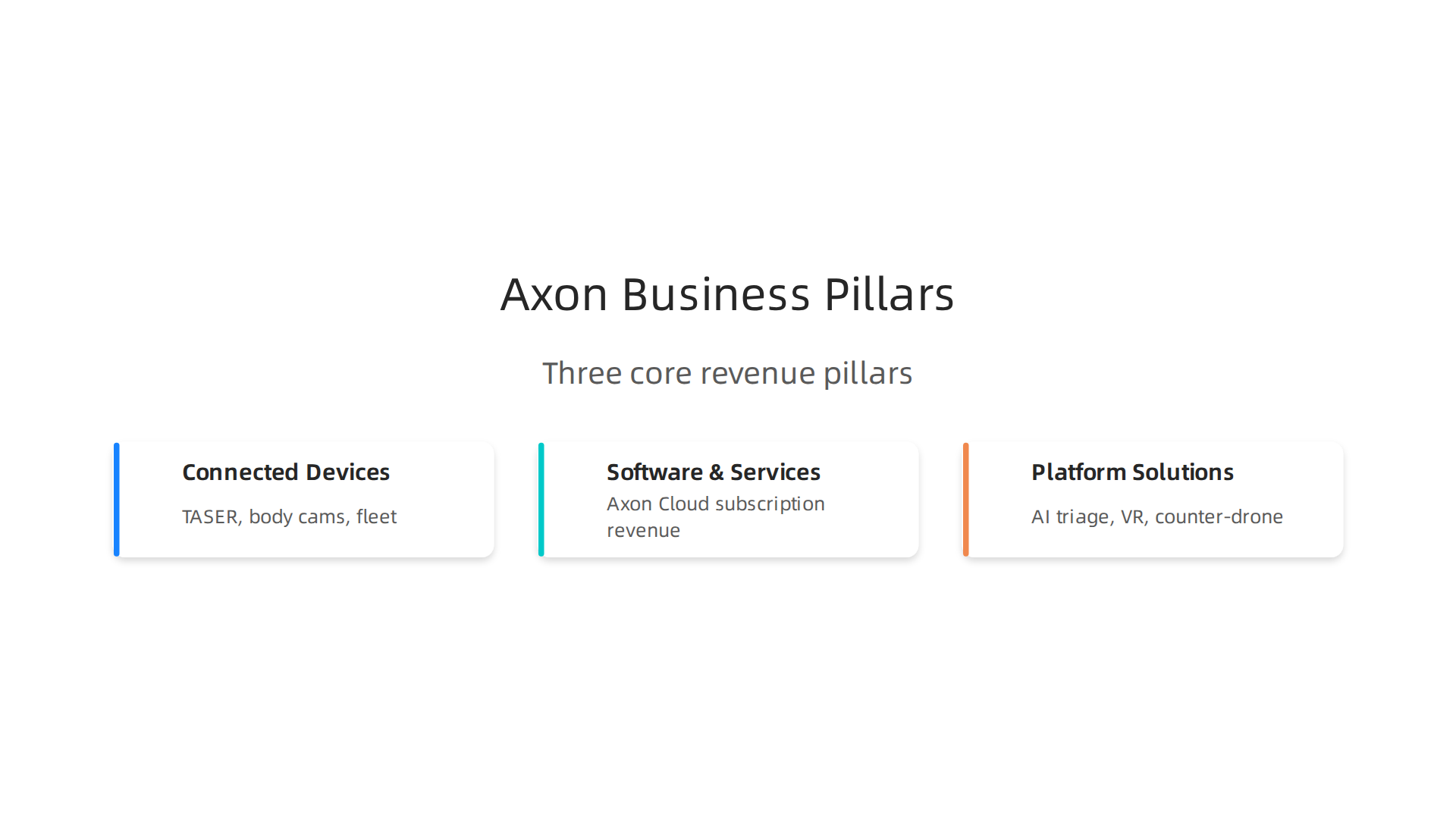
To really understand axon stock, you need to see how Axon makes money today. The business rests on three main pillars.
Each one plays a different role in the overall growth story.
The first pillar is Connected Devices. This is the hardware side. It includes TASER 10, Axon Body 4 cameras, and Axon Fleet systems. These devices are the entry point for most new customers. A police department buys the hardware first. TASER revenue alone was strong in early 2025, growing 19% year over year. But hardware has lower margins and is a one-time sale unless the customer buys upgrades or replacements.
The second pillar is Software & Services. This is the engine behind Axon’s high valuation. Once a department has cameras, they need a place to store all that video. They sign a subscription for the Axon Cloud. This recurring revenue is what investors love. In Q1 2025, Axon reported that Software & Services revenue grew 39% to $263 million, and annual recurring revenue hit $1.1 billion, as shown in the company’s Q1 2025 financial results. This part of the business now accounts for over half of total sales. It is high margin and predictable. That is a very different profile from an old-school manufacturer.
The third pillar is Platform Solutions. This covers newer offerings like AI triage for reviewing footage, virtual reality training for officers, and counter drone technology. This segment grew 51% year over year in Q1 2025. It is smaller today, but it represents Axon’s future. They are using AI to automate police reports and search hours of body cam footage in seconds.
One thing you will notice when tracking axon stock is how different it looks from other stocks. If you spend time on dividends reddit or scan yahoo stocks, you will see companies that pay steady dividends or rely on one product. Axon does not pay a dividend. It reinvests everything into subscriptions and AI tools.
Geographically, the United States is still the core market. But that is changing fast. Police forces in Europe, the Middle East, and Asia Pacific are adopting Axon’s ecosystem. This international expansion opens up a huge addressable market. To understand how other tech companies are building similar global ecosystems, check out this analysis on how the world market order reshaping by AI is affecting Big Tech strategies.
Some investors tracking fig stock for design tools or mo stock for consumer staples might overlook Axon. But Axon sits in a unique category. It sells hardware, collects high-margin subscription fees, and is building the AI future for public safety.
Financial Health Check: Revenue Growth, Margins, and Cash Flow Trajectory
Let’s talk numbers. When you evaluate axon stock, the financial story is what separates it from a traditional hardware company. The headline numbers are impressive, but the real strength is hiding in the details.
Axon closed 2025 with total revenue of $2.78 billion, up 33% year over year. That marks its fourth consecutive year of 30% plus growth, according to detailed analyst coverage of the Axon Q4 2025 earnings beat. Q4 alone delivered $797 million in revenue, a 39% jump. And the company is guiding for 27% to 30% growth in 2026, the strongest initial year outlook it has ever issued.
But revenue growth alone does not tell you the whole story. You need to look at gross margins. Axon’s overall gross margin sits at 57.9%, with adjusted gross margin at 61.1%. That number dipped a bit due to tariffs and a changing product mix. However, here is the key insight. The Software & Services segment, which grew 40% to $343 million in Q4, carries much higher margins approaching 70%. As software becomes a bigger piece of the pie, overall margins should trend upward over time.
Free cash flow is another metric worth watching. In Q4 2025, operating cash flow came in at $217 million, supporting free cash flow of $155 million. The company targets a free cash flow conversion rate of 60% on adjusted EBITDA. Management expects 2025 to be the low point, with that number climbing back toward 60% in 2026.
What about earnings per share? Axon beat expectations handily. Q4 2025 delivered adjusted EPS of $2.15, well above the $1.60 consensus estimate. Then in Q1 2026, the company posted EPS of $1.61, beating estimates by nearly 26%, based on the company’s latest earnings report. That pattern of consistent beats is a strong signal.
The three metrics you should track most closely for axon stock are Annual Recurring Revenue, Net Revenue Retention, and Adjusted EBITDA margin.
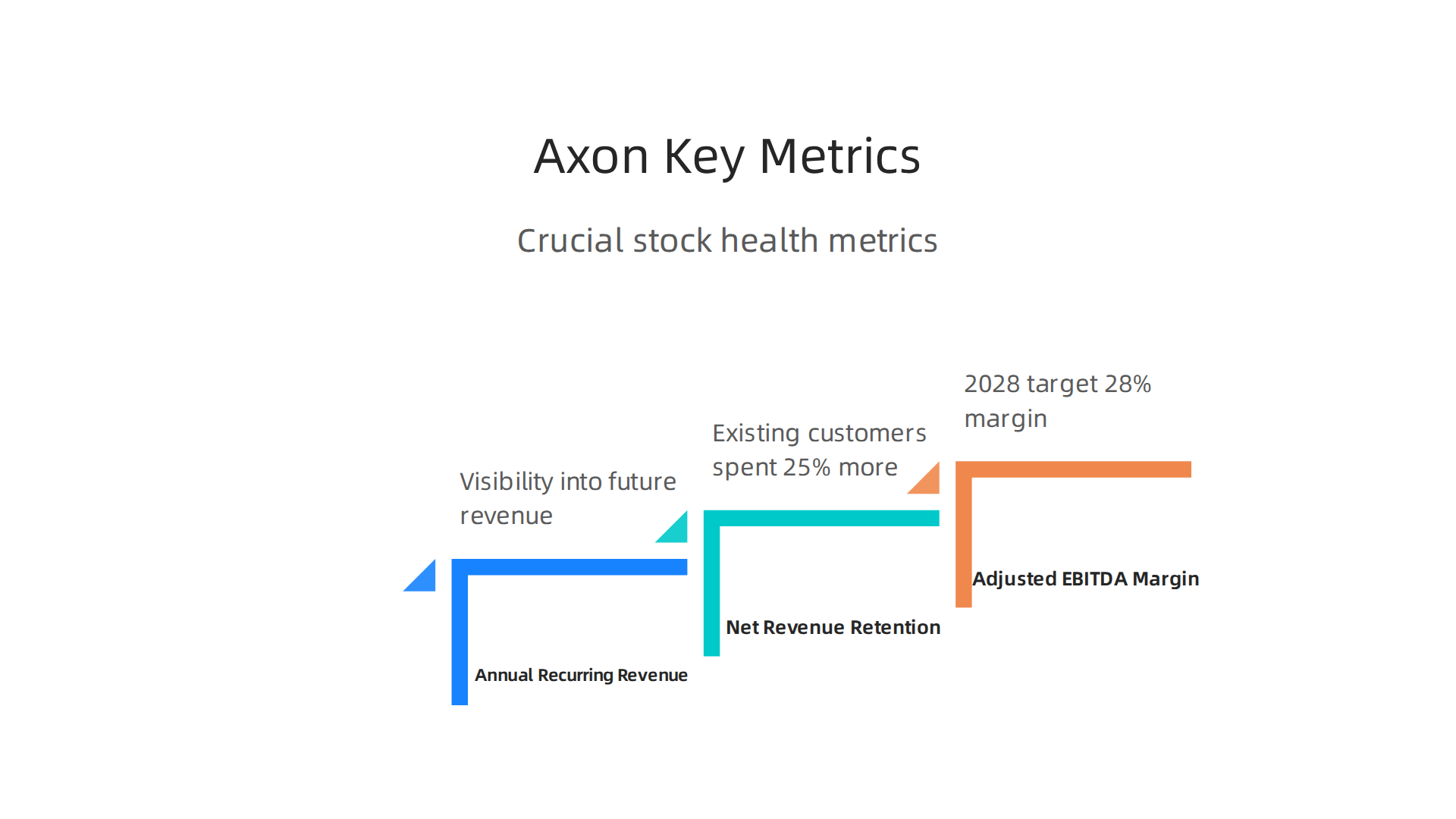
Full year 2025 bookings hit $7.4 billion, up 46%. That backlog gives visibility into future revenue. Axon also introduced a 2028 target of roughly $6 billion in revenue at a 28% adjusted EBITDA margin.
If you compare this to other stocks you might see on yahoo stocks or discussed on dividends reddit, the profile is different. Axon does not pay dividends. It reinvests aggressively. But the compounding growth in subscriptions and AI tools creates a financial engine that most companies cannot match. For a deeper look at how recurring revenue models drive growth in other tech companies, check out this analysis of SoFi Technologies stock performance.
One thing to remember. Net income on a GAAP basis was only $3 million in Q4 2025, down sharply from the prior year. That was caused by heavy investment in headcount and stock based compensation. But non-GAAP net income of $178 million tells a different story. It shows the underlying business is highly profitable when you strip out non-cash charges and strategic investments.
If you want to stay ahead of how AI is reshaping financial analysis and investment decisions, consider subscribing to The AI Newsletter Worth Reading. It delivers clear daily updates on the technology trends driving companies like Axon forward.
Competitive Landscape: How Axon Stacks Up Against Rivals
Now that you’ve seen the financial engine behind axon stock, it’s time to ask: who else plays in this space and can they catch up? The short answer is no, and here is why.
Axon’s main rival is Motorola Solutions, a big name in public safety radios and dispatch software. But Axon owns the body-worn camera market.

According to the company’s Axon Enterprise Wikipedia entry, Axon cameras hold an 85% market share among police departments in America’s largest cities. That is huge. Their less-lethal weapons (TASERs) have an even stronger hold.
Smaller AI-focused startups and international vendors like Digital Ally or Panasonic try to compete. But they lack the ecosystem that makes Axon sticky. Every camera and every TASER feeds directly into Axon’s cloud platform. That platform includes Axon Evidence, a digital evidence management system that stores, manages, and shares video and other files. The system is described in detail on the Secure, AI-Powered Digital Evidence Management page. It creates a tamper-proof audit trail that courts and agencies trust. Once a police department adopts the full Axon ecosystem, switching away would mean retraining officers, migrating years of evidence, and losing AI tools that save time.
This is where the data network effect becomes the real competitive moat. Each new camera and TASER feeds more data into Axon’s cloud. That data trains its AI models to become smarter at detecting threats, redacting faces, and surfacing key moments. The more data Axon ingests, the harder it is for any competitor to match its accuracy.
The global body-worn camera market is growing fast. A report on the Body Worn Camera Market expects a 14.5% compound annual growth rate from 2026 to 2035. Axon is positioned as the clear leader in that expansion. While you might browse yahoo stocks for names like MO stock (Altria) or FIG stock (Figma), those companies operate in completely different worlds. Axon has a lock on government contracts, recurring subscription revenue, and an AI-powered platform that gets stronger every day.
For a broader look at how AI and geopolitical shifts are reshaping entire industries, check out this analysis of the global market order reshaped by AI. It helps put Axon’s competitive advantage into perspective.
The bottom line: Axon’s combination of hardware dominance, cloud lock-in, and AI-driven data network effect creates a moat that startups and legacy players alike will struggle to cross. That is a big reason axon stock continues to attract serious investor attention.
Growth Drivers: AI, International Expansion, and the Shift to Recurring Revenue
You have seen how Axon dominates the competition. But what keeps pushing axon stock higher year after year? Three big engines: artificial intelligence, a growing global footprint, and a smart subscription model that turns one-time buyers into long-term customers.

AI Is the Game Changer
The biggest catalyst for Axon right now is artificial intelligence. Axon has rolled out two AI products that are getting a lot of attention.
First is Draft One. This tool uses AI to write police reports from body camera footage. Officers spend hours every shift typing reports. Draft One cuts that time down to minutes. Early adopters say it reduces paperwork and lets officers stay in the field longer. That is a massive value add for any police department.
Second is AI triage for video evidence. When an officer uploads hours of footage, Axon’s AI scans it automatically. It finds key moments, flags threats, and redacts faces to protect privacy. Instead of a human watching every second, the AI does the heavy lifting. This saves agencies huge amounts of time and money.
These AI features live inside Axon’s cloud platform. They are premium add-ons that increase the average revenue per user. As more agencies adopt AI tools, Axon’s software revenue grows faster than hardware. In the first quarter of 2025, Software & Services revenue jumped 39% year over year to $263 million, according to the Axon Q1 2025 earnings report. That is a clear sign that AI is driving real dollars.
International Markets Are Still Wide Open
Axon already owns the US law enforcement market. But the rest of the world is still underpenetrated. Europe, Australia, and parts of Asia are just starting to adopt body cameras and digital evidence systems. Axon is moving fast to capture that demand.
The company is working on localizing its software and getting regulatory approvals in new countries. It is also building partnerships with local distributors. The global body camera market is expected to grow at a compound rate of 14.5% from 2026 to 2035, and Axon is the clear leader.
Axon is also expanding beyond police. In 2025, it launched the Axon Body Workforce Mini, a small camera designed for retail workers, healthcare staff, and other frontline employees. You can see details in this Axon Body Workforce Mini product overview. That opens a whole new customer base beyond law enforcement. More customers mean more data flowing into Axon’s platform, which makes its AI even smarter.
The Mission Subscription Bundle Locks Customers In
Here is the part that excites long-term investors. Axon has shifted its business model from selling cameras one at a time to selling subscription bundles called "Mission." When a police department buys a TASER or a body camera, it also signs up for a monthly subscription that includes cloud storage, AI tools, evidence management, and training.
This converts a onetime hardware sale into years of recurring revenue. And Axon is excellent at getting customers to upgrade to pricier plans. In the fourth quarter of 2025, the company reported net revenue retention of 125%. That means existing customers spent 25% more than they did the year before. Annual recurring revenue hit $1.3 billion, up 35% year over year, as shown in the Axon Q4 2025 earnings press release.
Once an agency adopts the Mission bundle, switching away becomes painful. They would lose years of evidence, retrain officers on new software, and give up AI tools that make their jobs easier. That stickiness is what makes axon stock so attractive to growth investors.
Why This Matters for Your Portfolio
When you look at yahoo stocks and see names like fig stock or mo stock, those companies rely on consumer demand or commodity pricing. Axon is different. It has a recurring revenue engine that grows faster every quarter, powered by AI features that get better with more data. And it is just starting to expand internationally.
If you want to understand how AI is reshaping entire industries, check out this analysis of how IBM stock shows steady growth through AI and cloud transformation. It puts Axon’s AI push into a bigger picture.
For daily updates on AI breakthroughs that could affect stocks like Axon, consider The AI Newsletter Worth Reading. It delivers clear, daily insights straight to your inbox, helping you stay ahead of the curve.
Risks and Headwinds: What Could Derail the Axon Story?
Axon’s growth story sounds exciting. But no investment is perfect. Even the best companies face real risks that could slow their momentum.

Here are the biggest ones to watch.
Legal and Regulatory Pressure
Axon operates in a high-scrutiny space. It faces ongoing lawsuits tied to TASER misuse, privacy concerns with body cameras, and antitrust claims. The company is also pushing into facial recognition and weapons systems, which attracts additional attention from regulators and activist investors.
In early 2026, Axon settled a shareholder lawsuit filed by the Nathan Cummings Foundation over political spending transparency. The case was part of a broader trend where investors are pushing for more disclosure. You can read more about the shareholder lawsuit settlement on the ICCR site.
The company is also defending itself in patent infringement suits related to drone and 911 technology. Axon says it does not expect these cases to materially affect its finances. But legal costs and management distraction are real risks. New regulations around AI and facial recognition could also limit how Axon uses its technology. That would slow adoption and hurt revenue growth.
Valuation Risk Could Hit Hard
Axon trades at a premium price-to-earnings ratio. Historically it has been above 50x earnings. That is fine when growth is strong, but it leaves the stock exposed to any disappointment.
If Axon misses a quarterly number or if interest rates stay high, investors might reassess the stock’s value. A sharp correction could happen quickly. Many traders on yahoo stocks and chat rooms like dividends reddit compare Axon to stable dividend payers like mo stock (Altria) or consumer names like fig stock. Those stocks offer income, while Axon offers none. That comparison can work against Axon when markets get nervous.
If you want a framework for understanding how market volatility affects high-growth stocks, check out this guide on the VIX and tech stock volatility. It helps explain why a stock like Axon can swing hard on news.
Concentration Risk Is Real
Axon depends heavily on US law enforcement for its revenue. If state and local budgets tighten, upgrade cycles could slow. Budget cuts during a recession would directly impact Axon’s hardware and subscription sales.
The company also relies on a few key suppliers for chips and sensors. A supply chain disruption could delay product shipments and hurt quarterly results. Axon’s international expansion helps diversify, but the US still makes up the majority of sales.
Axon stock has a lot going for it. But every investor should understand these risks before buying. No stock goes up in a straight line, and Axon’s premium valuation leaves little room for error.
Now let’s look at the numbers. Axon does not trade like a typical industrial stock. At a current price around $393, the trailing P/E ratio sits near 170x according to data from one analyst tracking site. That sounds extreme. But forward P/E based on expected 2026 earnings drops to roughly 57x. That is still high, but it reflects the market’s bet that earnings will catch up to the share price quickly.
Analysts on Wall Street are overwhelmingly optimistic. Out of 20 analysts covering Axon, 18 rate it a buy or outperform and only 2 rate it a hold. The mean price target from those analysts is roughly $708, which implies about 80% upside from current levels. Some targets go as high as $825, while the low end sits around $440. That is a wide range, which tells you there is real uncertainty beneath the bullish consensus.
A discounted cash flow model suggests that today’s stock price assumes Axon will grow revenue at roughly 23% to 25% annually for the next five years. That is lower than the 33% three-year CAGR the company just delivered. So the market is already pricing in some deceleration. If Axon hits its own 2026 guidance of 27% to 30% growth, the stock looks cheap relative to those assumptions. But if international expansion stalls or AI features fail to drive expected software adoption, a miss could cause the multiple to contract sharply. A drop of 30% or more is possible in that scenario.
Comparing Axon to slower-growth stocks like mo stock (Altria) or fig stock (Fig, Inc.) misses the point. Those companies trade on stable income. Axon trades on growth expectations. That is why discussions on dividends reddit and yahoo stocks often get heated. Investors who focus on steady payouts may never buy Axon. But for those who believe in the long-term platform shift, the current valuation may look like a buying opportunity.
If you want a broader view of how market forces are reshaping technology investments, check out this analysis of how the world market order is being reshaped by AI and geopolitical competition. It provides useful context for evaluating any Big Tech growth story.
Staying informed about Axon means tracking AI adoption in law enforcement, quarterly earnings surprises, and macro sentiment. For daily, clear updates on AI and the companies driving it, consider reading The AI Newsletter Worth Reading. It helps cut through the noise so you can focus on what matters for your portfolio.
Summary
This article cuts through the headlines to explain why Axon (AXON) is more than a TASER maker: it is a hardware-plus-software platform built around body cameras, cloud subscriptions, and AI-powered tools. The piece walks through Axon’s three revenue pillars—Connected Devices, Software & Services, and Platform Solutions—shows recent financials (about $2.8B in 2025 revenue and accelerating software ARR), and highlights the metrics investors should watch like ARR, net revenue retention, and adjusted EBITDA margin. It explains how AI products such as Draft One and video triage boost recurring revenue and stickiness, outlines competitive advantages and market share in body cameras, and lays out the main risks including lawsuits, regulation, and a premium valuation. Readers will come away able to assess Axon’s growth thesis, monitor the right numbers, and weigh the upside potential against the legal and valuation headwinds.