

In 2026, the world of business is moving at top speed, and much of that speed comes from advanced artificial intelligence and machine learning. For leaders and smart thinkers, it’s not enough to just know what AI is. We need to understand the deeper parts to really use it well and safely.

This means looking at how to make AI tools bigger for more users (scaling), how to test them to make sure they work correctly (evaluation), how to put them into real-world use (deployment), and how to make sure they are fair and trustworthy (governance).
Actually, knowing about these advanced topics in artificial intelligence and machine learning is super important right now. Many people face big problems. There is so much news and talk about AI every single day, which leads to a lot of information overload.

It’s hard to find deep, useful information that helps you make smart choices. Plus, everyone is busy, so there’s often a lack of depth in what they learn, and not enough time to read everything.
This guide is here to help you cut through all that noise. It gives you clear insights into the most important parts of advanced AI, saving you time and helping you lower risks. For example, understanding what an AI governance framework means in 2026 is key to using AI in a way that is responsible and safe for your company.
This helps ensure that the AI you use works for everyone, bringing real value and growth.
To keep up with all the fast changes and get clear, daily updates on AI, you might find this useful:
The AI Newsletter Worth Reading
To truly master advanced artificial intelligence and machine learning, leaders must look beyond a simple AI overview and understand the core ideas that make these powerful tools work. These foundational ideas are like the building blocks of AI. They help us understand how AI thinks, learns, and makes decisions.
Core Theoretical Frameworks
First, let’s explore some key ideas that guide how AI operates:
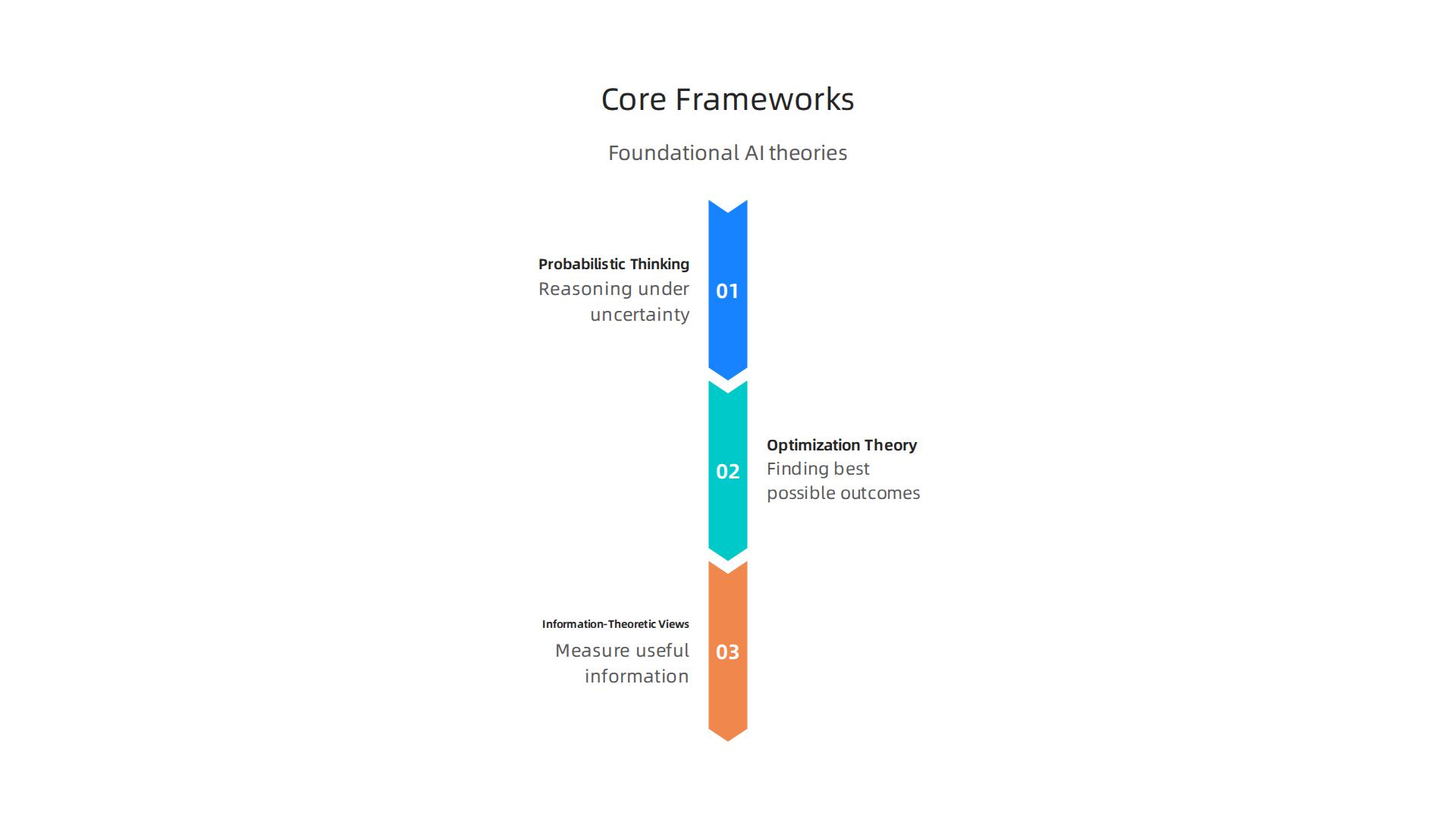
- Probabilistic Thinking: This is how AI deals with things that aren’t 100% sure. Imagine trying to guess the weather. You can’t be certain, but you can say there’s a good chance of rain. AI uses math to make educated guesses or predictions, like knowing the likelihood of a customer buying a certain product or a machine failing soon. This way of thinking helps businesses make smarter choices even when information is not perfect.
- Optimization Theory: At its heart, optimization is about finding the "best" possible outcome. If you want to make a product with the highest quality or find the quickest way to deliver goods, AI uses optimization to figure that out. It’s how AI learns to get better at its tasks over time, constantly improving its performance to reach a goal.
- Information-Theoretic Views: This concept helps AI understand how much truly useful information is present in a set of data. It’s about finding the important signals in a lot of noise. By focusing on what’s meaningful, AI can learn more efficiently and make sense of vast amounts of information, which is a critical skill for any advanced data analysis.
Understanding these core ideas is very important for anyone leading product development or setting company strategies. They help us build artificial intelligence and machine learning tools that are not only smart but also reliable, efficient, and capable of solving real-world problems.
Representation Learning Fundamentals
Next, let’s talk about a big part of modern artificial intelligence and machine learning called representation learning. Imagine you have a photo of a cat. For a computer, this is just a bunch of numbers or pixels. Representation learning is about teaching the computer how to "see" that photo in a way that makes sense to it. It’s how AI transforms raw data, like pictures, sounds, or text, into a format that it can easily understand and work with.
Think of it like how a child learns what a "car" is by seeing its shape, wheels, and how it moves. Representation learning helps AI automatically find these important features or "representations" in data. For instance, an AI might learn to recognize specific patterns or features that define a cat, like its whiskers or pointy ears, no matter the cat’s color or size.
Choosing the right way to represent data is incredibly important. It directly affects how well the AI performs its tasks. If the AI learns a poor representation, it might struggle to tell a cat from a dog. But with a good representation, it can easily tell them apart and make accurate predictions. Researchers are always working to discover better ways to represent different types of information. For example, new studies explore how to improve representation learning for tabular data or even for diffusion models and representation learning, which are key to many generative AI systems.

Good representations also help us understand why an AI made a certain decision. This is called interpretability. If we can see what features the AI is focusing on, it makes the AI less of a "black box." This understanding is crucial for building trustworthy AI in 2026 and ensuring that AI systems produce fair and explainable results. This area of study is growing fast, with many new research papers being shared at major events like ICLR 2026 Papers.
Learning how AI sees the world is a big step. But how does artificial intelligence and machine learning actually build these "representations"? And how can we look inside an AI to understand its choices? Let’s dive into the different ways AI forms its understanding and how we can make these powerful tools less of a mystery.
Representation & Interpretability: Embeddings, Transformers, and Beyond
In the world of modern artificial intelligence and machine learning, there are different ways for AI to understand and store information. Think of it like a library with different kinds of books for different topics.
New Ways AI Learns About Data
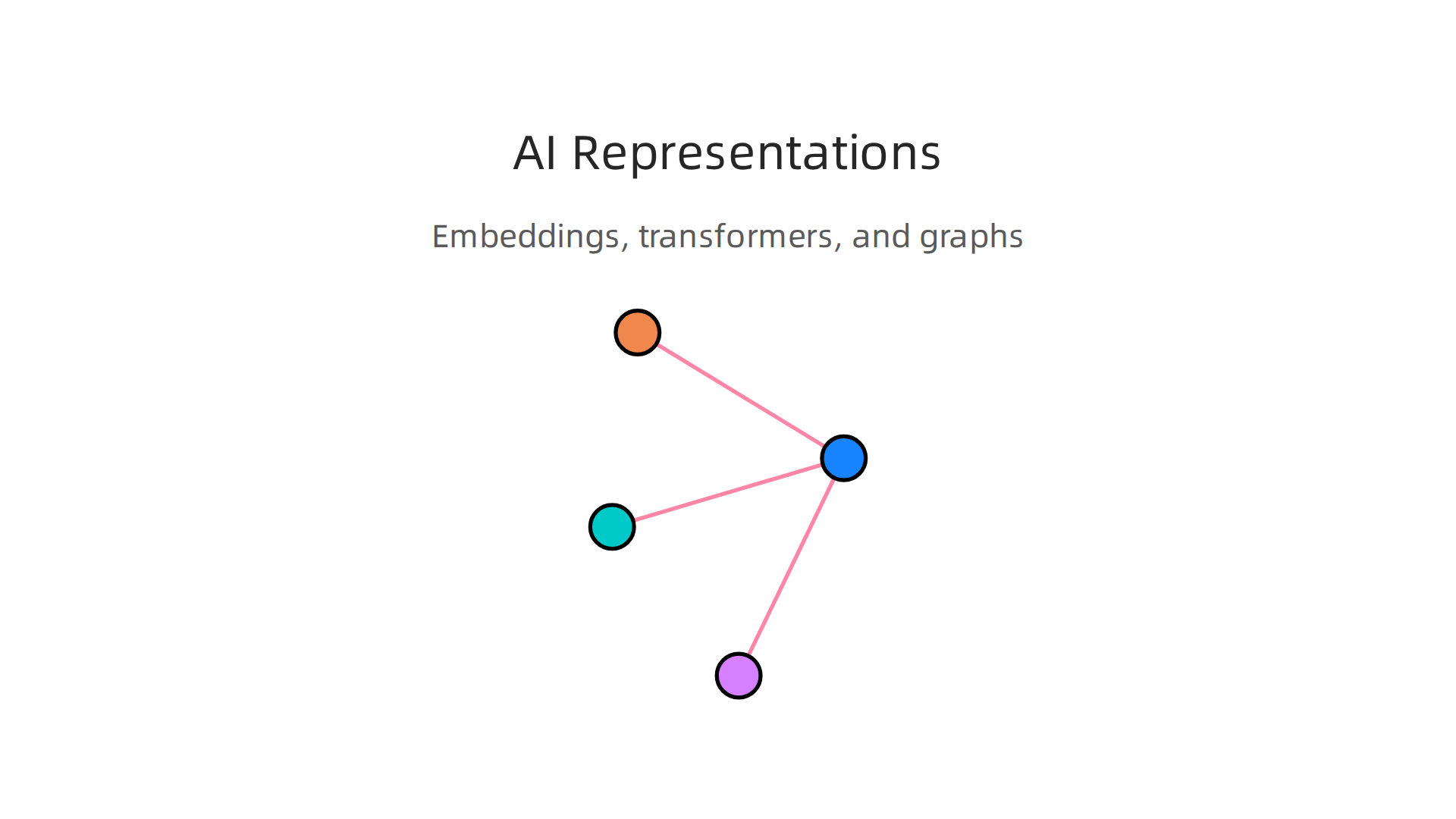
- Dense Embeddings: Imagine you have many words. Instead of just listing them, AI can turn each word into a special string of numbers called a "dense embedding." These numbers capture the meaning of the word and how it relates to other words. Words with similar meanings will have similar numbers. This helps AI understand language better. We use these for text, pictures, and even sounds. Researchers are always looking for better ways to learn these representations, even for complex things like how molecules interact in science A survey of contrastive learning methods in molecular ….
- Transformers: These are a very important type of AI model, especially for handling text. They use dense embeddings in a smart way to understand long sentences or whole articles. Transformers are key to many new generative AI tools that can write stories, answer questions, or even create pictures. Their ability to connect distant pieces of information has changed how AI works with language.
- Sparse and Structured Representations: Sometimes, data isn’t just a jumble of numbers. It might already have a clear structure, like a spreadsheet with columns and rows. For this kind of data, AI might use "sparse" representations, which focus on specific, important features rather than trying to capture everything. Or it might use "structured" representations that keep the data’s original organization in mind.
- Graph-Based Encodings: Imagine a social network where people are connected to their friends. This is called "graph data." AI can learn to represent these connections using graph-based encodings. These help AI understand how different pieces of information are linked together, which is useful for things like recommending friends or products. Understanding how AI learns from these connections is a big field of study A Comprehensive Survey on Deep Graph Representation Learning.
Choosing the right way to represent data is super important for how well the artificial intelligence and machine learning model works. It’s like giving a student the right textbook for their class.
Making AI Understandable: The Interpretability Challenge
Even with all these smart ways for AI to learn, sometimes it feels like a "black box." We put information in, and we get an answer out, but we don’t always know why the AI made that specific choice. This is where interpretability comes in.
Interpretability means being able to understand and explain how an AI model makes its decisions. This is very important for businesses, especially when AI helps with big choices like healthcare diagnoses or financial loans. If we can’t understand the AI, how can we trust it?
Here’s how interpretability methods help:
- Shining a Light: These methods act like a flashlight, showing us which parts of the input data the AI paid most attention to. For example, if an AI predicts a customer will buy a product, interpretability might show that it focused on their past purchases and how often they visited a certain page.
- Finding Important Features: They can help us find the most important factors that led to an AI’s decision. This is not always easy, as AI models can be very complex. Researchers are always working on new ways to make AI more transparent A Practical Guide Towards Interpreting Time-Series Deep Clinical Predictive Models: A Reproducibility Study. In 2026, understanding how AI works internally, known as mechanistic interpretability, was even named one of MIT Technology Review’s breakthrough technologies Mechanistic Interpretability Named MIT’s 2026 Breakthrough for ….
Limits and Evaluation
While interpretability is getting better, it’s not perfect. Sometimes, even the best tools can only give us a partial picture because artificial intelligence and machine learning models are so intricate.
For businesses, it’s crucial to evaluate interpretability. This means asking questions like:
- Can humans understand the explanations the AI provides?
- Do these explanations help us trust the AI more?
- Do they help us find and fix problems if the AI makes a mistake?
Building good ways to measure if an AI is truly explainable is a big area of focus in 2026, especially in sensitive fields like healthcare eXplainable artificial intelligence-Eval: A framework for comparative evaluation of explanation methods in healthcare.
Understanding these advanced ways AI represents information and how we can interpret its decisions is vital for leaders. It helps you ensure that your AI projects are not just powerful but also fair, safe, and understandable.

To stay on top of the latest advancements in AI and what they mean for your business, consider subscribing to a trusted source.
Get clear daily AI updates from The AI Newsletter Worth Reading. You’ll find deep insights without the usual information overload. You can also explore more strategic guides for leaders on topics like AI for business to see how these theories translate into real-world impact.
Now that we’ve seen how artificial intelligence and machine learning learn and how we can try to understand their choices, let’s talk about what it takes to actually build these powerful AI models. Making big AI models isn’t just about smart ideas; it’s also about having lots of special computers and good information. It’s about training at a very big scale.
Training at Scale: Compute, Data, and the New Efficiency Frontiers
Imagine you want to teach a student to be very smart. They’ll need a good school, lots of books, and plenty of time to learn. Training big artificial intelligence and machine learning models is much the same. It needs powerful computers (compute), a vast amount of teaching material (data), and smart ways to make the whole process faster and cheaper (efficiency).
The Power of Scaling Laws
For a long time, scientists have noticed something interesting: if you make AI models bigger, give them more data, and use more computing power, they generally get better. These patterns are called "scaling laws." They help people predict how well an AI will perform based on how many resources they put into it LLM Scaling Laws Explained: Will Bigger AI Models Always Win? (2026).
In 2026, understanding these scaling laws is very important. They help developers decide how big to make a model or how much data to gather to get the best results. It’s like knowing that the more hours you study, the better your test score will likely be Practical Scaling Laws: Converting Compute into Performance in a Data …. Even how AI thinks during a task, called "inference-time scaling," follows these rules, allowing for better performance by giving the AI more "thinking budget" Inference-Time Compute Scaling: From Thinking Budgets to … – Zylos.
Smart Ways to Be More Efficient
Building huge AI models can cost a lot of money and use a lot of energy. So, researchers and companies are always looking for ways to be more efficient. Here are some tricks they use:
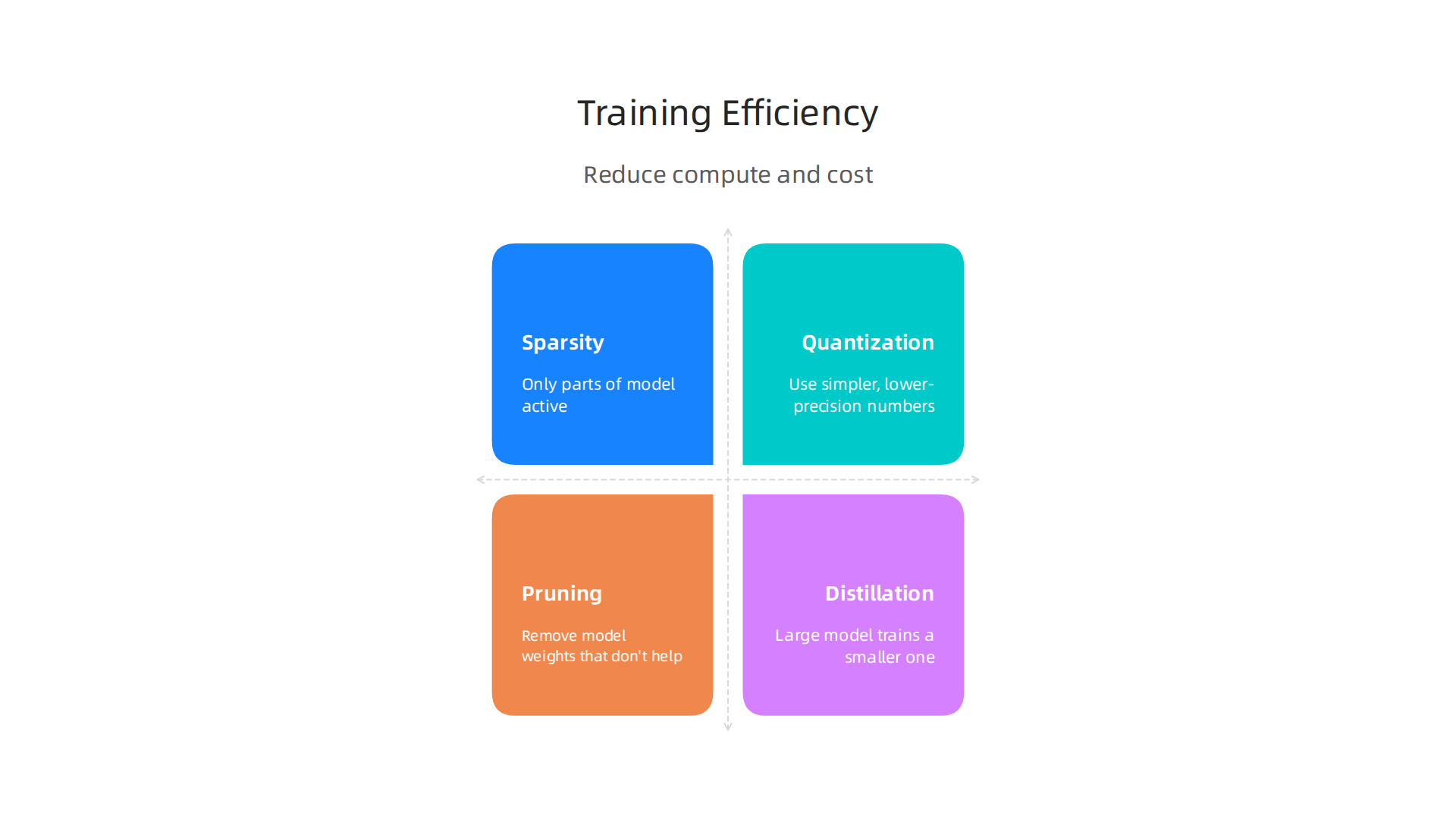
- Sparsity: Think of a big classroom where not every student needs to listen to every word at the same time. Sparsity means that only certain parts of an AI model are "active" or working on a task at any given moment. This saves computing power.
- Quantization: Computers usually use very precise numbers for their calculations. Quantization means using simpler, less precise numbers. This makes calculations faster and uses less memory, like using rounded numbers instead of decimals to do quick math.
- Pruning: Imagine a tree with too many branches. Pruning means cutting off the branches that aren’t very useful. In AI, this means removing parts of the model that don’t help much with its job, making the model smaller and faster without losing too much ability.
- Distillation: This is like a smart teacher sharing their knowledge with a new student. A large, complex AI model (the teacher) can teach a smaller, simpler AI model (the student) how to do tasks well. The small model then learns to be nearly as good as the big one but is much faster and cheaper to use.
These methods are crucial for making advanced artificial intelligence and machine learning available to more businesses. They help cut down the massive costs tied to creating generative AI. For companies looking into an ai overview and how to get real results, efficiency is key.
The Big Role of Data
No matter how powerful your computers are or how clever your efficiency tricks, good data is the most important ingredient for training AI.
- Dataset Curation: This means carefully choosing, cleaning, and preparing the information the AI will learn from. It’s like making sure a student gets a well-organized and correct textbook, not just a pile of random papers. High-quality data leads to high-quality AI.
- Synthetic Data: Sometimes, getting enough real-world data can be hard or expensive. That’s where synthetic data comes in. This is data that is created artificially, but it looks and acts like real data. It can be a big help for training AI, especially when privacy is a concern or when certain types of data are rare.
- Operational Realities: Running these large training projects is a huge undertaking. It involves managing vast amounts of data, hundreds or thousands of powerful computers, and making sure everything works together without problems. This requires careful planning and skilled teams to handle the complexities. For businesses, having AI-ready data is a strategic priority in 2026 to make sure their AI projects succeed.
The combination of scaling laws, smart efficiency methods, and careful data management helps companies build powerful artificial intelligence and machine learning models that can truly make a difference. As leaders, understanding these aspects is essential for strategic decision-making in the world of AI.
After building powerful artificial intelligence and machine learning models, the next big step is to make sure they actually work well. It’s like building a new car: you can put in a great engine and design it smartly, but you still need to test it on the road to ensure it’s safe and performs as expected. For AI, this means careful evaluation and benchmarking.
Evaluation & benchmarks: metrics, robustness, and real-world validation
Checking how well an AI model works is super important. We need to know if it does its job, if it’s fair, and if it can handle unexpected problems. This is called evaluation.
How We Check AI: The Evaluation Strategy
When we test an AI, we look at a few key things:
- Task-Specific Metrics: This means setting clear goals for what the AI should do. For example, if an AI is supposed to find cats in pictures, we count how many cats it found correctly and how many it missed. Before you even start testing, you need to decide what "success" looks like, using 3 to 5 main ways to measure it that are tied to real business goals or how users will experience the AI LLM Evaluation: The Complete 2026 Guide to Metrics, Frameworks, and …. Different AI jobs need different ways to measure if they are doing well.
- Robustness Testing: AI models don’t always see the world perfectly. Sometimes the information they get can be a little different from what they learned from, or even tricky. Robustness testing checks if the AI still works when:
- Distribution Shifts: The "new" data looks a bit different from the "old" data it was trained on. Imagine an AI that learned about cats from sunny pictures. What if it suddenly sees cats in rainy pictures? It should still be able to find them.
- Adversarial Attacks: These are like trying to fool the AI on purpose. Someone might make tiny, invisible changes to an image or text that a human wouldn’t notice, but they could trick the AI into making a big mistake. Robustness tests make sure the AI is strong against these clever tricks.
- Human-in-the-Loop Validation: Even the smartest AI needs a human eye sometimes. This means real people check the AI’s work. For example, after a generative AI creates a story, a person might read it to make sure it makes sense and is helpful. In 2026, many experts believe that having humans and AI work together to solve tasks (called "centaur evaluations") gives a better picture of how well the AI really performs in the real world Technical Performance | AI INDEX REPORT 2026. This mix of automatic checks and human checks helps ensure quality and safety.
Benchmarks: Helpful or Misleading?
You often hear about AI models getting high scores on "benchmarks." These are like standardized tests for AI. They compare how different artificial intelligence and machine learning models perform on a set of common tasks.
- When Benchmarks Are Helpful: High scores on benchmarks can show that an AI model is very smart and capable in general. They give us a quick way to compare new models. For example, if a model scores well on many language tests, it probably understands and creates text very well. To truly be useful, an evaluation should combine 3-5 benchmarks that are very important for your specific work LLM Benchmarks 2026: MMLU, GPQA, SWE-Bench & ….
- When Benchmarks Can Be Misleading: Here’s the tricky part: just because an AI does well on a test doesn’t always mean it will be perfect in real life. Sometimes, benchmark tests don’t truly match how people will actually use the AI. In 2026, we see that AI systems can perform much worse in the real world compared to lab tests, sometimes costing 50 times more to get similar accuracy AI Benchmarks 2026: Top Evaluations and Their Limits. Also, some benchmarks can be "gamed," meaning an AI might learn to do well on that specific test without truly understanding the task. That’s why leaders need to look beyond just the scores and consider how the AI will work with real users and real business goals.
For businesses looking to use artificial intelligence and machine learning, understanding these evaluation methods is key. It helps you make sure the AI you invest in will actually deliver on its promises and truly help your company.

It also helps in building AI ethics for leaders by ensuring models are fair and safe.
Want to keep up with the latest in AI?
The AI Newsletter Worth Reading
Once you know your artificial intelligence and machine learning models are working well through careful testing, the next big step is to put them into action. This means getting them ready for everyday use and making sure they keep performing as expected over time. It is all about smoothly moving from a tested model to one that is helping people or businesses in the real world.
Deployment and Operations: Inference, Monitoring, and Lifecycle Management
Putting AI to work means handling a few important things like how the AI makes decisions, how fast it works, and how to keep it running well day after day.
Getting AI to Work: Inference Architectures
When an artificial intelligence and machine learning model is used to make a prediction or a decision, that is called "inference." It’s when the AI takes new information and applies what it learned to give an answer.
How you set up your AI for this work is called its "inference architecture." Think of it like deciding how to set up a kitchen. Do you need one big stove for many meals at once, or several small stoves for quick, individual dishes?
- Speed (Latency) vs. Workload (Throughput):
- Latency is how fast the AI gives one answer. For things like self-driving cars, you need very low latency, meaning instant decisions.
- Throughput is how many answers the AI can give in a certain amount of time. For checking thousands of emails for spam, you care more about throughput.
Sometimes, you have to choose between getting one answer super fast or getting many answers less quickly. This is a trade-off. In 2026, companies are always looking for ways to make AI inference more efficient, especially with large language models Inference-Time Compute Scaling: From Thinking Budgets to … – Zylos.
- Cost Models for Production ML: Running AI models can cost money, especially if they are complex or used often. You pay for the computer power needed to make all those predictions. Businesses need to think about these costs. Strategies like using "Mixture of Experts" (MoE) models are helping large AI labs lower their inference costs in 2026 How Much Runway Do Scaling Laws Have Left? A 2026 Deep Dive | SmallFireDragon Lab. Finding the right balance between how well the AI works, how fast it works, and how much it costs is key for success.
Keeping AI Healthy: Monitoring and Lifecycle Management
Once an AI model is deployed, the work doesn’t stop. You need to constantly watch it to make sure it is still doing a good job. This is where monitoring and observability come in.
- Monitoring and Observability: This means keeping a close eye on your AI. Are its answers still accurate? Is it running into errors? Are there any unexpected changes in how it performs? Good monitoring helps you spot problems early.
- Drift Detection: The world changes, and so does the information AI sees. For example, an AI that helps you pick stocks might perform differently if the economy suddenly shifts. When the real-world data starts to look different from the data the AI learned from, it’s called "data drift" or "model drift." Spotting this drift is super important because it can make your AI less useful over time. If you notice your AI ready data is changing, it’s a sign your model might need an update.
- Incident Response: Sometimes, despite your best efforts, AI models can go wrong. They might start giving bad answers or stop working entirely. Having a plan for what to do when this happens (an incident response plan) is vital. This plan helps teams fix problems quickly and keep the AI running smoothly again.
Managing the entire lifecycle of an AI model, from its creation to its deployment and ongoing care, is a continuous job. It ensures that the artificial intelligence and machine learning investments continue to provide real value to your business.
Once your artificial intelligence and machine learning models are working well, you also need to make sure they are used in a good and safe way. This is where rules, safety checks, and government guidelines come in. It is all about making sure the powerful tools of artificial intelligence and machine learning bring good opportunities without big risks.
Governance, safety, and regulatory expectations: aligning risk and opportunity
Using AI safely and correctly is a big deal in 2026. Companies need plans in place to make sure their AI systems are fair, private, and don’t cause harm. This includes setting up rules, checking things often, and following new laws.
Rules for Safe AI: Governance Frameworks
Think of AI governance as the set of rules and steps a company uses to manage its artificial intelligence and machine learning tools responsibly. It helps guide how AI is used, from big decisions to everyday tasks. Good governance makes sure AI is safe, open, and used in a way that people can trust AI Governance Framework in 2026: Responsible AI & Data ….
Important parts of these rules include:
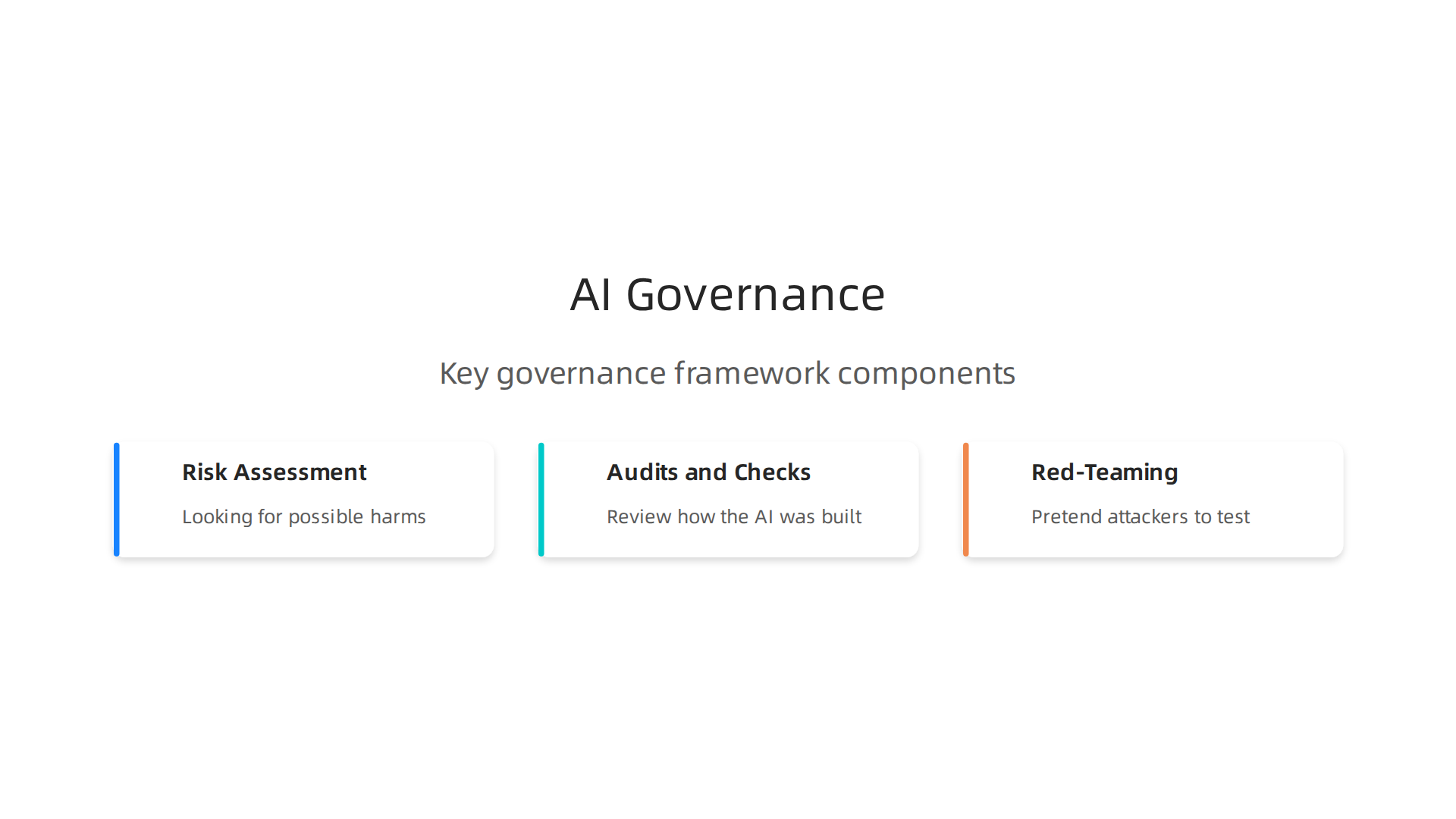
- Risk Assessment: This means looking for possible problems or harms that an AI could cause. For example, could it make unfair decisions? Could it share private information by mistake? Finding these risks early helps fix them.
- Audits and Checks: Just like a business gets its money checked, AI systems need to be audited. This involves carefully looking at how the AI was built, how it makes choices, and if it follows all the rules. It is a way to prove that the AI is working as it should.
- Red-Teaming: This is like having a team of "good guys" pretend to be "bad guys" to test the AI. They try to find ways the AI could be tricked or misused. This helps make the AI stronger and safer before it goes out to everyone.
Many companies in 2026 look to frameworks like the NIST AI Risk Management Framework from the US and ISO 42001. These frameworks help businesses set up their own rules for AI safely. They help connect how AI is built and used with how a company runs its business and follows the law 7 AI Governance Frameworks You Should Know in 2026 ….
New Laws for AI: Regulatory Expectations
The world is quickly catching up with artificial intelligence and machine learning. More and more governments are creating laws about how AI can be used. This means businesses must be ready to follow these new rules.
- Preparing for Compliance: In 2026, experts predict that AI governance will move from just general ideas to real rules that must be followed How AI will redefine compliance, risk and governance in 2026. Laws like the EU AI Act in Europe and specific laws in places like Colorado are setting new standards. Companies need to know what these laws require and make sure their AI systems meet those standards. This often means keeping a clear list of all AI systems and understanding their risks.
- Managing Reputation: Beyond just following the law, how a company handles AI can affect what people think of it. If an AI system is found to be unfair or harmful, it can damage a company’s good name. Being open about how AI works and having strong safety plans can help build trust and protect a company’s reputation. Establishing good AI ethics for leaders is a key part of this.
To stay on top of these fast changes, leaders must keep learning. The world of AI, machine learning, and generative AI news moves incredibly fast. Getting the right information can help you make smart choices for your business.
Stay informed about the fast-moving world of AI with concise, daily updates.
The AI Newsletter Worth Reading
Summary
This article is a practical guide to the advanced parts of artificial intelligence and machine learning that matter to executives and technical leaders in 2026. It explains core theoretical frameworks—probabilistic reasoning, optimization, and information‑theoretic views—and shows how modern systems learn useful internal representations (embeddings, transformers, graphs, sparse formats) and why that matters for performance and interpretability. The guide covers the realities of training at scale, including scaling laws, the role of high‑quality and synthetic data, and efficiency levers like sparsity, quantization, pruning, and distillation to reduce cost. It then walks through rigorous evaluation and benchmarking approaches, robustness testing, and the need for human‑in‑the‑loop validation to avoid being misled by lab results. Finally, it lays out production concerns—inference architectures, latency vs throughput tradeoffs, monitoring, drift detection, incident response—and governance expectations, such as risk assessments, audits, red‑teaming, and compliance with emerging regulation. After reading, leaders will better judge AI investments, ask the right evaluation questions, plan deployments, and set governance to manage risks while unlocking value.