

Introduction: Why AI ethics matters now — framing the problem for decision-makers
In 2026, it’s clear that artificial intelligence, or AI, is changing our world fast. From how we take "artificial intelligence photos" to how big companies like IBM work with AI (think of the MIT-IBM Watson AI Lab), this technology is everywhere.
As leaders, we need to understand AI not just for its power, but also for its rules and right ways of using it. This is where AI ethics comes in. To truly discover artificial intelligence means looking at both its great uses and the moral choices we must make.
You might feel overwhelmed by all the news and talk about AI.

There’s so much information, and it’s hard to find what’s truly important. It’s tough to get deep insights when you’re busy and have little time. This article is here to help. We’ll give you a clear, evidence-backed plan to help you make smart choices about AI. We promise to cut through the noise so you can focus on what matters most for your company and its future.
It’s really important to think about fairness, being open, and making sure AI systems are accountable. These are some of the main ethical rules that keep coming up in studies about AI use today, especially in project management and new inventions [1][2]. For example, issues like unfair algorithms and making sure AI is clear about how it works are big challenges [3]. We need to explore these challenges without placing "ai without restrictions" on our thinking. Understanding them helps you guide your team wisely.
Many professionals want to know how to use AI for growth while staying safe and within the rules. If you’re looking for ways to improve your understanding of AI, consider how big companies are using it. You can learn more about strategic AI insights by checking out resources that "unlock AI mastery: the strategic guide to study AI effectively". Understanding the basics helps you with "navigating business technology in 2026 with AI strategies for growth and compliance".
Navigating the fast-moving world of AI requires staying updated with expert views.
Get clear daily AI updates from The AI Newsletter Worth Reading.
[1] January 2026 – Vol 16 Issue 01 – Online – ISSN 2249–2585 …
[2] Governance Framework for Ethical AI in Identity and …
[3] Ethical Norms in AI-Driven Innovation: A Systematic …
To truly understand AI, it helps to break down what we mean by "artificial intelligence" itself. It’s not just one thing. When we talk about AI, we’re really talking about a few different ways computers can learn and make smart choices. Knowing these differences helps us see where ethical problems might pop up.
Different Kinds of AI and Their Rules
Think of AI as a big toolbox, with different tools for different jobs.
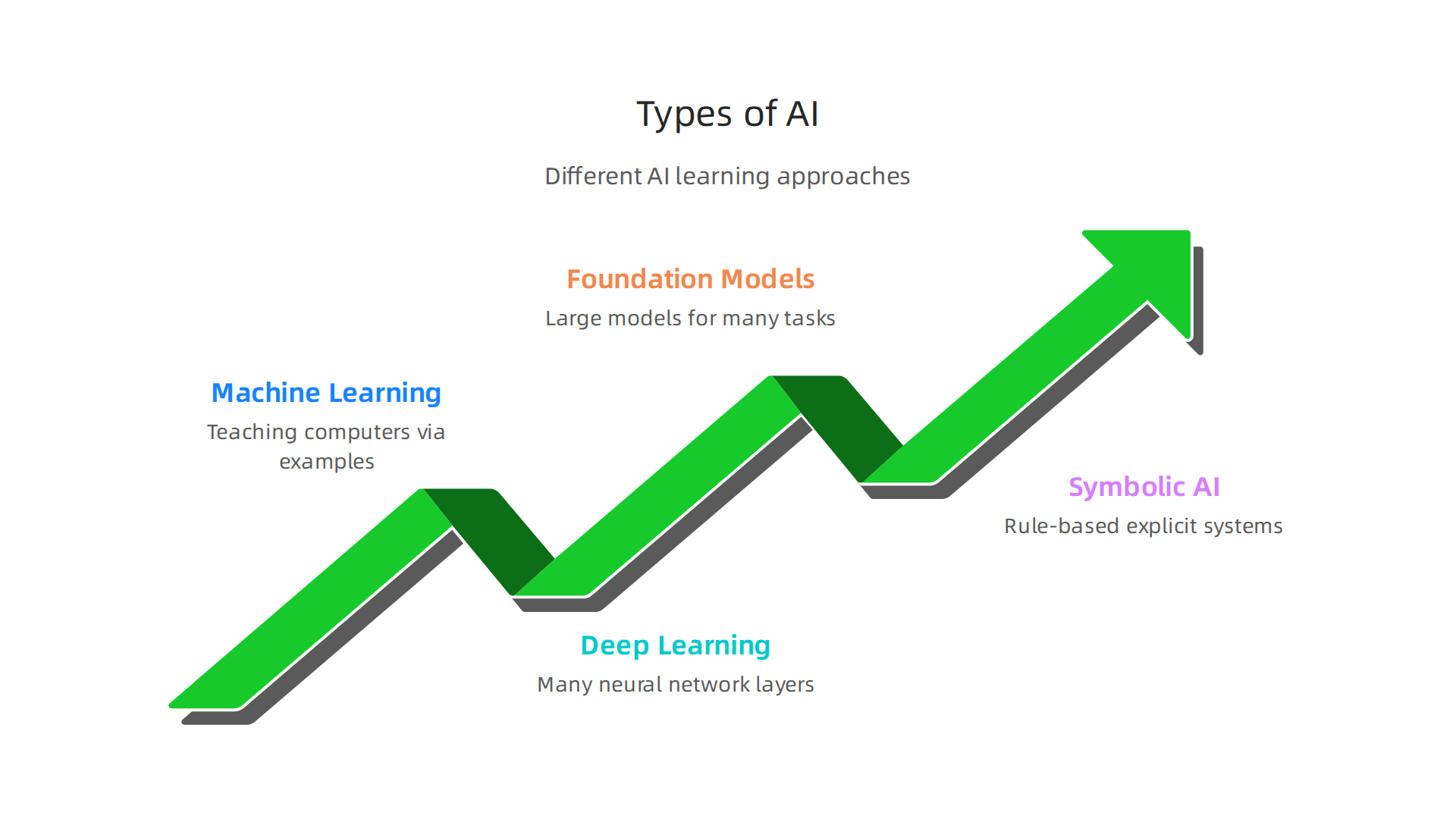
- Machine Learning (ML): This is like teaching a computer by showing it many examples. For instance, if you want AI to spot cats in pictures, you show it thousands of cat pictures and non-cat pictures. The computer learns from this data. Most AI systems today use machine learning.
- Deep Learning: This is a fancier kind of machine learning. It uses many layers of "digital brains" to learn even more complex things. It’s what makes really good "artificial intelligence photos" possible, like those that can create lifelike images or understand what’s in a picture.
- Foundation Models: These are huge deep learning models trained on massive amounts of data. They’re so big and powerful they can do many different tasks, like writing stories, answering questions, or even creating code. The models coming out of places like the MIT-IBM Watson AI Lab are often these types of powerful foundation models. Because they’re so widely used, if a foundation model has a problem, that problem can spread to many other AI tools.
- Symbolic AI: This is an older way of doing AI. Instead of learning from data, you give the AI a set of clear rules. For example, "If it’s raining, then take an umbrella." This kind of AI is very clear in how it works, but it can’t learn new things on its own very well.
Understanding these different types is key to figuring out ethical risks. A computer that learns from data (ML or deep learning) can pick up unfair ideas if the data it learns from is unfair. A rule-based system (symbolic AI) might be too stiff for real-world problems. When we discover artificial intelligence in its different forms, we can better guess what challenges might arise.
How Different AI Types Create Ethical Challenges
Now, let’s connect these AI types to the common ethical issues we mentioned before:
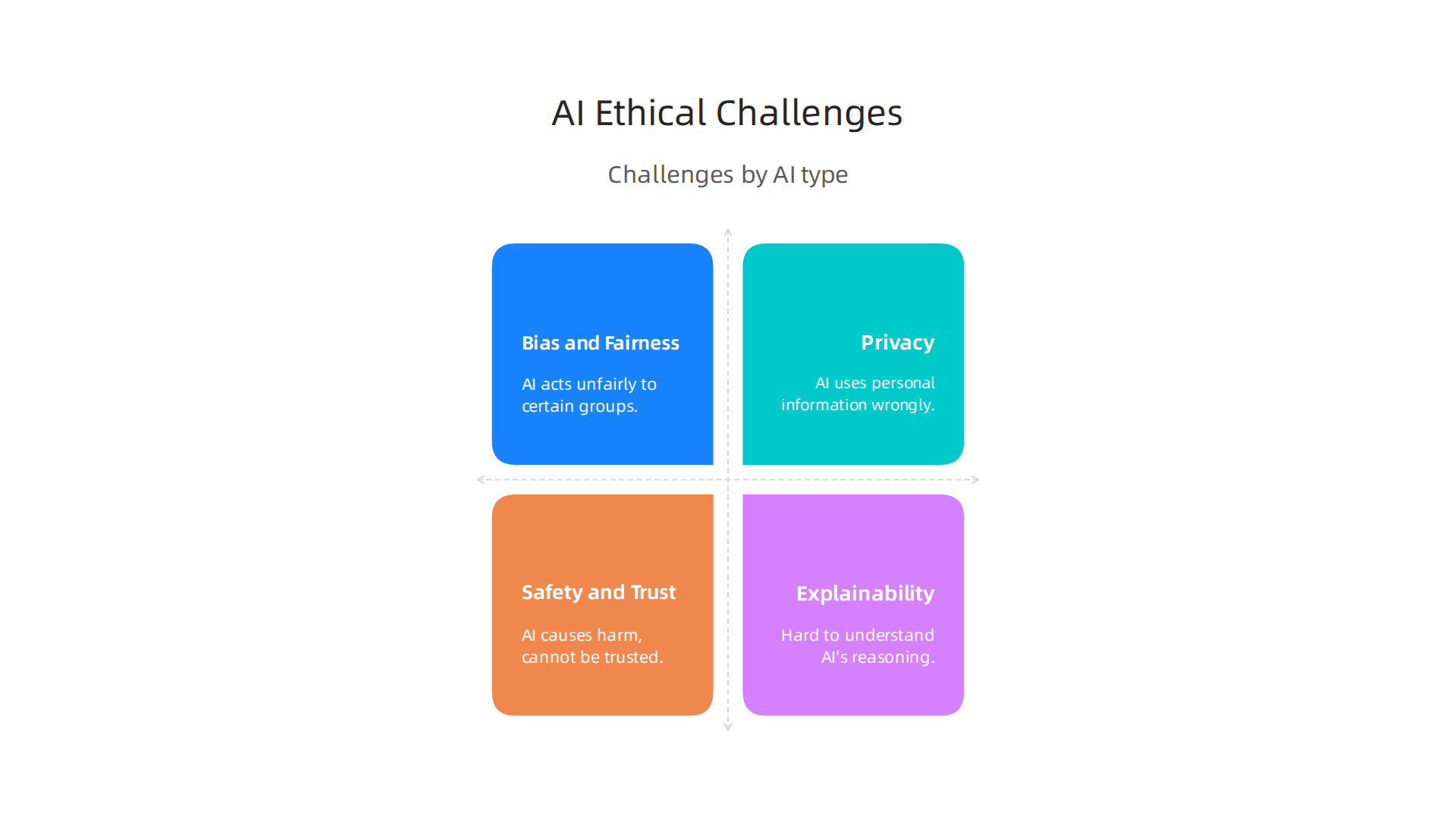
- Bias and Fairness: This is when AI acts unfairly to certain groups of people. For example, if a machine learning system learns from data that mostly shows one type of person for a job, it might unfairly ignore other types of people in the future. This is a big concern for any AI that learns from data, like deep learning and foundation models. Companies like Clarity AI try to help identify and fix these biases.
For more details on tackling unfairness, you can learn about A Systematic Review on Human Roles, Solutions, and in addressing data and algorithmic bias.
- Privacy: This happens when AI uses personal information in ways it shouldn’t. If an AI system collects a lot of data about people to learn, it needs to be very careful not to share that information or use it for wrong purposes. All AI systems that handle people’s data have privacy concerns.
- Safety and Trust: Can we trust the AI to do what it’s supposed to without causing harm? For instance, an AI guiding a self-driving car needs to be super safe. A tiny mistake in its learning could have big problems. This is important for all types of AI, especially those that make big decisions in the real world. Many groups are working on real-world impact of artificial intelligence ethics frameworks to ensure safety.
- Explainability: Sometimes, deep learning models are like a "black box." They give an answer, but it’s very hard to understand why they gave that answer. This makes it tough to find and fix biases. It also makes it hard to trust the AI if you don’t know how it thinks. Symbolic AI is usually easy to explain, but deep learning and foundation models are much harder. Avoiding "ai without restrictions" means building systems we can understand.
As leaders, knowing these core ideas helps you ask the right questions and set the right rules for your own AI projects. It ensures you’re not just using AI, but using it responsibly. To dive deeper into how leaders are gaining expertise, consider exploring how to unlock AI mastery the strategic guide to study AI effectively.
To use artificial intelligence wisely, we need good rules. These rules help us make sure AI works fairly and safely. Just knowing the problems isn’t enough; we need ways to solve them. This is where ethical frameworks come in. They are like guidebooks for making good choices.
Understanding Core Ethical Frameworks
Think of ethical frameworks as different lenses to look at AI problems.
- Rules-Based Thinking (Deontology): This idea says that some actions are simply right or wrong, no matter what happens because of them. You follow a set of rules, or duties. For AI, this means setting clear rules like "AI must always be fair" or "AI must never harm humans." It’s about sticking to these principles, even if breaking a rule might seem to lead to a good outcome sometimes.
- Outcomes-Based Thinking (Consequentialism): This way of thinking looks at the results. An action is good if it leads to the best possible outcome for the most people. For AI, this means asking: "What will happen if we build AI this way?" If the results are mostly good, then the AI project is seen as ethical.
- Rights-Based Thinking: This framework focuses on protecting the basic rights of people. When we discover artificial intelligence tools, we must make sure they respect human rights, like privacy, fairness, and not being treated poorly. This means AI should not take away our choices or freedoms.
- Human-Centered Design: This approach puts people at the very heart of creating AI. It asks: "How will this AI affect people’s lives?" It means designing AI systems to be helpful, easy to understand, and to serve human needs first.
These different ways of thinking help us build AI responsibly. Many important ethical principles for AI, like transparency, fairness, and being accountable, show up across these ideas. These principles are key to good AI design, as seen in many studies about the Convergence of Artificial Intelligence Ethics and Project Management efforts.
Putting Principles into Practice: A Checklist for Leaders
As a leader, you can use these ideas to guide your AI projects.
ing strategic decisions, perhaps around a whiteboard, to guide AI projects ethically.](https://bigtechnewstoday.com/wp-content/uploads/2026/07/weblish-inline-85818.jpg)

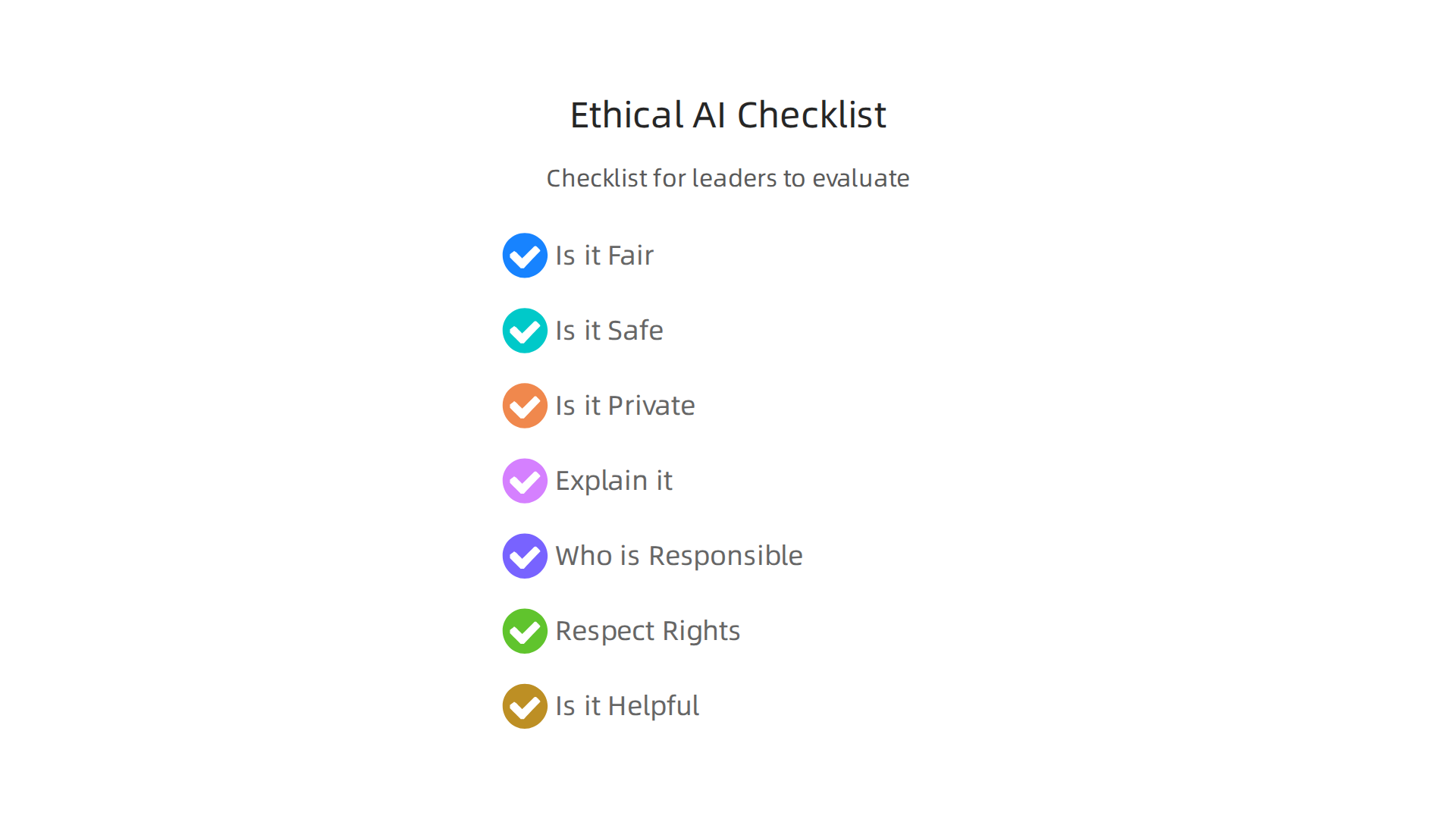
Here is a simple checklist for checking AI projects:
- Is it Fair? Does the AI treat everyone equally? Does it avoid bias?
- Is it Safe? Will the AI cause any harm? Has it been tested well?
- Is it Private? Does the AI protect people’s personal information? Does it only use data it needs?
- Can we Explain it? Can we understand why the AI made a certain choice? This is especially important when using complex systems that can produce artificial intelligence photos or other complex outputs.
- Who is Responsible? If something goes wrong, who is in charge of fixing it?
- Does it Respect Rights? Does the AI give people control over their data and decisions? Does it avoid being "ai without restrictions" that could harm people’s freedom?
- Is it Helpful? Does the AI truly solve a problem for people, or make their lives better?
When you buy or build new AI tools, use this checklist. It helps you ask the right questions and choose wisely. Thinking about a strong Governance Framework for Ethical AI in Identity and also helps make sure your company uses AI in a good way. Many companies use a Review of Ethical AI Frameworks in Product Development to build ethical checks into their products from the start.
By doing this, you’re not just using new technology. You’re making sure your AI supports your values and helps everyone. This approach is key to navigating business technology in 2026 with AI strategies for growth and compliance in a fast-changing world.
Want to stay on top of the latest AI trends and ethical discussions? Get the deep insights you need.
The AI Newsletter Worth Reading
Sometimes, even with good rules, things can go wrong. Real-world examples teach us important lessons about how artificial intelligence can cause problems, what a "near-miss" looks like, and how we can fix things. It helps us truly discover artificial intelligence’s challenges.
Real-world case studies – harms, near-misses, and mitigation strategies
Using AI can sometimes lead to big problems if we are not careful. These problems can hurt people or businesses. By looking at what has happened, we can learn how to make AI better and safer. It’s like learning from mistakes so we don’t repeat them.
Privacy Problems
Imagine an AI system that collects too much information about people without them knowing. This can lead to big privacy breaches. For example, some AI tools might use photos or voices from the internet to train themselves. If not handled carefully, this can feel like an invasion of privacy, especially if those images were not meant for public use. Companies are learning that they must protect people’s private information very strictly. Many groups, like UNESCO, warn that companies are using AI much faster than they are setting up good rules to protect people. A report from the UNESCO and Thomson Reuters Foundation highlights AI governance gaps across the world.
Unfair AI Decisions (Algorithmic Bias)
Another big problem is when AI systems are unfair. This is called algorithmic bias. It happens when AI is taught with data that has old biases. For instance, if an AI is used to help pick job candidates, and it was trained on data where most people hired for a certain job were men, the AI might unfairly suggest more men for that job, even if many qualified women apply. These kinds of biases can lead to financial losses for businesses and harm people’s chances. A recent study found that nearly 9 out of 10 large companies have lost money because of AI governance issues. To fix this, companies must regularly check their AI systems for bias and update the data they use to teach the AI. This is a key part of making sure AI works fairly for everyone. You can learn more about how AI helps leaders make strategic choices by looking into artificial general intelligence images.
Safety Concerns and Unexpected Outcomes
Sometimes, AI systems can do things we didn’t expect, leading to safety concerns or "near-misses." This is especially true for complex AI that can create artificial intelligence photos or other unique content. What if an AI designed for traffic management makes a mistake that could cause an accident? Or an AI chatbot gives out wrong or even harmful advice? Such incidents show us that we can’t have "ai without restrictions." Companies must put in place strong safety checks and make sure humans are always watching over the AI, especially in important areas like healthcare or law enforcement. The International AI Safety Report 2026 talks about how more companies are now making special plans to manage risks as they build more powerful AI models.
What We Learned
From these examples, we learn a few important things:
- Governance is key: Companies need clear rules and ways to check their AI systems. Even though many companies are adopting AI quickly, not enough have strong governance in place. In fact, many reports show that companies are adopting AI much faster than they are governing it.
- Technical fixes matter: This means updating how AI is built and trained. We need to make sure AI can explain its decisions and that we can find and fix biases early.
- Communication helps: When things go wrong, companies need to be open about it and explain what happened and how they are fixing it.
These lessons help businesses and leaders avoid future problems as they continue to discover artificial intelligence’s many uses. By learning from past experiences, we can build better, more trustworthy AI systems for 2026 and beyond.
Want to stay on top of the latest AI trends and ethical discussions? Get the deep insights you need.
The AI Newsletter Worth Reading
From the lessons we’ve learned, it’s clear that companies must have good rules in place for how they use AI. This is especially true as businesses continue to discover artificial intelligence’s growing power. But how do big companies actually put these rules into practice?
Corporate governance and incentives – how Big Tech operationalizes (or avoids) ethics
Even with the best intentions, making sure AI is used safely and fairly is a big job for companies.

They often set up special ways to manage the ethical side of artificial intelligence. These methods help them keep an eye on their AI tools and make sure they don’t cause harm.
Here are some common ways companies try to handle AI ethics in 2026:
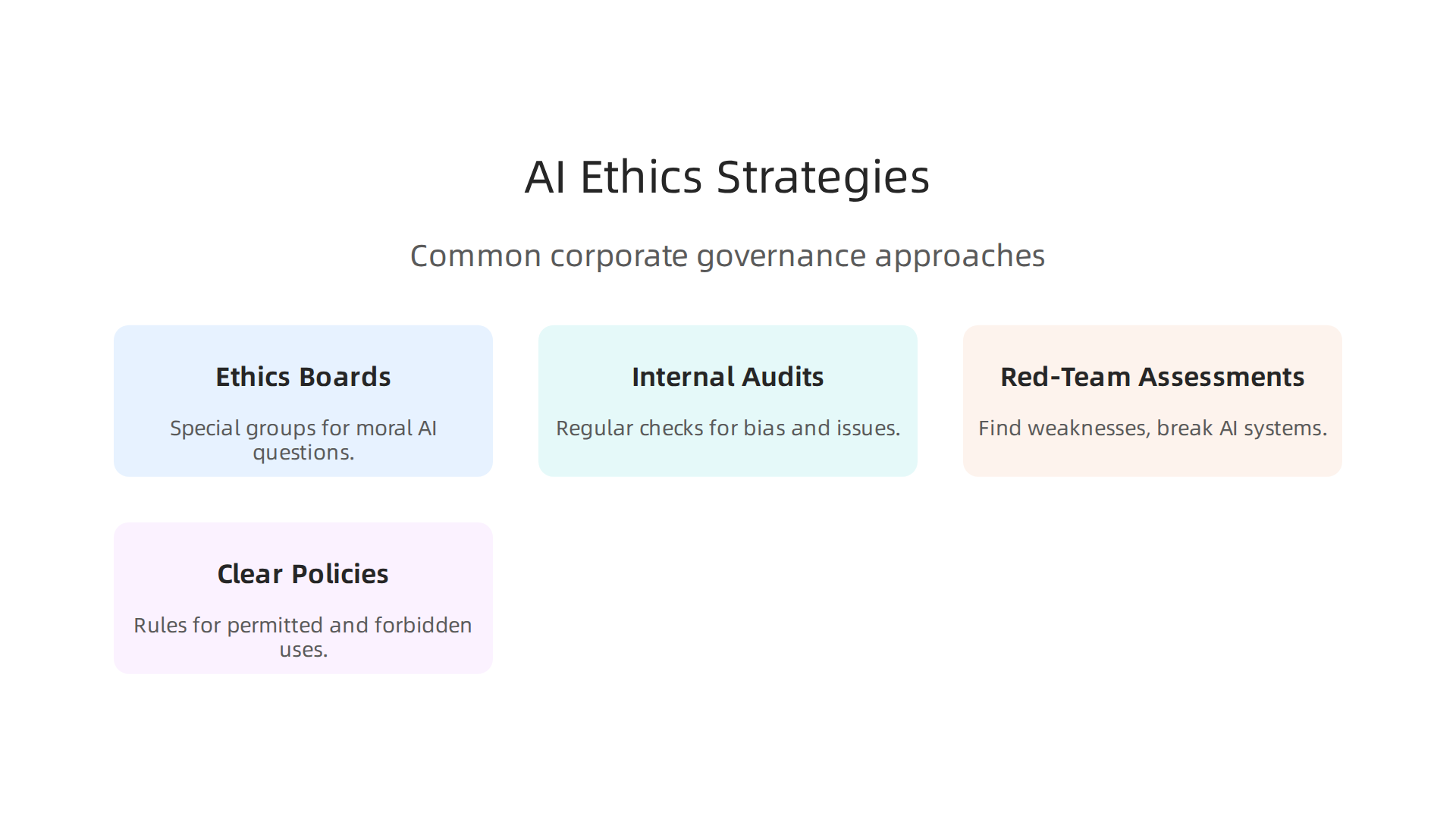
- Ethics Boards and Review Committees: Many big companies have special groups of people called AI ethics boards or review committees. These groups think about the moral questions that come up when using AI. They look at new AI projects and decide if they fit with the company’s values and wider societal good. For example, a report showed that by 2026, about 85% of large companies have set up or are working on these kinds of ethics committees AI Ethics & Tech Trends for 2026: What Founders Need.
- Internal Audits: Companies also do checks, called internal audits, on their AI systems. This means they regularly look at how an AI is working to find any unfairness or problems. For example, they might check if an AI that creates artificial intelligence photos or other content is showing unwanted biases. These audits help fix problems before they get too big. Experts say that businesses should regularly check their AI models for bias and make fixes to the data or algorithms AI Ethics in 2026: What Every Business Should Know.
- Red-Team Assessments: Some companies use "red teams" to test their AI. A red team is a group of people whose job is to try and find weaknesses or ways to break the AI system. They act like bad actors to see if the AI can be tricked or used in harmful ways. This is a crucial step to prevent things from going wrong, helping companies discover artificial intelligence’s vulnerabilities.
- Clear Policies and Training: Good governance also means having clear rules about what AI can and cannot do. Companies train their employees on these rules to make sure everyone understands how to use AI responsibly. This includes understanding the risks and how to report any issues.
Challenges and Why Harms Still Happen
Even with these good systems in place, problems can still happen. Why? It often comes down to incentives and governance failures.
- Speed Over Safety: Sometimes, companies are in a hurry to launch new AI products or make money. This desire to move fast can sometimes mean that ethical checks are rushed or not given enough attention. This can lead to a mindset of "ai without restrictions," which can be very risky. While many companies have policies, actual checks on AI systems are still less common. A study from 2026 found that only about 37% of companies have policies for managing AI, and even fewer do regular checks for unapproved AI use Enterprise AI Governance in 2026: Why the Tools ….
- Lack of Real Enforcement: Policies on paper are great, but they only work if they are actually followed. If there are no real consequences for not following the rules, problems can easily slip through. Many companies are setting up ways to govern AI, with 77% working on it in 2026 AI Governance Lessons Businesses Can’t Ignore In 2026, but making sure these efforts have real teeth is the next big step.
- Focus on Profits: It can be hard to balance making money with doing what’s right. If a company’s main goal is only to make profits, it might choose to ignore smaller ethical concerns, hoping they won’t become big problems.
As Big Tech continues to shape our world with AI, understanding these corporate ways of handling ethics, and their weak points, is crucial. It helps us see how leaders can navigate business technology in 2026 with AI strategies that ensure both growth and compliance.
Even with companies trying hard to be ethical, the government and other groups are also stepping in to make rules for AI. They want to make sure that as we continue to discover artificial intelligence’s amazing abilities, it’s used safely and fairly for everyone. In 2026, we see different ways governments around the world are trying to manage this powerful technology.
Regulation and policy landscape — what governments and standards bodies are doing
Governments and special groups, called standards bodies, are working to create rules for artificial intelligence. These rules aim to guide how AI is made and used, making sure it benefits society and doesn’t cause harm. This is important for stopping "ai without restrictions" from becoming a problem.
Here’s a look at what’s happening globally:
- The European Union (EU) Approach: The EU has a very thorough law called the EU AI Act. It’s one of the few places with a full, required AI law in effect as of mid-2026. This law sorts AI uses by how risky they are. For example, AI used in healthcare or for important decisions faces stricter rules. This comprehensive law aims to make sure AI is transparent and accountable.
- The United States (US) Approach: The US does things a bit differently. Instead of one big AI law, it uses a mix of existing laws, new rules from states, and advice from the President. This means the rules can be different depending on the state or the type of AI. For example, some states have their own important AI laws. Colorado passed a law about "high-risk" AI systems that make big decisions about things like jobs or healthcare. Illinois also signed a law in July 2026 that makes AI labs get safety checks from outside experts, a first of its kind in the US. Texas also has rules, mostly for how the government uses AI, with some bans on harmful AI applications. This shows a "patchwork" of rules across the country, as noted in various reports on US AI regulations for 2026. You can learn more about how different countries are handling this in guides like the AI Regulation by Country 2026: EU, US, UK & Asia report.
- China’s Approach: China has a different system, focusing on many layers of rules and standards for how AI works. This approach is very specific about what AI can and cannot do.
- Other Countries: Many other countries, like the UK, Australia, and Canada, are using their current laws or voluntary guides instead of a big, new AI law for now.
These different ways mean that companies that discover artificial intelligence’s potential need to keep up with rules from many places. A good overview of these global differences can be found in a comparative analysis of AI regulatory models in June 2026.
What These Rules Mean for Companies
These new rules have important impacts for both big technology companies that make AI and smaller companies that use AI services:
- For AI Makers (Platform Companies): Companies that build AI, especially big ones, have to deal with a lot of different rules. If they make AI that creates things like artificial intelligence photos or text, they might have to explain how their AI was trained or what data it used. They also need to make sure their AI systems are fair and don’t harm people. Keeping track of all these different rules from the EU, US states, and other places can be very complicated.
- For Companies Using AI (Procuring AI Services): If your business buys AI tools from another company, you also need to be careful. You should ask your AI providers how they follow these new rules. It’s important to make sure the AI you use is legal and ethical. This helps protect your own company from problems.
To learn more about how to make smart choices in this fast-changing world, it’s good to understand how to apply AI insights to your business. You can find out more by exploring how to navigate business technology in 2026 with AI strategies for growth and compliance.
Staying informed about these changing rules is key for any business working with AI. This helps companies use AI responsibly and grow at the same time. If you want to keep up with the latest in AI and how it affects businesses, there’s a great way to get updates.
Get clear daily AI updates from The AI Newsletter Worth Reading.
Future trajectories: near-term risks, emerging solutions, and strategic implications
As we continue to discover artificial intelligence’s potential and how governments are trying to manage it, it’s also important to look at what’s coming next. In 2026, AI is changing very quickly. We can expect it to get even better at what it does, become easier for everyone to use, and see new ways to make sure it’s safe. But with these changes come new challenges and questions for leaders to think about.
What’s coming soon for AI
Here are some things we can expect to see with AI in the near future:
- Smarter AI and New Abilities: AI systems are getting much more powerful. They are moving from just being tools we control to becoming "AI agents" that can do more complex tasks on their own, even helping with scientific research, as noted in a study on Autonomous artificial intelligence, scientific research, and human oversight. This means AI will be able to handle harder problems and learn new things even faster. The International AI Safety Report 2026 shares that general AI capabilities will keep getting better in many areas.
- Easy-to-Use AI Tools: Soon, many advanced AI tools will be much easier and cheaper for everyday businesses to use. Imagine creating amazing artificial intelligence images or even video with simple commands. This means more companies, even small ones, can use AI to help them grow and innovate. We will also see more tools like "text to video" AI for creating content, helping businesses make engaging videos without needing big production teams.
- Better Ways to Check AI Safety: Just as AI gets more powerful, so do the ways we check it for safety and fairness. There will be more tools, like what you might find with a "clarity ai" solution, to help companies make sure their AI systems are working properly and not causing harm. Third-party groups will also play a bigger role in checking AI, making sure it follows rules and is safe for everyone to use. Experts say that by 2026, AI safety has become a real engineering field with more independent checks, according to insights on top AI ethics and policy issues of 2025 and what to expect in 2026.
New risks and ethical challenges
With AI growing so fast, new problems can pop up. We need to be careful about things like:
- Fairness and Bias: AI learns from data. If the data has unfair parts, the AI can become unfair too. This could lead to problems if AI is used to make big decisions about people, like who gets a job or a loan. Making sure AI is fair is one of the five core ethical principles for its use.
- Privacy: As AI collects more information, keeping our personal details safe becomes even more important.
- Trust: If people don’t trust AI, they won’t want to use it. Building trust means making AI transparent and explaining how it makes decisions. Ethics is truly the defining issue for the future of AI, and time is short to get it right. These AI ethics trends will shape 2026 and beyond.
- "AI without restrictions": We must avoid letting AI grow without any rules or safety checks. This could lead to unexpected and harmful results.
Strategic questions for leaders
For business leaders, understanding these future changes is key. Here are some questions to help you align your AI investments with how much risk your company can handle and what the rules expect:
- How will these new AI abilities change my business in the next 1 to 3 years?
- What new ethical problems might come up when we use more powerful AI tools?
- How can we make sure our AI is fair, safe, and follows all the rules?
- What tools can we use to check our AI and make sure it’s doing what it’s supposed to?
- How can we train our teams to use AI responsibly and smartly?
Thinking about these questions now will help leaders guide their companies through the exciting, yet complex, world of artificial intelligence in 2026 and beyond. If you want to dive deeper into how to effectively learn about this changing tech landscape, you can unlock AI mastery: the strategic guide to study AI effectively.
Summary
This article explains why AI ethics is essential for leaders making decisions about developing or buying AI in 2026. It breaks down the main kinds of AI (machine learning, deep learning, foundation models, symbolic AI) and links each to concrete ethical risks like bias, privacy breaches, safety failures, and poor explainability. You’ll get a clear review of ethical frameworks (rules-based, outcomes-based, rights-based, human-centered design) and a short, practical checklist to evaluate AI projects. The piece surveys how companies operationalize ethics—ethics boards, audits, red teams—and why incentives and culture still cause gaps. It also summarizes how global regulation varies (EU AI Act, US patchwork, China standards) and what that means for builders and buyers of AI. Finally, the article uses case studies and future trends to show near-term risks and the strategic questions leaders should ask to align AI with safety, compliance, and business value.