

Why ‘Study AI’ Matters Right Now (and How This Guide Helps)
In 2026, artificial intelligence, or AI, is everywhere. It is changing how we work, how we learn, and even how we play. This speedy progress means that understanding AI is more important than ever. Everyone, especially leaders and people who make big choices, needs to know what AI is and how it works.
The big problem is there is too much information out there. It’s like a huge puzzle with a million pieces. Trying to learn about AI can feel overwhelming, and it is hard to know where to start. You might have many AI questions and answers that you need simple answers for. This flood of news and new ideas can make it tough to figure out what truly matters for your business or your career.
Actually, AI is when computers can do smart tasks that usually need human thinking. This includes things like solving problems, learning new things, and making choices, as explained in one report from the University of Oviedo Artificial Intelligence (AI) and automation technologies. To truly benefit from this exciting computer systems technology, you need to study AI in a focused way.
This guide is made to help you do just that. We will give you a clear, easy-to-follow map to the most important parts of AI.

You won’t get lost in all the extra information. Instead, we offer a simple plan to grasp the main ideas, show you the best learning tools, and teach you smart ways to learn quickly. Our goal is to make sure you can study AI effectively, saving your precious time and helping you make smarter choices.
If you are feeling buried under too much AI news, there’s a simple way to stay on top.
Get clear daily AI updates by signing up for The AI Newsletter Worth Reading and get the insights you need without the information overload.
What is AI? Core Concepts Explained
To truly understand and begin to study AI, we first need to get a clear picture of what it is. Think of artificial intelligence as the big umbrella. Under this umbrella are different kinds of smart computer ideas. At its heart, AI is when computer systems can do tasks that normally need human brains. This includes seeing things, hearing sounds, understanding language, solving problems, and making choices. One way to look at it is as technology that lets machines copy many complex human skills, as explained in a review of AI fundamentals Fundamentals of Artificial Intelligence: A Review.
Let’s break down the main parts:
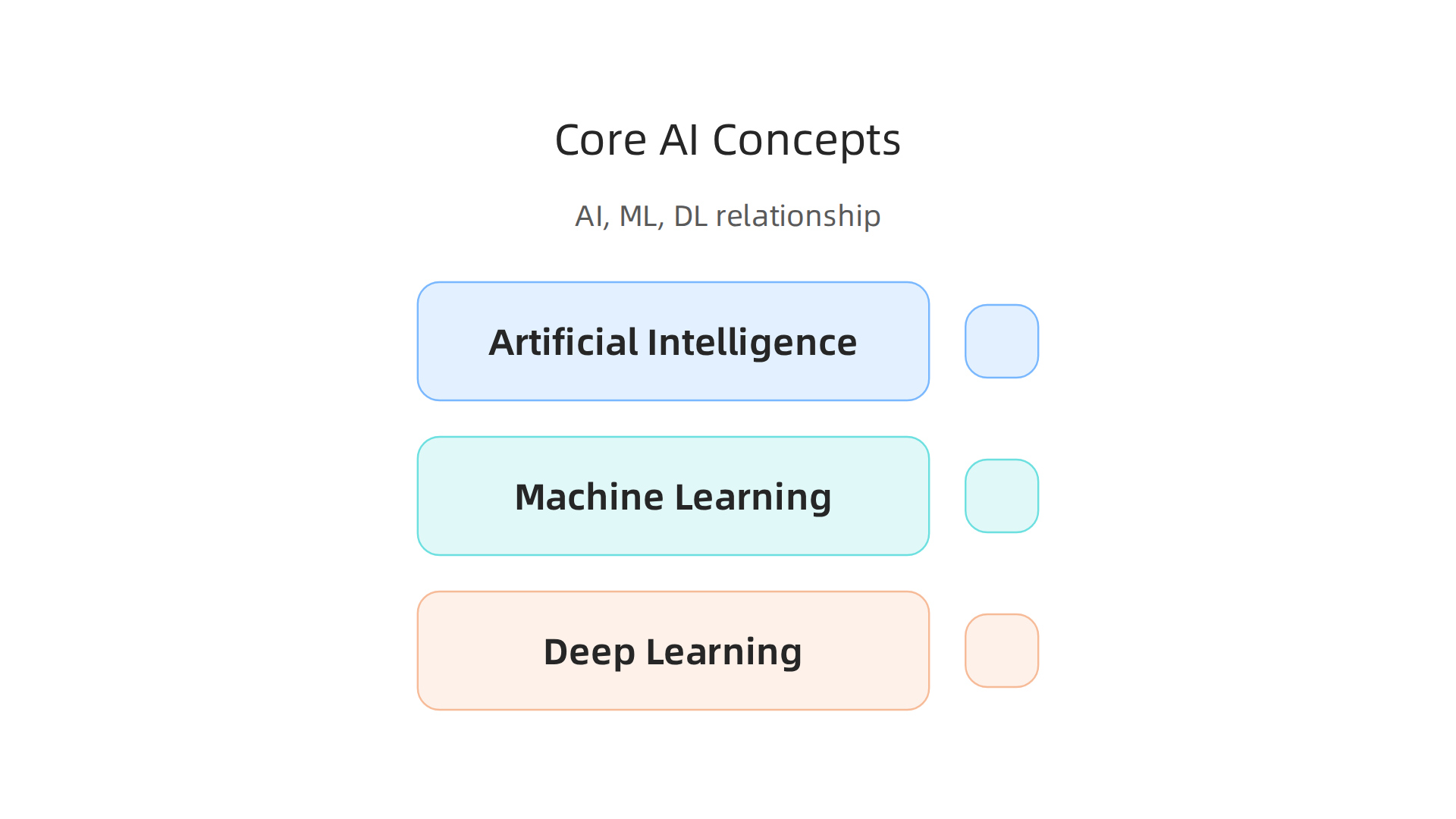
- Artificial Intelligence (AI): This is the widest idea. It’s about building machines that can "think" or act smart. This means they can look at their surroundings, process information, make decisions, and work towards goals, as noted in one official AI Watch report AI Watch. Defining Artificial Intelligence 2.0. Towards …. It’s the big field of making computers intelligent.
- Machine Learning (ML): This is a key part of AI. With machine learning, computers can learn from data without being told exactly what to do. Imagine showing a computer thousands of cat pictures and dog pictures. Over time, it learns to tell the difference itself. This kind of computer systems technology is all about finding patterns in data and making predictions. It’s a way for AI to learn and get better over time.
- Deep Learning (DL): This is a special type of machine learning. Deep learning uses big computer networks called neural networks. These networks are built a bit like the human brain, with many layers. This allows them to learn very complex things, like understanding speech or recognizing faces, as described in a detailed overview of AI standards CEN-CENELEC JTC21 AI Standards: Complete Detailed …. It’s behind many of the amazing AI tools we see today.
Models vs. Systems: What’s the Difference?
When you study AI, you’ll hear about "AI models" and "AI systems." It’s good to know the difference.
- An AI model is like the brain of the AI. It’s the part that has learned from data and can make predictions or decisions. For example, if you train an AI to write stories, the part that generates the story is the model.
- An AI system is the whole package. It includes the AI model, plus all the other computer programs and tools that make it work in the real world. So, for the story-writing AI, the system would include the model, plus the program that takes your prompt, sends it to the model, and then shows you the finished story. A well-built system often has many parts working together. One paper talks about how AI systems can be sorted by their task, what they take in, and how they are built 20250714_BL_Whitepaper_AI System Taxonomy_V2.
How AI Capabilities Differ
Different kinds of AI are better at different jobs.
- Simple AI might follow strict rules to do tasks, like a computer playing chess.
- Machine Learning is great for tasks where there’s a lot of data, and you want to find patterns, like suggesting what movie you might like next.
- Deep Learning shines at even more complex tasks, like understanding natural language or seeing things in pictures, because its networks can learn from huge amounts of raw data. This makes it a core technology for building very smart systems.
Understanding these basic ideas is the first step when you decide to study AI. It helps you sort through all the "AI questions and answers" you might have. Knowing these core concepts helps you see why certain AI methods are used for certain jobs and how they fit into the bigger picture of intelligent computer systems. You’ll quickly see that what people call "AI" can mean many things, from simple programs to highly advanced ones.
The world of AI is quite large, and within it are many special areas. Think of it like a big toolbox. Each tool is designed for a different job. If you decide to study AI, you will learn about these different tools. Knowing them helps answer many common AI questions and answers you might have. Let’s look at some key subfields and when they are most useful.
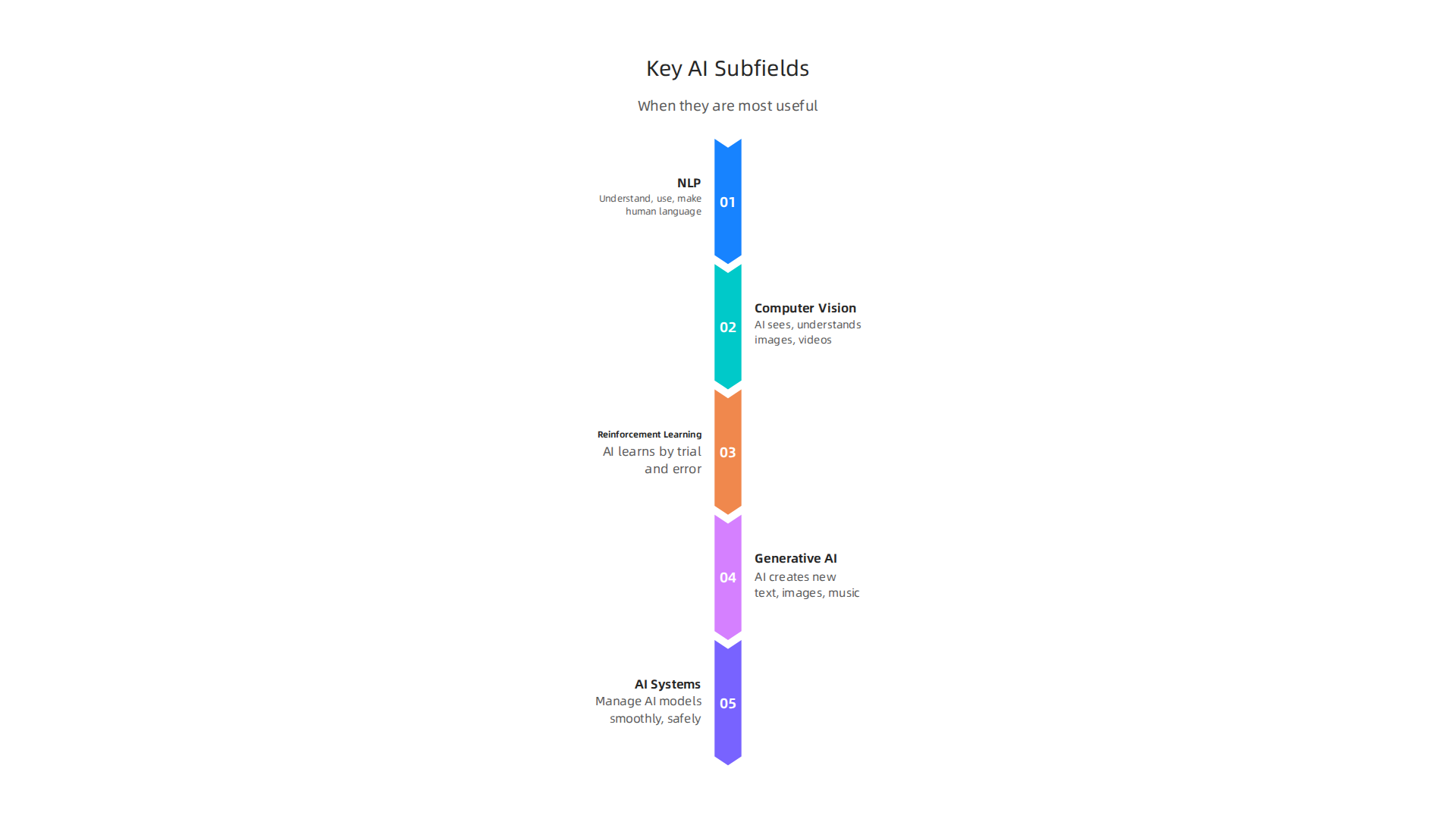
These areas help us sort through the many parts of artificial intelligence, as seen in a study comparing AI subfields over time Horizontal and Longitudinal Comparisons Among AI Subfields.
Natural Language Processing (NLP)
This part of AI teaches computers to understand, use, and even make human language.
- What it does: It lets computers read text, hear speech, understand what it means, and reply in a natural way.
- Examples: Think of the chatbots you use online, language translation apps, or tools that summarize long documents for you. It’s also behind voice assistants like the ones on your phone.
- When it matters: If your business needs to talk with customers, understand feedback from reviews, or process lots of written information, NLP is the key.
Computer Vision
This subfield gives computers "eyes." It’s all about letting AI see and understand images and videos.
- What it does: Computers can spot objects, recognize faces, tell the difference between things in a picture, and even understand actions happening in a video.
- Examples: Self-driving cars use computer vision to see roads and other cars. Security cameras can use it to find unusual activity. It also helps check the quality of products on a factory line.
- When it matters: If you work with photos, videos, or need machines to inspect things visually, computer vision is the right tool for the job.
Reinforcement Learning (RL)
This is how AI learns through trial and error, much like how a child learns by playing.
- What it does: An AI program tries different actions in an environment and gets "rewards" for good choices or "penalties" for bad ones. Over time, it learns the best way to reach a goal.
- Examples: This is often used to train AI to play complex games, teach robots how to move and pick up objects, or manage smart systems like heating and cooling in buildings.
- When it matters: For tasks where the AI needs to make many decisions over time to reach a long-term goal, especially in changing situations, RL is very powerful.
Generative AI
This newer, exciting area focuses on AI that can create new content.
- What it does: Generative models can make brand new text, pictures, music, or even videos that look very real. They don’t just copy, they invent.
- Examples: Making unique artwork from a text description, writing marketing ads, creating realistic fake photos for movies, or even helping design new products. This technology is rapidly evolving and leaders are using artificial intelligence images strategic mastery for leaders to understand its power.
- When it matters: If you need new ideas, custom content, or want to speed up creative work, generative AI is a strong choice.
AI Systems and Operations (AI Ops)
Beyond the specific types of AI, there’s also the field of making sure AI works well in the real world. This connects directly to computer systems technology.
- What it does: AI Ops is about setting up, running, and taking care of AI models and systems. It involves making sure they are fast, reliable, safe, and fair. It’s about how to manage these smart computer systems.
- Examples: Monitoring how an AI customer service bot is performing, updating AI models with new information, or making sure an AI tool is secure from bad actors.
- When it matters: Any time you want to use an AI tool in a real company setting, AI Ops is needed to keep everything running smoothly and safely.
Matching Problems to the Right AI Tool
To truly study AI means understanding which tool fits which problem.

If you have a business problem, ask yourself:
- Is it about understanding human words? Think NLP.
- Is it about seeing or identifying things in pictures? Think Computer Vision.
- Does the AI need to learn by trying things out and getting feedback? Think Reinforcement Learning.
- Do I need the AI to create something new and original? Think Generative AI.
- Do I need to make sure an AI runs properly and safely all the time? Think AI Ops.
By asking these questions, you can start to guide your journey to study AI more effectively and apply these powerful tools where they will do the most good.
Ready to dive deeper into how these AI subfields are changing the world? Stay informed with expert analysis.
The AI Newsletter Worth Reading
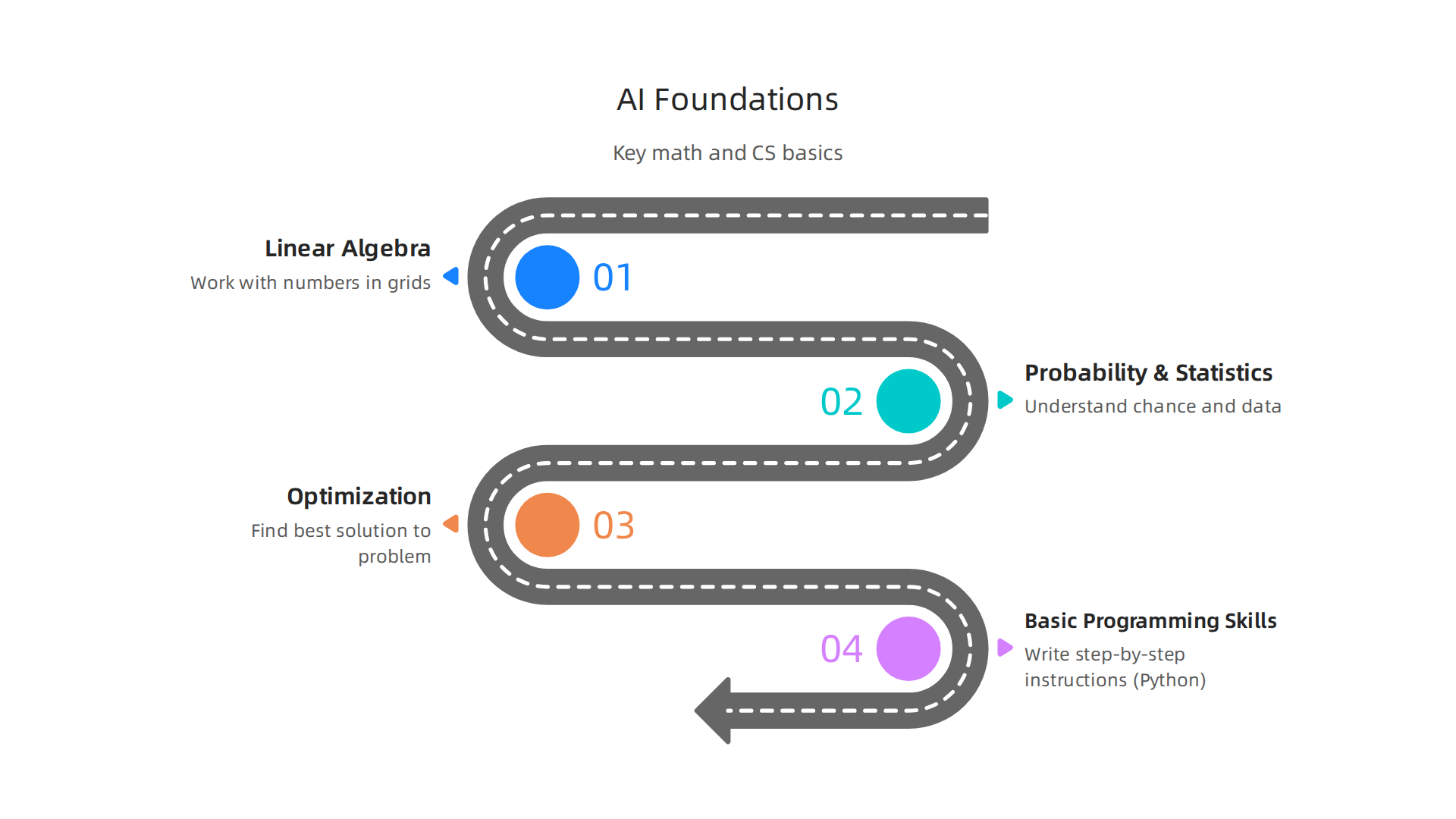
To truly understand and work with artificial intelligence, you need to know some basic ideas from math and computer science. Think of these as the building blocks. Without them, it’s hard to really get how AI works or even ask the right AI questions and answers. The world of AI is moving very fast, as shown in reports like Stanford’s AI Index for 2026 Shows the State of AI, making these foundations more important than ever.
Here are the key areas to focus on if you want to study AI:
Linear Algebra
This branch of math deals with lines, planes, and spaces, but in a way that helps computers handle lots of information.
- What it is: It’s about working with numbers in grids, called matrices and vectors.
- Why it matters for AI: AI uses these grids to store and process data, like images or large datasets. When an AI "learns" from data, it’s often doing many linear algebra calculations. It’s how AI sees patterns in huge amounts of numbers.
Probability & Statistics
These are about understanding chance and data.
- What it is: Probability helps us guess how likely something is to happen. Statistics helps us make sense of groups of numbers and find meanings.
- Why it matters for AI: AI often works with things that are not certain. For example, a self-driving car needs to guess what other cars might do. AI models use probability to make predictions and statistics to understand if those predictions are good. It helps answer many complex AI questions and answers about uncertainty.
Optimization
This is about finding the best possible solution to a problem.
- What it is: Imagine you have many choices, and you want to pick the very best one. Optimization is the math that helps you do that.
- Why it matters for AI: When an AI model learns, it’s trying to get better at its task. Optimization is the process it uses to adjust its settings to reduce errors and improve its performance. This is like tuning an engine to run at its best.
Basic Programming Skills
Knowing how to tell a computer what to do is a must-have.
- What it is: This means learning a programming language, often Python, which is popular for AI. It involves writing step-by-step instructions for the computer.
- Why it matters for AI: All AI tools and models are built using code. To truly study AI, you need to be able to write programs, work with data, and run AI models. It’s the practical side of connecting to computer systems technology and making AI ideas come alive.
How Deep Should You Go?
The amount you need to learn depends on what you want to do:
- For Decision-Makers (like business leaders): You don’t need to be a math expert, but you should understand the ideas behind these topics. You need to know what they are for, what problems they can solve, and what questions to ask your tech teams. You need enough knowledge to make smart choices about how AI can help your company grow and how AI drives big tech performance.
- For Practitioners (like AI developers or researchers): You need to go much deeper. You’ll spend a lot of time learning the math formulas and writing code. You’ll need to know how to build and fine-tune AI models yourself.
By building these strong math and computer science foundations, you’ll be much better prepared to explore the exciting world of artificial intelligence and truly study AI in a meaningful way.
Now that you know the basic ideas behind AI, it’s time to look at how you can really start to study AI. Just like we talked about before, how deep you go depends on what you want to do. Here are some clear paths you can take with courses, books, and projects.
Learning Paths for Different Goals
Different jobs need different kinds of AI knowledge.
-
For Business Leaders and Decision-Makers:
You need to know how AI can help your company, not how to write the code itself. Your learning should focus on strategy, how to use AI in business, and what questions to ask your tech team. Look for courses like "AI for Everyone" or other programs made for executives. These courses teach you about the big picture and the main ideas without getting lost in hard math. Many great options are available in 2026, including programs designed to help business leaders understand AI strategy. For example, some experts recommend specific AI Training for Executives (2026) — Courses for the C-Suite to guide leaders. You can also find lists of Top 10 Best AI Courses for Business Leaders (2026) to help you choose. -
For AI Builders and Researchers (Practitioners):
If you want to create AI, you need to dive deep into the math, programming, and actual building of AI models. This path involves taking detailed online courses or even going back to school. You’ll spend a lot of time coding in languages like Python and working with large datasets. Reading key books in the field is also important. These books often cover complexai questions and answersand teach you how AI systems are built from the ground up, linking strongly tocomputer systems technology. -
For Product Managers:
Product managers need a mix of both. They don’t have to be coding experts, but they must understand what AI can and cannot do. They need to know how AI features work, what data is needed, and how AI might affect users. Their learning should focus on how to plan and launch AI products, making sure they solve real problems for people. Studying AI for product management often involves looking at case studies and how differentartificial intelligence: a modern approach 5thideas are used in actual products. Learning about newer companies like Anthropic AI: What Leaders and Investors Need to Know can offer insights into real-world applications.
How to Pick Good Courses and Books
When looking for learning materials, think about these things:
- Look for clear goals: Does the course or book promise to teach you exactly what you need for your role?
- Check who teaches it: Is the instructor well-known and respected in the AI world? Andrew Ng’s "AI for Everyone" is a well-known starting point, for instance. You can find many recommendations, like this YouTube video highlighting 5 AI Courses Every Executive Should Take in 2026.
- Hands-on practice: Does it offer projects or exercises? This is super important.
The Power of Hands-On Projects
No matter your path, working on real projects is the best way to truly learn and understand AI.

- Start small: Try to build a simple AI model.
- Use public data: Many websites offer free datasets you can use to train your AI.
- Join a community: Share your work and learn from others.
Projects help you connect all the ideas you learn to practical uses. This is how you really get a feel for how AI works and how it can solve problems.
To stay on top of all the fast changes in AI, many professionals rely on daily updates and insights.
Get clear daily AI updates from The Deep View Newsletter. The AI Newsletter Worth Reading.
As you learn to study AI and even work on projects, you’ll find lots of news and research papers. But here’s the thing: not all information about AI is equally good or true. Just like learning to ask the right ai questions and answers in your studies, you need to learn how to check if what you read is reliable. This is especially important if you want to use AI insights for big decisions.
How to Evaluate AI Research & News for Strategic Insight
Think of yourself as a detective. You want to find the real facts and not just shiny stories.

Here’s a simple checklist to help you figure out if AI news and research are worth your time:
-
Can it be repeated? (Reproducibility)
Good science means someone else can do the same experiment and get the same results. In AI, this means if researchers share their code and data, another team should be able to make the same AI model and get similar results. If they don’t share how they did it, it’s harder to trust their claims Reproducible AI: Why it Matters & How to Improve it. This is a core idea incomputer systems technologyand research. Experts say that improving this helps everyone trust AI more Improving reproducibility of artificial intelligence research. -
How good is it really? (Benchmarks and Baselines)
When an AI model is presented, people often talk about its "performance." But what does that mean? AI models are tested using special challenges called benchmarks. These benchmarks show how well an AI does on certain tasks. For example, some benchmarks test how well AI understands text or images What Are the Top 10 AI Benchmarks Used in 2026?. A good report will compare the new AI’s score to older models (a "baseline") or even to how well humans do. If a report just says an AI is "good" without showing these comparisons, it’s like saying a car is "fast" without saying how fast compared to other cars. We see in 2026 that AI capability is growing very quickly, so good benchmarks are key to keeping up Technical Performance | AI INDEX REPORT 2026. -
Who is telling you this? (Conflicts of Interest)
Always think about who is sharing the information. Is it a company trying to sell a product? Or is it a group of university researchers? Companies might make their products sound better than they are. Research from independent groups is often more balanced. This doesn’t mean company news is bad, but you should read it with a thoughtful mind. Understanding the largerworld market order is being reshaped by AI and geopolitical competitionhelps here, as company motives can be strategic.
Corporate AI News vs. Peer-Reviewed Work
There’s a big difference between a press release from a tech company and a scientific paper reviewed by other experts.
-
Company Announcements: These are often about new products, features, or big achievements. They are exciting and show how AI is being used in the real world. For example, you might read about how Alphabet Stock 2026: Cloud Revenue Surges 63 Percent as AI Drives Big Tech Performance. But they might not share all the technical details, how the AI was built, or its limits. Their main goal is often to show success and get people interested.
-
Peer-Reviewed Research: These are detailed papers written by scientists and checked by other experts in the field before being published. They give deep technical details, explain the math, and usually discuss the weaknesses of the AI model. These papers are where you find the core ideas of
artificial intelligence: a modern approach 5thand truly new discoveries. While harder to read, they offer a more complete and honest picture of AI advancements. The Stanford AI Index for 2026, for example, points out that companies often share capability scores but less about how responsible their AI models are Key Insights from Stanford’s 2026 AI Index Report.
By asking these questions and knowing the source, you can better understand the true state of AI and use that knowledge wisely.
Knowing how to check AI news is just the start. Actually, the world of AI changes so fast that simply checking facts isn’t enough. To stay ahead, especially as a busy professional, you need a smart way to keep learning every day. Think of it as building an ongoing learning routine, a habit that helps you truly understand and study ai.
Building an Ongoing Learning Routine for Busy Professionals
It might seem hard to find time to learn new things when your work schedule is packed. But even small chunks of time can make a big difference. The key is to be smart about how you learn.
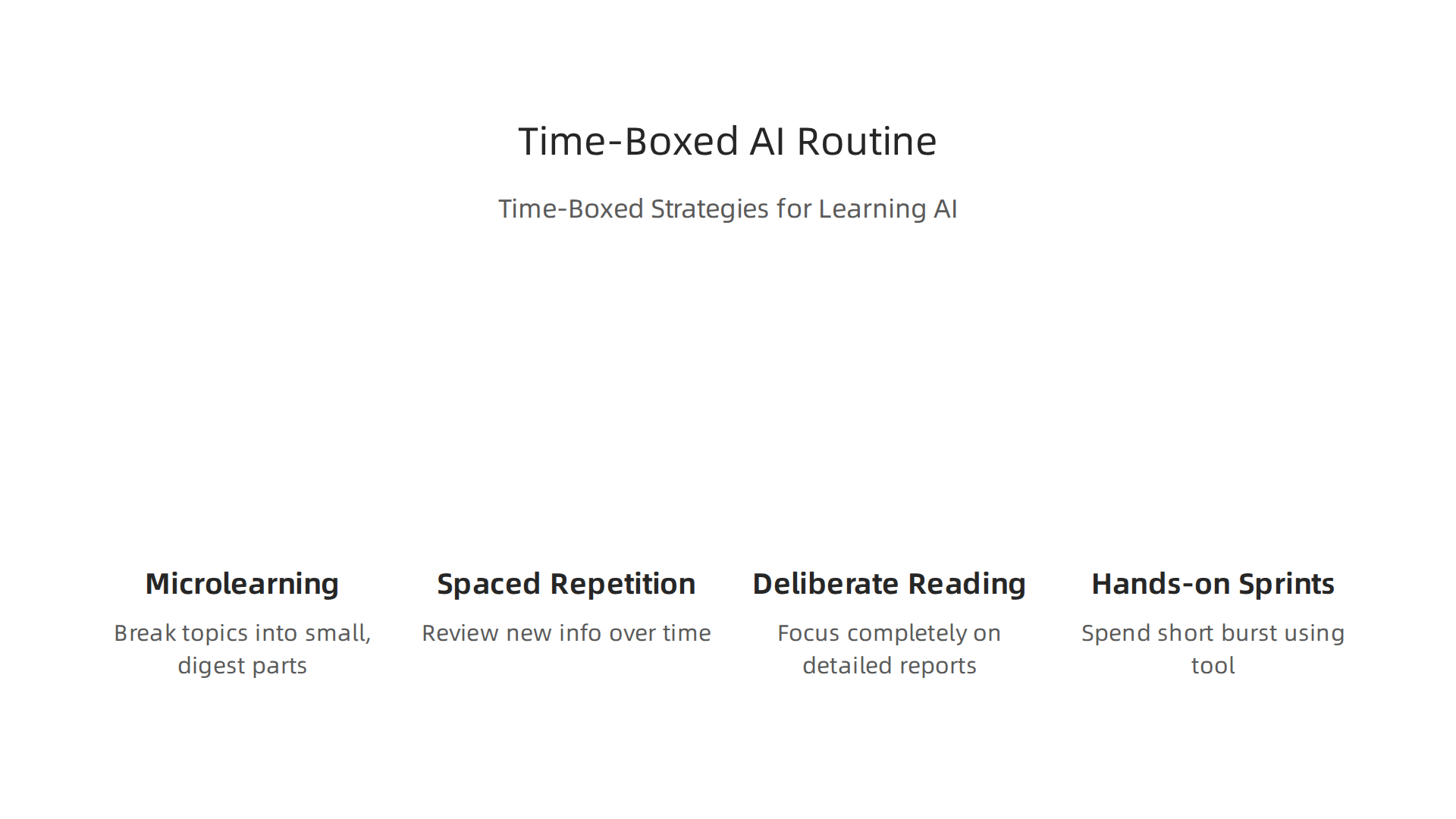
**Time-Boxed Strategies for Learning AI
**
-
Microlearning: Small Bites of Knowledge
This means breaking down big topics into very small, easy-to-digest parts. Instead of reading a whole book at once, you might spend 5-10 minutes learning one new AI concept. Research shows that microlearning can make you remember things much better, boosting knowledge retention by 25-60% compared to longer lessons Microlearning: Why Bite-Sized Training Works Better. Many busy people find microlearning more time-efficient and engaging too The Effectiveness of Microlearning in Skill Development and. It’s all about focusing on one idea at a time. -
Spaced Repetition: Learning That Sticks
This idea works hand-in-hand with microlearning. It means you review new information over time, but at set, growing intervals. You learn something new, then review it a day later, then three days later, then a week later, and so on. This helps move knowledge from your short-term memory to your long-term memory. Experts say that using spaced repetition can improve how well you remember things by over 200% compared to learning something just once Spaced Repetition And The Science Of Retention. When you mix microlearning with spaced repetition, your memory for new facts can be two to three times better after a month 47 Microlearning Statistics for 2026 (Updated). -
Deliberate Reading and Hands-on Sprints
Even with small bites, sometimes you need to dive deeper. Set aside short "sprint" times, maybe 30 minutes, to read a detailed AI report or a chapter from an important book like Artificial Intelligence: A Modern Approach. During these sprints, try to focus completely. Also, get your hands dirty! If you’re studying a new AI tool, spend a short burst of time actually using it. This kind of project-based practice helps answer your ownai questions and answersand makes the learning real.
How to Integrate AI Learning into Your Work
Making learning a part of your daily work life is crucial.
-
Curated Feeds: Don’t let yourself get lost in all the news. Find a few trusted sources that give you the most important AI updates. This could be specific blogs, industry analysts, or newsletters. Getting clear, helpful updates can save you time and keep you informed about new developments in
computer systems technology. -
Project-Based Practice: The best way to learn is by doing. Look for chances to use AI in your current projects. Even small tasks, like using an AI tool to help summarize a long document or brainstorm ideas, will deepen your understanding. This practical experience is far more valuable than just reading about AI.
-
Internal Knowledge-Sharing: Talk about AI with your coworkers. Share what you’ve learned, and ask them what they’re finding. Teaching others is a great way to make sure you truly understand a topic yourself.
By using these strategies, you can build a strong, ongoing learning habit that keeps you smart about AI without overwhelming your busy schedule.
Get clear daily AI updates from The Deep View Newsletter. When you need to cut through the noise and get straight to the strategic insights, turn to [The AI Newsletter Worth Reading](https://subscribe.thedeepview.com/subscribe?utm_term=bigtechnewstoday.com).
Summary
This guide explains why studying AI is essential in 2026 and gives a clear, practical roadmap to learn it without getting overwhelmed. It defines core ideas—AI, machine learning, and deep learning—then shows how models differ from full systems and which subfields (NLP, computer vision, RL, generative AI, AI Ops) suit specific business problems. The article lays out the math and programming foundations you’ll need at different depth levels, recommends role-based learning paths and hands-on projects, and offers methods to judge AI research and corporate claims. It finishes with time-smart study habits like microlearning and spaced repetition so busy professionals can build lasting expertise and make better, faster decisions about AI applications.