

Introduction
You already know the feeling. You open your news feed, and there are dozens of stories about Alphabet, Amazon, Meta, Nvidia, and the rest of the Magnificent Seven. Everyone has an opinion. Everyone has a prediction. But separating the signal from the noise gets harder by the day.

Here is the thing. Big Tech stocks have been the primary engine driving broader market returns in 2026. That is not just a feeling. Data from Fidelity shows that Alphabet stock alone delivered a 76.5% one-year return as of February 2026, placing it among the strongest performers in the group. The Magnificent 7 stocks performance reveals a landscape where a handful of companies now account for roughly one-third of the S&P 500’s total market capitalization. And Alphabet sits right at the center of that shift.
But here is where it gets tricky. When you try to make sense of it all, the sheer volume of information becomes a problem. New AI launches. Regulatory battles. Earnings surprises. Every day brings another headline about Alphabet stock versus Nvidia stock versus Meta stock. Meanwhile, stocks like Cisco, Johnson & Johnson, and even small-cap ETFs like IWM are moving in their own directions, creating a confusing picture for anyone trying to build a clear strategy.
You need a deeper view.
This article gives you exactly that. A data-rich, evidence-based comparison of Alphabet stock within the Big Tech landscape. We will look at regulatory pressures, competitive dynamics, and the macroeconomic forces that matter most in 2026. No fluff. No hot takes. Just the analysis you need to make informed decisions.
Before we dive into the numbers, there is one resource that can help you stay ahead of the daily noise. The The AI Newsletter Worth Reading delivers clear daily updates on the developments that actually move markets. It is a practical way to cut through the clutter without spending hours scrolling. And if you want a framework for evaluating which big tech stocks deserve your attention this year, our top 10 picks for big tech investors in 2026 is a solid place to start.
Let’s get into what makes Alphabet stock different from its peers right now.
The Big Tech Stock Performance Landscape in 2026
So how is Alphabet stock actually performing compared with the rest of the Magnificent Seven this year? The picture is more complicated than a single headline suggests.
At the start of 2026, the Magnificent Seven experienced a broad pullback. According to the analysis on why Magnificent 7 stocks are down in 2026, all seven names were in negative territory by mid‑February. Alphabet stock was down 3.3%, while Microsoft and Amazon faced steeper declines. Macro headwinds and shifting sentiment around AI spending dragged the group lower.
But the story shifted as the year progressed. By late April, the group had largely recovered, with Alphabet leading the way. Data from market observers shows Alphabet stock gained 12.6% year‑to‑date by that point, ahead of Nvidia’s 7.3% and Apple’s 6.4%. That rebound was fueled by strong earnings and upward revisions. Alphabet and Meta together drove a 25% and 10% boost in 2026 EPS forecasts, highlighting the market’s confidence in their AI monetization strategies.
The market capitalization hierarchy has also been reshaped by AI. Nvidia now sits at the top with a valuation of roughly $4.2 trillion, followed by Microsoft and Apple. Alphabet occupies the fourth spot at around $2.6 trillion, according to the latest data as of August 2025. That puts Alphabet behind the leaders but still ahead of Amazon and Meta. The gap reflects the premium investors assign to companies with dominant AI chip sales and cloud‑AI integration.
Valuation multiples tell an interesting story too. While Nvidia trades at a rich 30x forward earnings, Alphabet’s multiple is more moderate. Morningstar analysts recently called Alphabet stock undervalued by about 22% relative to its fair value estimate, suggesting room for upside if the company executes on its Gemini‑driven strategy and cloud‑revenue growth. Compared with peers, Alphabet offers a compelling blend of stability and growth potential.
For investors trying to track these movements daily, it helps to watch how the group behaves as a whole. A resource that tracks the biggest movers today in big tech stocks for 2026 can help you spot shifts before they become headlines.
Ultimately, the Big Tech stock landscape in 2026 is defined by two forces: AI‑driven divergence in market cap and valuation, and a resilient earnings engine that keeps Alphabet competitive even when the sector faces turbulence.
Alphabet’s Business Segments: Cloud, AI, and Search as Growth Engines
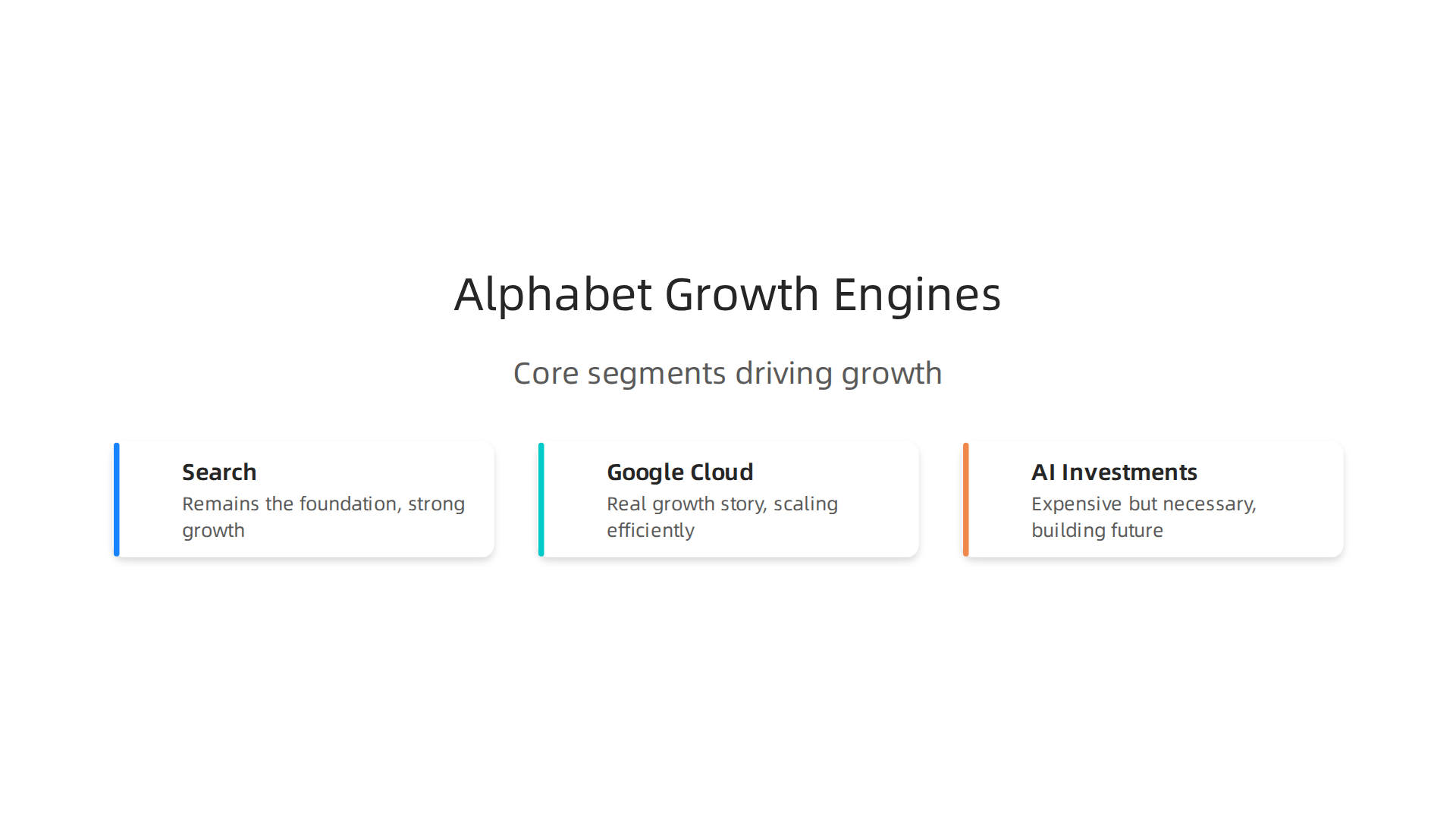
Alphabet’s ability to bounce back from that early 2026 pullback isn’t luck. It comes down to three powerful business engines working together: Search advertising, Google Cloud, and AI investments.
Each one plays a different role, but together they make Alphabet stock a unique story in the Big Tech landscape.
Search remains the foundation. Despite all the talk about AI chatbots replacing search, Google Search actually grew stronger. In Q1 2026, Google Search and other advertising revenues climbed 19% to $60.4 billion. Retail and financial services verticals led the charge. People are using AI features like AI Mode and AI Overviews, and they keep coming back to Search more often. This shows that AI isn’t hurting the search business. It’s making it more valuable.
Google Cloud is the real growth story. This segment has become Alphabet’s fastest-growing major business. According to the Q1 2026 earnings analysis from AlphaSense, Google Cloud revenues hit $20 billion for the first time, up 63% year over year.
Even more impressive is the profit side. Cloud operating income tripled to $6.6 billion, and the operating margin jumped from 17.8% to 32.9%. That kind of margin expansion shows the business is scaling efficiently. The backlog also nearly doubled to $462 billion, meaning customers are signing long-term contracts. Most of that backlog should convert to revenue over the next two years.
What is driving this cloud acceleration? Enterprise customers are adopting Google’s AI products. Revenue from products built on Google’s generative AI models grew nearly 800% year over year. New customer acquisition doubled compared with the same period last year. The company is also signing more big deals, with the number of $100 million to $1 billion deals doubling. A few billion-dollar-plus deals closed too. This shows that businesses see Google Cloud as a serious AI infrastructure partner.
AI investments are expensive but necessary. Capital expenditures reached $35.7 billion in Q1 2026, with about 60% going to servers and 40% to data centers. Full year CapEx guidance now sits between $180 billion and $190 billion. That is a massive number. It is also causing Alphabet to pause stock buybacks and use most of its operating cash flow on infrastructure instead. The question investors need to ask is whether these investments will pay off. Based on how fast Cloud revenue and margins are growing, the early returns look promising.
If you want to track these AI-driven changes daily, subscribe to The Deep View Newsletter for clear daily AI updates.
For investors comparing infrastructure plays across Big Tech, Cisco stock AI infrastructure orders offer another interesting angle on how hardware demand ties to cloud growth.
The bottom line is simple. Alphabet stock now depends on three engines instead of one. Search pays the bills. Cloud drives the growth. AI investments build the future. All three are firing at once, which is why the stock has been able to recover faster than most of its Magnificent Seven peers.
Regulatory and Competitive Threats Facing Alphabet Stock
All three engines are firing, but Alphabet stock doesn’t face a clear runway. Two big threats loom: regulatory pressure from governments and competitive pressure from AI rivals.

The DOJ antitrust case is far from over. In September 2025, a federal judge ordered Google to stop using exclusive contracts that kept its search engine as the default on most devices. The court also required Google to share search data with competitors. But the government wanted more. The DOJ appealed the decision in February 2026, arguing that the judge should have forced Google to sell Chrome and end its deal with Apple. According to the US files appeal in Google search antitrust case, the appeal centers on whether stronger remedies are needed. Google is also appealing the ruling itself. This legal battle could drag on for years, creating uncertainty for shareholders.
On top of that, there is a second antitrust case targeting Google’s ad tech business. In April 2025, a different judge ruled that Google illegally monopolized the market for publisher ad servers and ad exchanges. The Department of Justice Wins Significant Remedies Against Google case already resulted in a win for the government. A remedies decision is expected in early 2026. If the court orders a breakup of Google’s ad tech business, it could cost Alphabet billions in revenue.
AI competition is heating up. Microsoft’s Copilot is integrated into Bing and Windows, giving it a direct path to users. Meta’s open source LLaMA models are being adopted by developers who want to avoid vendor lock in with Google’s Gemini. Smaller AI startups like Perplexity are also gaining traction. While Google still holds the lead in search and cloud AI, these competitors are narrowing the gap. Understanding the broader competitive landscape is key. For more context on how technology shifts affect markets, read about AI and geopolitical competition reshaping global markets.
The EU’s Digital Markets Act adds another layer of friction. Alphabet has been designated as a gatekeeper under the DMA, which means it must comply with strict rules on how it operates in Europe. This includes allowing users to uninstall pre installed Google apps, letting third parties interoperate with Google services, and not favoring its own products over rivals. Compliance costs are real, and the EU is not shy about issuing fines. In 2025, the European Commission opened a new investigation into whether Google’s search practices violate the DMA. Any negative ruling could result in fines of up to 10% of global annual revenue.
These threats do not mean Alphabet stock is a bad investment. They do mean investors need to watch regulatory developments closely and consider how competition might erode Google’s market share over time.
Macroeconomic Factors Driving Big Tech Valuations
Beyond regulatory and competitive threats, broader economic forces are shaping Alphabet stock in 2026. Interest rates, consumer spending, and global growth fears all play a role in how the market prices Big Tech.
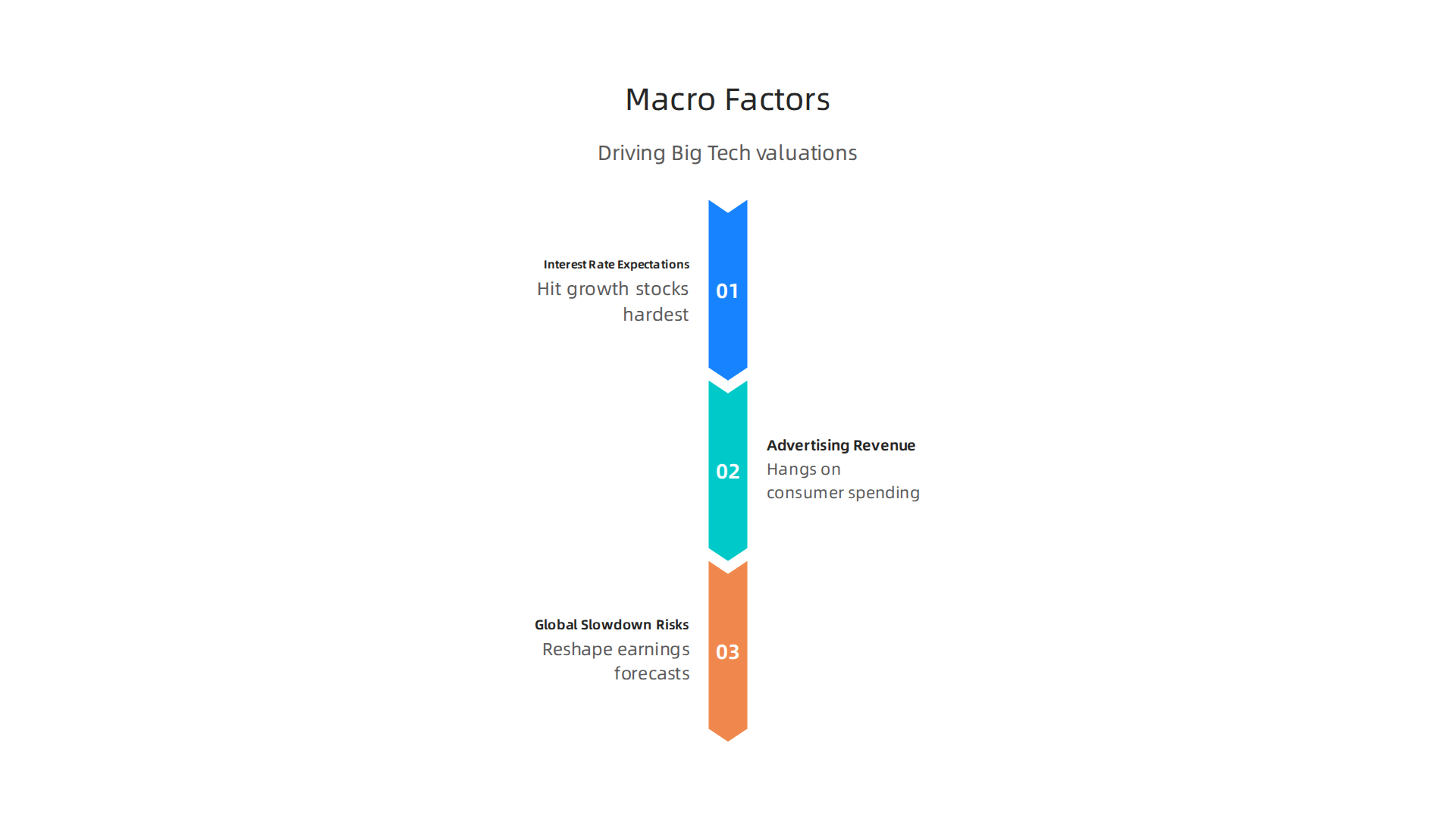
Interest Rate Expectations Hit Growth Stocks the Hardest
The Federal Reserve held its benchmark rate at 3.5% to 3.75% in June 2026. But the latest projections show a possible rate hike before the end of the year. According to the Fed interest rate decision June 2026, nine of 18 officials expect rates to end 2026 above the current range. Higher rates make future profits worth less today, which hurts high-growth names like Alphabet. This is the same dynamic that punished tech stocks in 2022 and 2023. Investors need to watch each Fed meeting closely because even a hint of a hike can send growth stocks lower.
Advertising Revenue Hangs on Consumer Spending
Alphabet makes most of its money from search and YouTube ads. When inflation eats into household budgets, companies cut marketing spend. If consumer confidence drops, ad rates fall and Alphabet stock takes a hit. The reverse is also true. If inflation cools and spending stays strong, ad revenue holds up. This makes Alphabet sensitive to every jobs report and retail sales number. Other companies like Cisco stock and JNJ stock are less tied to ad cycles, but Alphabet lives and dies by the ad market.
Global Slowdown Risks Reshape Earnings Forecasts
A broader economic slowdown would hit all Big Tech companies, not just Alphabet. IWM stock, which tracks small caps, often signals early fear about the economy. If small businesses pull back, that weakness eventually reaches the largest tech platforms. Analysts may cut earnings estimates for Alphabet if global GDP growth slows. Some of the best ways to prepare are by understanding how different assets react to macro shifts. For a deeper look at how futures markets signal these moves, check out how stock futures predict big tech stock moves before the market opens.
These macroeconomic factors don’t mean Alphabet stock is doomed. But they do mean that investors should keep one eye on the Fed and the other on consumer health. The same forces that lift growth stocks can also knock them down.
Analyst Sentiment and Institutional Positioning on Alphabet Stock
After looking at the big picture macro forces, let’s zoom in on what the pros are saying about Alphabet stock right now. Wall Street analysts spend all day studying these companies. Their ratings and price targets can move markets. So what do they think about GOOGL in mid-2026?

The consensus analyst rating remains Overweight. Most analysts still see Alphabet as a buy. The median price target sits at a premium to the current share price. But the range is wide. Some analysts are cautious because of the advertising slowdown we talked about earlier. Others are bullish on AI investments finally paying off. According to the outlook for Fed rate cuts in 2026, interest rate expectations directly affect how analysts value growth stocks like Alphabet. A higher terminal rate means a lower present value for future profits, which can drag down price targets.
Now let’s talk about insider transactions. Recent filings show that some Alphabet executives have been selling shares. That can sound like a warning sign. But it’s also common for insiders to sell for personal reasons like taxes or diversifying their portfolios. You need to look at the big picture. If a CEO dumps a huge chunk of stock all at once, pay attention. But routine sales from a compensation plan are less meaningful. So far in 2026, the insider selling trend at Alphabet is pretty mild compared to other big tech names like Cisco stock.
Institutional ownership changes tell another part of the story. Large funds like Vanguard and BlackRock still hold massive positions in Alphabet. But there have been some notable adjustments. Some funds trimmed their stakes in early 2026 to lock in profits from the AI rally. Others added shares on pullbacks. The key takeaway is that institutional money remains heavily allocated to Alphabet, though the buying has slowed compared to late 2025. For investors who want to see where professional analysts rank the top tech stocks right now, check out this list of stock advisor top 10 picks for big tech investors in 2026. It gives you a clear sense of where the smart money is flowing.
So here’s the summary. Analyst sentiment is cautiously optimistic. The Overweight consensus still holds, but price targets may shift as macroeconomic conditions change. Insider selling is under control. Institutions are still buying, just at a slower pace. That paints a picture of a stock that’s well-liked but not loved to excess. And that is actually a healthy sign for long term holders of Alphabet stock.
Future Outlook: Where Alphabet Stock Is Headed in 2026 and Beyond
So where does that leave Alphabet stock for the rest of 2026 and the years ahead? The Q1 earnings report in April gave us a clear picture of what is working right now. And honestly, the numbers are impressive.
The big story is AI monetization. Google Cloud revenue surged 63% year over year to $20 billion. That is not a fluke. Management said that enterprise AI solutions are now the main growth catalyst for the cloud business. Gemini Enterprise, the paid version of Alphabet’s AI assistant, saw a 40% quarter over quarter jump in paid monthly active users. That kind of adoption is real. According to the Alphabet Q1 2026 earnings report, the total number of paid subscriptions across Google reached 350 million. And the Gemini model is now processing over 16 billion tokens per minute through direct API use, up 60% from last quarter. These are not vanity metrics. They show that customers are actually using and paying for AI.
Alphabet is also spending heavily to keep that momentum going. Full year 2026 capital expenditure guidance was raised to a range of $180 billion to $190 billion. The CFO said they expect to increase spending again in 2027. That is a lot of cash going into data centers, custom TPUs, and infrastructure. The risk is that those investments may not pay off as quickly as expected. But the Q1 results suggest that demand is there.
Shareholders got a little something extra too. The company announced a 5% increase to the quarterly dividend, bringing it to $0.22 per share. That is not a massive yield, but it shows confidence from management. Alphabet has also been active with buybacks, though the pace slowed slightly in Q1 compared to late 2025.
Now let’s talk about the newer bets. Waymo, Alphabet’s autonomous driving unit, has now surpassed 500,000 fully autonomous rides per week. That is a big milestone. The revenue from Other Bets actually declined slightly in Q1, but the scale is building. Healthcare through Verily is still early, but the potential is there. These businesses could become meaningful revenue drivers in the next five years. For a broader view of how these industries fit into the global economy, check out this analysis of the top industries reshaping the world in 2026.
The bottom line is that Alphabet stock has clear catalysts. AI adoption is accelerating. Cloud growth is real. And the company is returning cash to shareholders. The execution risk is high given the massive capex, but the early returns are strong.
If you want to stay on top of these AI developments without drowning in noise, there is a simple tool that does the heavy lifting for you. Get clear daily AI updates from The AI Newsletter Worth Reading. It cuts through the hype and gives you the signals that actually matter for your portfolio.
The Role of AI in Driving Big Tech Valuations
Beyond just tracking Alphabet’s quarterly numbers, it helps to zoom out and look at the bigger picture. The role of AI in driving Big Tech valuations has become impossible to ignore in 2026. Across the sector, market cap gains are increasingly tied to how much AI-related revenue a company can show right now.
Take Alphabet stock as the clearest example. The company is spending like never before to dominate AI infrastructure. Full year 2026 capital expenditure guidance jumped to a range of $180 billion to $190 billion. That is roughly three times what Alphabet was spending just two years ago. According to the Alphabet earnings preview for Q1 2026, CapEx estimates surged more than fivefold from $32.3 billion in fiscal 2023. That kind of spending shift tells you exactly where management sees the future.
But here is the thing. That massive investment does not guarantee instant returns. The ROI is still emerging. Google Cloud revenue surged 63% to $20 billion in Q1, and the Google Cloud revenue surged 63% in Q1 2026. That is real progress. Yet the Cloud segment still makes up only about 18% of total revenue. The core ad business is still doing most of the heavy lifting. So investors are paying a premium today for AI growth that has not fully materialized across the whole company.
This "AI premium" is not unique to Alphabet either. Across Big Tech, stocks are being rewarded based on AI narrative as much as actual earnings. Companies that can credibly claim AI tailwinds tend to trade at higher multiples. The risk is that some of that premium is overstated. If AI revenue does not scale as fast as expected, valuations could correct. On the other hand, if the current trajectory holds, the premium may end up looking cheap in hindsight.
The same dynamic is playing out across the broader tech landscape. For example, networking and hardware companies are also benefiting from the AI buildout. Our analysis of cisco stock AI infrastructure orders shows how demand for data center gear is driving earnings growth in unexpected places.
The bottom line is that AI is now the single biggest factor in Big Tech valuations. For investors, the key question is whether the companies spending the most will actually deliver the returns. Alphabet is the test case. If their bet pays off, the whole sector gets a lift. If it stumbles, the premium could vanish fast.
Dividends and Share Buybacks: Big Tech Cash Returns
So here’s the thing about owning alphabet stock. You are not just buying into an AI gamble. You are also getting paid to wait. That shift started in 2024 when Alphabet launched its first ever dividend.
Before that, the company famously kept all its cash for reinvestment. Now it sends a little back to you every quarter.
And the dividend is growing. In 2025, Alphabet raised its quarterly payout by about 10%. That might not sound huge compared to old school dividend stocks. But for a company spending billions on AI infrastructure, it sends a strong signal. Management believes the cash flow is stable enough to reward shareholders while still funding growth.
But dividends are only half the story. The real firepower comes from share buybacks. In early 2025, Alphabet’s board authorized a massive $70 billion buyback program. That was on top of the $70 billion authorized the year before. The pace of execution matters a lot. If Alphabet buys back shares aggressively, it reduces the share count. That boosts earnings per share without actually growing profits. It also supports the stock price during market dips.
For long term investors, these cash return policies add a layer of stability. Sure, the stock can swing on AI headlines and antitrust news. But knowing that Alphabet is using part of its massive cash pile to reward shareholders makes it easier to hold through the volatility. Even the US files appeal in Google search antitrust case did not stop the company from returning billions to investors. That is a sign of financial strength.
How does this compare to other corners of the market? Traditional dividend payers have been doing this for decades. For example, if you look at how Enbridge stock delivers a 5% yield and 31 years of dividend growth, you see a completely different approach. Enbridge offers a steady income stream. Alphabet offers lower yield but faster growth potential and aggressive buybacks. Each serves a different purpose in a portfolio.
The bottom line for Alphabet stock is this. Between the dividend and the buybacks, total shareholder return gets a meaningful boost. The dividend keeps income focused investors interested. The buybacks signal confidence from the board. And both together make the stock less volatile than a pure growth play. That combination matters in 2026, when many investors are looking for stability alongside AI upside.
Alphabet Stock in 2026: Balancing Growth, Regulation, and Macro Risk
Here is the thing about being an Alphabet shareholder in 2026. The fundamentals look rock solid. Q1 2026 revenue hit $109.9 billion, up 22% from last year, with net income soaring 81% to $5.11 per share. Google Cloud stole the show with a staggering 63% revenue jump. Those numbers came straight from the official Alphabet Q1 2026 earnings report. The AI driven growth is real, and it is happening now.
But here comes the hard part. The massive AI opportunity comes with a massive price tag. Alphabet raised its full year 2026 capital spending guidance to between $180 billion and $190 billion. That is more than five times what it spent on capex back in 2023. Management even told investors to expect another big jump in 2027. For impatient investors, the fear is that these huge spending bills will eat into profits before the AI revenue fully materializes.
Regulation adds another layer of uncertainty. The antitrust case against Google is ongoing, and even a favorable ruling does not eliminate risk. Appeals can drag on for years. Professionals watching alphabet stock need to keep one eye on Washington and one on the balance sheet.
The macro environment in 2026 also matters. Rising interest rates or a slowdown in ad spending could pressure the stock, even if company specific execution stays strong. Compare that to infrastructure plays like how Cisco stock relies on AI infrastructure orders for growth. Alphabet has the same tailwind but with more regulatory baggage.
The smart play is to monitor three things from here. Watch Google Cloud revenue growth at Q2 earnings, expected in late July. Track any antitrust rulings. And pay attention to the pace of buyback execution.

If cloud growth stays above 55% and buybacks keep reducing the share count, the risk reward still favors long term holders.
AI is reshaping everything in tech right now. If you want clear daily updates on how AI impacts the biggest companies, The AI Newsletter Worth Reading delivers exactly that.
Summary
This article offers a data-driven, investor-focused analysis of Alphabet stock within the 2026 Big Tech landscape, comparing performance, valuation, and market position against the Magnificent Seven. It breaks down Alphabet’s three core growth engines—Search advertising, Google Cloud, and AI investments—showing how cloud revenue and AI monetization are driving recent gains while massive capex and regulatory battles create meaningful risks. The piece explains how interest-rate expectations, ad spending cycles, and global macro trends affect valuations, and summarizes analyst sentiment, insider activity, and institutional positioning. You’ll get a clear view of the company’s cash-return policies (dividends and buybacks), the tradeoffs of heavy AI spending, and the legal threats from antitrust cases and EU rules. After reading, you’ll know which metrics to watch at each earnings report, how to balance growth versus regulatory risk, and practical steps to monitor Alphabet without getting lost in the daily noise.