

Introduction: The Landscape of Emerging Tech Stocks
Technology investing has never moved faster. In 2026, artificial intelligence, quantum computing, and fintech are driving some of the biggest market shifts we have seen in decades. A single breakthrough can send a stock soaring, and a single regulation can cool an entire sector. According to the 2026 Emerging Technology Outlook, the bull run in tech may continue thanks to strong earnings and innovation acceleration, especially in AI companies. But here is the challenge: with so much hype, how do you tell the real opportunities from the fleeting ones?
Many investors struggle to separate hype from fundamentals when looking at emerging tech names.

It is easy to get caught up in the excitement of a new quantum announcement or an AI partnership. But without a clear framework, you risk buying into noise instead of real value.
That is exactly why we created this analysis. In this article, we provide a structured, research-backed comparison of four high-profile stocks: d wave stock, lumn stock, webull stock, and aaoi stock. Our main focus will be on d wave stock and what it tells us about the future of quantum computing investing.
Along the way, you will get practical tools to cut through the noise. If you want to stay ahead of daily AI and tech developments, check out The AI Newsletter Worth Reading for clear daily updates that help you make smarter decisions.
For a broader view of where tech fits into the global economy, you can also read our guide on the top industries in the world in 2026. Let us dive into the details of d wave stock and the other three names that are shaping this year’s tech landscape.
D-Wave Systems: The Quantum Computing Pioneer
D-Wave Systems stands out as the first company to sell commercial quantum computers.
While tech giants like IBM and Google chase universal gate-model machines, D-Wave has carved its own path using a technique called quantum annealing. This approach solves specific optimization problems that classical computers struggle with, making it useful for industries like logistics, finance, and defense today.
The company hit a major milestone in 2025 with the launch of its Advantage2 system. That system is now live at Davidson Technologies in Huntsville, Alabama, where it is helping solve defense and aerospace problems. D-Wave also earned awardable vendor status on the Department of Defense’s Tradewinds marketplace, making it easier for government agencies to buy quantum services.
Financially, the numbers tell a mixed but promising story for d wave stock. The company reported Q1 2026 revenue of $2.9 million, which dropped from $15 million in the same quarter a year earlier. But here is the exciting part: closed bookings hit $33.4 million, up an incredible 1,994% year over year. You can check the full first quarter 2026 financial results directly from D-Wave.
Revenue for the first three quarters of 2025 reached $21.8 million, a 235% jump. And with more than 100 organizations using D-Wave systems, the customer base keeps growing. Analysts see big upside too, with quantum computing stock analyst outlook targets ranging from $40 to $48 per share.
D-Wave also plans to launch its first gate-model system in 2026, which would directly expand its market. That puts it in a stronger competitive position against players like IBM. If you want to see how IBM fits into this same landscape, read our breakdown of IBM stock in 2026 and how its quantum strategy compares.
Recent Technical Milestones and Roadmap
D-Wave’s Advantage2 system is already live, but the company’s roadmap shows even bigger things ahead.
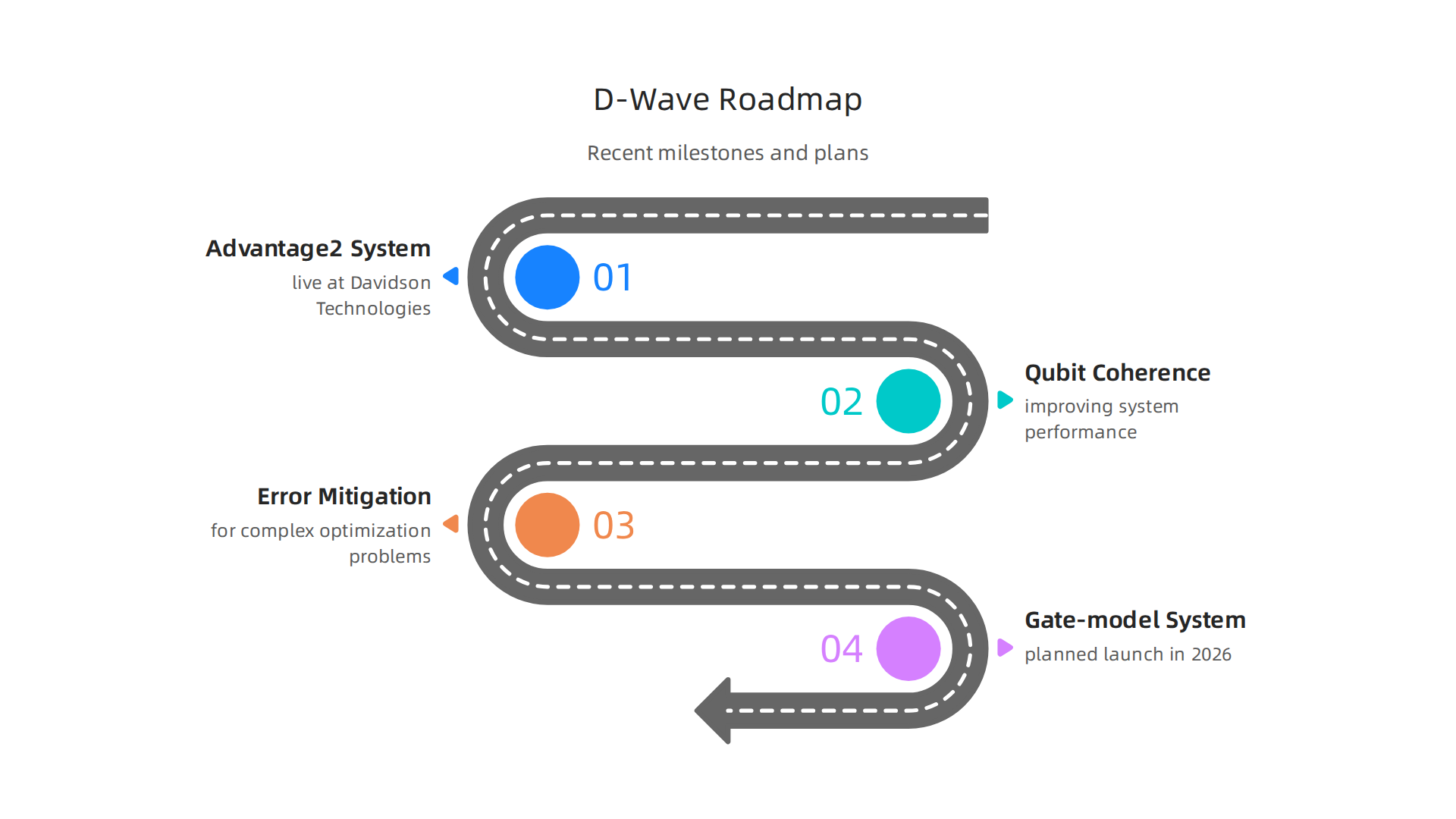
The next upgrades focus on improving qubit coherence and adding error mitigation techniques. These changes will let the system handle larger, more complex optimization problems for enterprise clients.
The timing is good. The quantum computing market is projected to grow from $1.9 billion in 2026 to $8.0 billion by 2033, according to the Quantum Computing Market Size & Share Report, 2026-2033. D-Wave is positioning itself to capture a big share.
On the roadmap, D-Wave plans to launch its first gate-model system in 2026. This would let it compete with IBM and Google on universal quantum computing while keeping its annealing systems for optimization. Government adoption is also growing, with more defense agencies exploring quantum solutions for everything from secure communications to logistics planning. For a broader look at how technology is reshaping global markets, read how the world market order is being reshaped by AI and geopolitical competition.
To stay on top of AI and tech developments, check out The AI Newsletter Worth Reading from The Deep View Newsletter.
Market Adoption and Use Cases
D-Wave’s quantum annealing technology is gaining traction across several key industries.
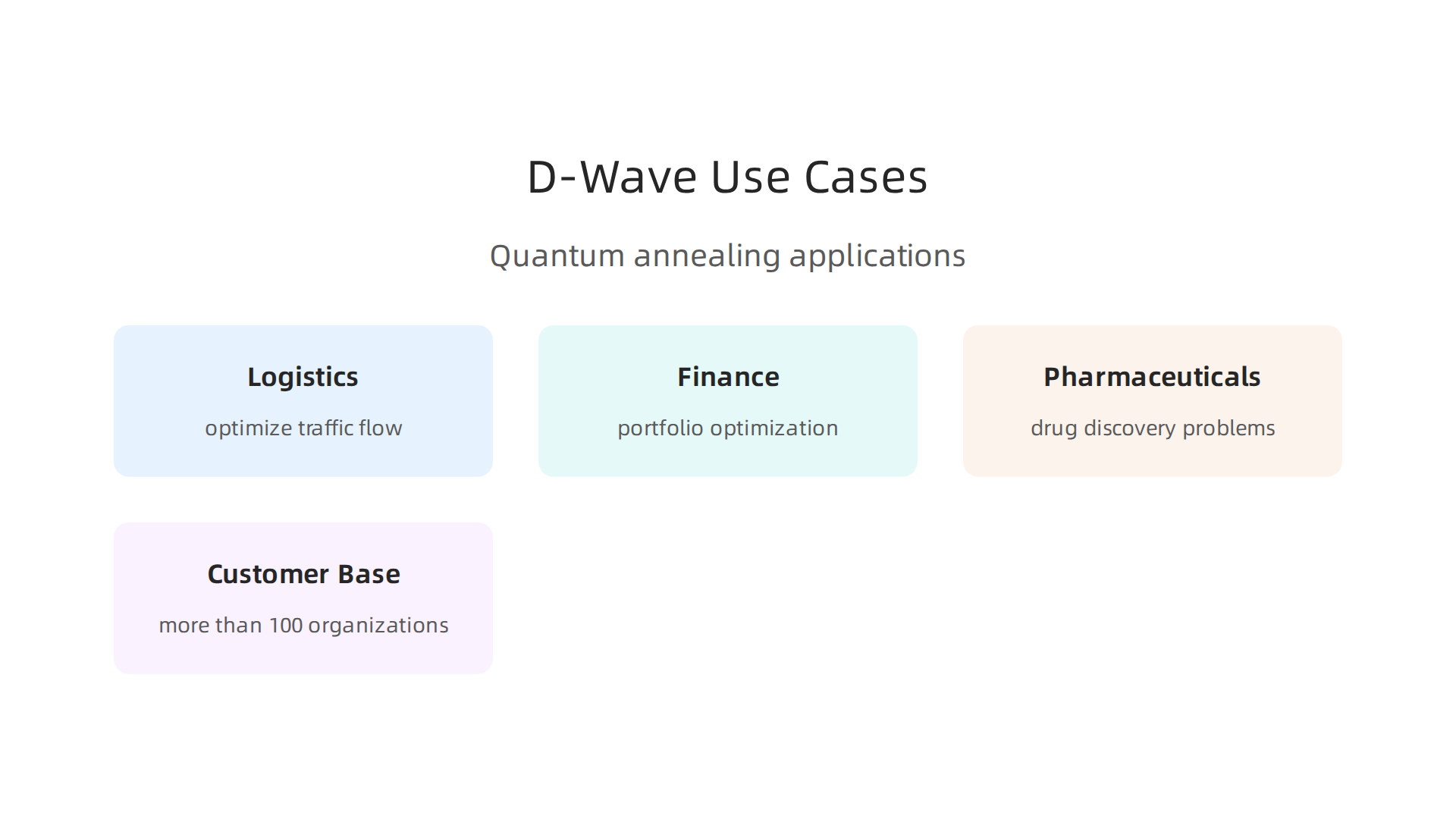
In logistics, companies like Volkswagen use D-Wave systems to optimize traffic flow and delivery routes. In finance, firms apply quantum annealing for portfolio optimization and risk analysis. In pharmaceuticals, researchers explore drug discovery problems that classical computers cannot solve.
The customer base is expanding. More than 100 organizations now use D-Wave systems. The company’s closed bookings hit $33.4 million in Q1 2026, up nearly 2,000% year over year, as reported in D-Wave’s first quarter 2026 results. That signals real enterprise commitment.
Compared to gate-model rivals like IBM and Google, D-Wave’s annealing approach has a narrower focus but delivers practical results for optimization problems today. That head start in commercial adoption could matter for d wave stock investors watching for revenue momentum. For a broader view of sectors driving economic change, check out the top industries in the world 2026.
Lumen Technologies: From Telecom to AI Infrastructure
Lumen Technologies is reinventing itself. The company, once known as CenturyLink, is moving away from its legacy telecom roots to become an AI-first connectivity provider.
The goal is to be "the trusted network for AI," as stated in the company’s AI connectivity strategy overview. That shift is why investors tracking d wave stock and other AI plays are paying attention to Lumen too.
Key strategic moves include building a metro edge network with sub-five millisecond latency, partnering with IBM to power enterprise AI at the edge, and growing its Network-as-a-Service (NaaS) customer base by nearly 30%. The company also sold about $6 billion in local fiber assets to AT&T in early 2026, using the cash to reduce debt. These actions show a clear focus on high-growth areas like edge computing and AI connectivity, rather than old-school phone lines.
Financially, Lumen is still a work in progress. Revenues fluctuate as it sells off non-core businesses and reinvests in the network. Losses continue, but the company is cutting debt and operating costs. For investors, the question is whether the transformation will translate into consistent profits. If you want a broader view of how AI infrastructure companies are reshaping markets, read more about AI infrastructure stocks like Cisco. And if you want to keep up with daily AI developments that affect these companies, you can subscribe to The AI Newsletter Worth Reading for clear daily updates.
Strategic Shift to AI and Cloud Connectivity
Lumen’s most important move in 2026 is building a network designed for AI workloads.
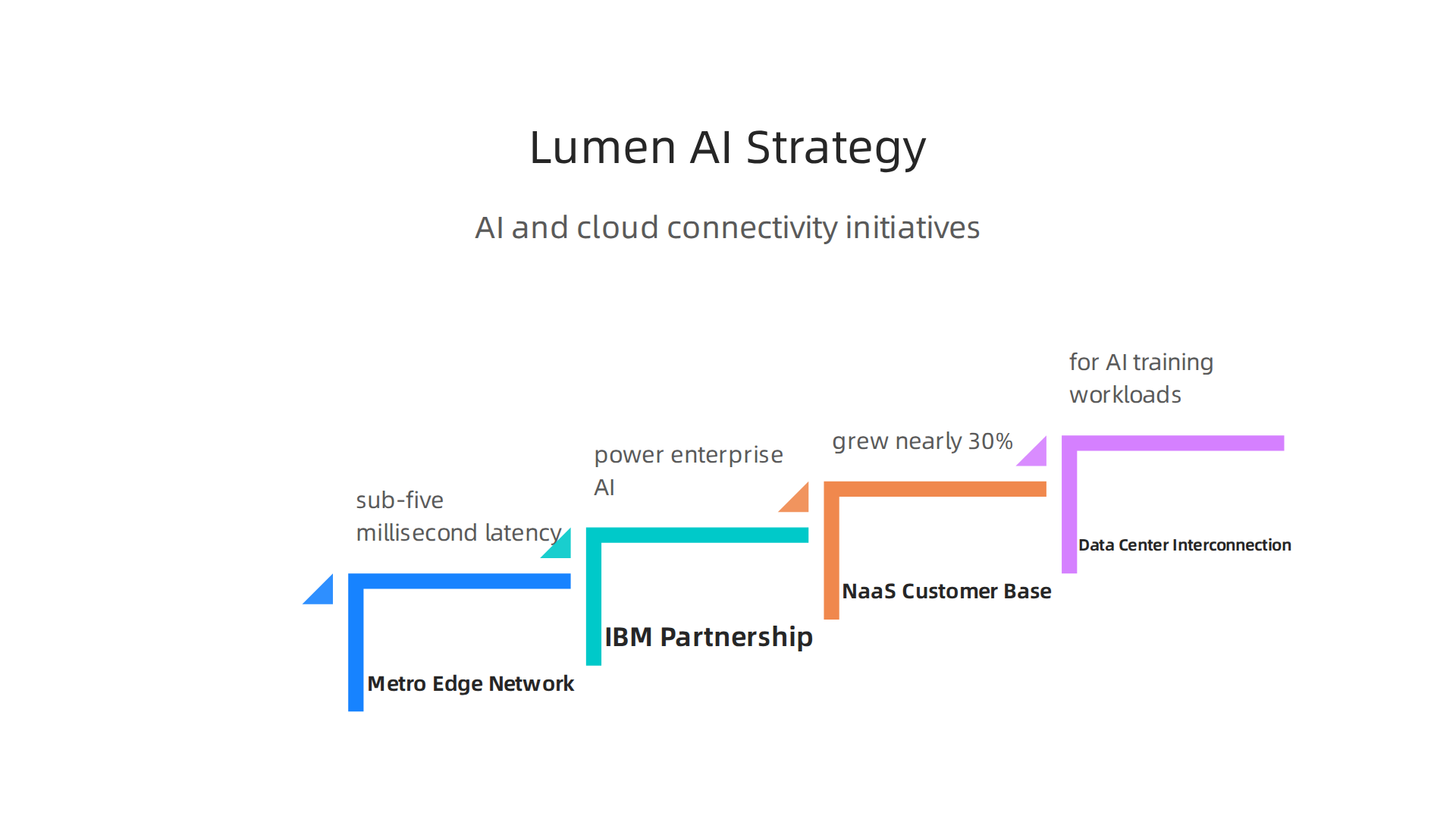
The company’s metro edge platform offers sub-five millisecond latency across the U.S., which is critical for real-time AI inferencing and experimentation. As explained in the company’s edge AI and low-latency network overview, this infrastructure helps businesses test and scale AI solutions as they move from testing to full production.
This puts Lumen in a competitive field against Akamai, Cloudflare, and AT&T. But Lumen’s edge is its programmable Network-as-a-Service platform, which dynamically routes traffic for multi-cloud and AI workloads. The company’s NaaS customer base grew 29% in early 2026, signaling real demand. For investors tracking d wave stock and other AI-connected plays, that growth rate is a positive sign.
The rising need for data center interconnection is another tailwind. As AI training workloads expand, enterprises require fast, reliable connections between cloud providers and their own infrastructure. Lumen is positioning itself as a key middleman in that ecosystem. To see how another legacy tech company is reinventing itself for AI, read our analysis of IBM stock and its AI-driven cloud transformation.
Financial Health and Growth Trajectory
Of course, all this investment comes with a cost. Lumen is still in the middle of a messy financial transition. The good news is that the company is actively reducing its debt by selling off older parts of its network. The sale of nearly $6 billion in local fiber assets to AT&T closed in Q1 2026, giving Lumen more breathing room to fund its AI strategy.
Revenue is still fluctuating as old business lines shrink and new ones ramp up. The NaaS customer base grew 29% in early 2026, which is a strong signal for future recurring revenue according to the Lumen Technologies Q1 2026 Earnings Call Transcript. Because of this transition, standard P/E ratios don’t tell the full story. Many analysts prefer EV/EBITDA to compare Lumen to other telecom and network players.
For investors who are chasing high-risk growth stories like d wave stock, LUMN stock offers a different path. It is a real business with existing physical infrastructure and a clear plan to cash in on the AI boom. Following this turnaround requires solid daily research. Get clear daily AI updates from The Deep View Newsletter to stay ahead of the curve. And for another example of a company navigating a major financial shift, check out our analysis of SoFi Technologies stock analysis financials growth.
Webull: The Fintech Challenger in Commission-Free Trading
Most traders know the pain of fees eating into profits. That is why webull stock has become such a hot name in 2026. Webull is a commission-free broker built for active traders who want more than basic tools.
It offers advanced charting, extended hours trading, and even crypto and prediction markets.
The numbers back up the hype. In Q1 2026, Webull reported a 36% jump in revenue to $159.9 million. Customer assets surged 90% to $24 billion. The platform now has 27.6 million registered users and added 800,000 new users in just one quarter. You can check the full details in the Earnings call transcript: Webull Corp’s Q1 2026 earnings miss.
What makes Webull stand out? The company is expanding into Europe with approvals in 22 new markets. It also secured a U.S. self-clearing license, which cuts costs and improves efficiency. On the feature side, it launched AI tools like Portfolio Blueprint and an AI Portfolio for automated investing.
But competition is fierce. Robinhood, Schwab, and Fidelity all offer free trading too. Webull’s edge is its focus on power users people who want real-time data, options, futures, and international access.
For investors comparing high-risk plays like d wave stock against more established fintech names, Webull offers a different kind of bet. It is a real platform with real revenue growth. If you want to learn how to spot winners in this space, check out how to cut through the noise with futures news for smarter trading decisions.
User Growth and Competitive Advantages
Webull targets active traders who want more than basic buy-and-sell buttons. The platform offers crypto trading, IPO access, paper trading, and advanced charting. That sets it apart from Robinhood’s simpler design and from Schwab or Fidelity, which cater to a broader audience. The stickiness comes from network effects: more users mean more liquidity, better data, and stronger community features.
The strategy is working. Webull achieved a Webull’s 17% user growth and 84% asset surge in an earlier quarter, and its retention rate hit 98.4% in Q1 2026. Funded accounts continue to climb, and the platform is expanding into B2B clearing.
For anyone weighing a high-risk pick like d wave stock against a fintech with proven traction, Webull’s user growth is a strong signal. To understand the retail trader behavior fueling these platforms, check out how WallStreetBets Reddit moves markets.
The AI Newsletter Worth Reading Get clear daily AI updates from The Deep View Newsletter. Stay ahead of the trends that shape fintech and beyond.
Regulatory and Market Risks
But even strong growth comes with risks. Webull relies heavily on payment for order flow (PFOF), a practice the SEC may tighten.

That could cut a major revenue stream. One analysis highlights these Webull’s 4x return potential alongside PFOF regulatory concerns. Larger incumbents like Schwab and Fidelity also offer zero-commission trades, squeezing Webull’s market share. And the platform depends on retail trading activity, which can dry up during market downturns. To understand how a direct rival navigates these pressures, check out this SoFi stock analysis. Staying on top of regulatory shifts and market cycles is key for any fintech investor. The AI Newsletter Worth Reading delivers daily AI updates that track these fast-moving trends.
Applied Optoelectronics (AAOI): The Critical Component Supplier
Every AI data center needs fast, reliable connections between servers. That is where Applied Optoelectronics (AAOI) comes in.

AAOI makes the optical transceivers and fiber-optic components that let data centers move data at lightning speed. Think of them as the plumbing behind the AI boom.
The demand is real. In Q1 2026, AAOI reported $151.1 million in revenue, up 51% from the same quarter last year. Data center revenue alone surged 154% to $81.4 million. The company aims to more than double full-year revenue to $1 billion in 2026, driven by orders for 800G transceivers from hyperscale customers. As AI workloads grow, these high-speed optics become essential.
But here is the risk. AAOI’s top ten customers made up 98% of revenue in Q1 2026. Microsoft alone accounted for nearly 29% of 2025 revenue, and a single CATV customer called Digicomm represented 53%. If one of these giants slows down orders or switches suppliers, AAOI feels it instantly. That kind of concentration is common in component suppliers, but it makes the stock volatile.
If you are looking for more context on how AI infrastructure investments are reshaping the market, check out our breakdown of AI infrastructure demand trends.
Corning Fiber and Data Center Demand
Optical transceivers are the invisible highways inside AI data centers. They turn electrical signals into light pulses so servers can talk at lightning speed. Demand for 400G and 800G transceivers is booming because AI models need this speed to train.
AAOI stands out because it designs its own laser chips. Most competitors buy chips from others. Making its own chips gives AAOI better control over performance and cost. In Q1 2026, the company shipped its first volume order of 800G transceivers to a large hyperscale customer. As reported in the AAOI Q1 2026 earnings release, management expects a strong ramp in Q2.
This growth ties directly to hyperscaler capacity expansion. Companies like Microsoft are spending billions on new data centers that need fiber optics. For investors weighing d wave stock against optical plays, AAOI offers a more direct bet on near-term AI infrastructure. For a broader look at which sectors are reshaping the economy, see our guide on top industries reshaping the world in 2026.
Stay ahead of AI trends without the noise. Get clear daily updates from The Deep View Newsletter.
Customer Concentration and Revenue Risks
Here’s a big risk that AAOI investors need to understand. The company depends heavily on just a few customers for almost all its revenue. In Q1 2026, the company’s top ten customers accounted for 98% of AAOI revenue. That is an extreme level of concentration.
Microsoft alone made up nearly 29% of AAOI’s total revenue in 2025. On the CATV side, Digicomm represented over 53% of revenue that same year. This means any change in a single customer’s buying habits can crush AAOI’s numbers overnight. A renegotiation, a push for lower pricing, or simply a shift in inventory strategy can hit the bottom line fast.
Compare that to more diversified peers like Coherent or Lumentum, which spread their revenue across a wider customer base. That broader mix helps protect them when one customer slows down.
For investors balancing risks across their portfolio, see our framework on evaluating tech stocks with consistent metrics. It helps you compare concentration risks across different companies before making any move.
Comparative Analysis: Performance Metrics and Valuation
When you look at d wave stock (ticker QBTS) next to other tech plays, the numbers tell a very different story.
D-Wave Quantum does not earn profits yet. So standard valuation tools like the P/E ratio do not work here. The P/E ratio is negative because the company is still losing money. Instead, investors look at the price to sales ratio (P/S). For D-Wave, that number is extremely high. One analysis shows a P/S ratio of about 425x. That means you are paying $425 for every $1 of revenue the company generates.
Compare that to a more established but struggling telecom like Lumen Technologies (LUMN stock). LUMN trades at a P/S ratio of roughly 0.5x. You are paying 50 cents for every dollar of revenue. This huge gap shows how much of D-Wave’s price is based on future hopes, not current results.
D-Wave’s enterprise value to revenue multiple is also sky high. As of early 2026, it traded at 98.58x next twelve months revenue. Analysts covering the stock have very different opinions on what that means. Some see huge upside based on expected growth. Others are far more cautious. One extreme valuation and execution reality analysis rates the stock a Strong Sell, warning that the $6.3 billion market cap is far above intrinsic worth.
Recent price performance shows extreme swings. D-Wave stock hit an all time high near $46.75 and then fell to a 52 week low of about $12.75. That is a 73% drop. The volatility is real. In contrast, LUMN stock has moved less but has also trended down over the same period.
So which stock offers more upside? Analysts targeting D-Wave see a mean price of $37.40, which would be a 169% gain from recent levels. But that assumes a very high growth rate. The TIKR analysis assumes a 69.6% revenue CAGR over the next few years. That is an ambitious bet. LUMN offers less upside but also less downside risk. It is a low growth, low multiple stock.
For investors who want to compare different tech stocks across sectors, reading our AFRM stock valuation analysis can help you understand how growth and profitability trade off in other high growth names.
If you want to stay ahead of fast moving trends in AI and quantum computing, consider The AI Newsletter Worth Reading. It delivers daily updates that help you separate hype from real progress.
Risk Factors and Catalysts Across the Basket
Every stock in this basket comes with a unique mix of risk and reward. Understanding them helps you decide where to put your money.
Common risks you need to know
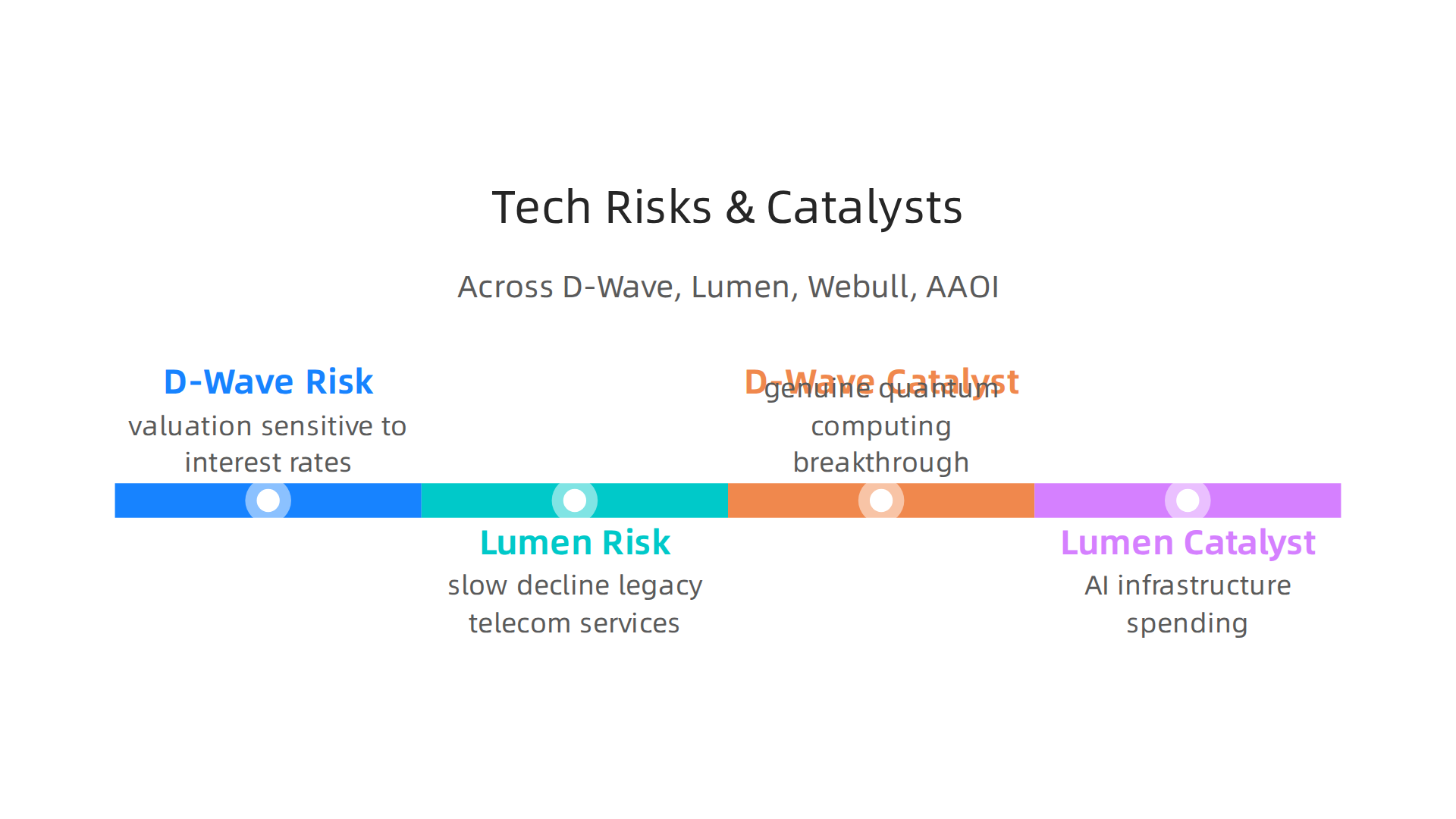
For a high-growth name like d wave stock, valuation is very sensitive to interest rates. If rates stay higher for longer, future cash flows get discounted more heavily, and a stock trading at 98x revenue can get crushed. That is exactly what happened when D-Wave fell 73% from its high. Regulatory changes are another wild card. Governments are still figuring out how to oversee quantum computing and AI. New rules could slow down adoption or raise compliance costs. Technological disruption is also real. D-Wave faces competition from IonQ, Rigetti, and even tech giants like Google and IBM. A breakthrough from a rival could make D-Wave’s annealing approach less valuable.
For lumn stock, the biggest risk is the slow decline of legacy telecom services. The company is cutting costs and pivoting to fiber, but it is fighting a long trend. Any slip in execution could push the stock lower.
Unique catalysts that could spark gains
D-Wave’s biggest catalyst is a genuine quantum computing breakthrough. The company is already selling its Advantage2 systems and growing its QCaaS subscription revenue. If D-Wave shows a big jump in commercial revenue, the stock could soar. The detailed growth projection analysis on TIKR shows the mid-case target of $22.14 relies on a 69.6% revenue CAGR. That is a steep bet, but if it pays off, the upside is massive.
For LUMN, the catalyst is AI infrastructure spending. Data centers need massive bandwidth, and Lumen’s fiber network could see new demand. That is a slower story, but one with real assets behind it.
Stocks like webull stock and aaoi stock sit in different corners of the same tech ecosystem. Webull benefits from retail trading and fintech adoption. AAOI plays in AI optical networking. Each has its own risk profile, but all depend on the same macro tailwinds.
An overall risk/reward framework
Think of it this way: D-Wave is a venture bet with huge potential and huge risk. LUMN is a turnaround value play with limited upside but more downside protection. Webull and AAOI are mid-range growth names. A balanced portfolio might include a small position in D-Wave for the lottery ticket, a larger position in LUMN for stability, and a mix of mid-cap tech for growth.
For a broader look at how different tech stocks fit together in a portfolio, check out our stock advisor top 10 picks for big tech investors guide. It gives you a repeatable way to compare risk and reward across the sector.
Summary
This article compares four high‑profile technology stocks—D‑Wave (quantum computing), Lumen (AI connectivity), Webull (fintech broker), and Applied Optoelectronics (AAOI, optical components)—to give investors a practical framework for separating hype from durable opportunity. It traces D‑Wave’s commercial progress with Advantage2, its bookings surge, and the planned gate‑model launch, and it evaluates Lumen’s strategic shift to edge AI, Webull’s rapid user and revenue growth, and AAOI’s booming optics orders alongside customer concentration risks. The piece breaks down relevant financials and valuation metrics, explains sector use cases (logistics, data centers, fintech), and highlights unique catalysts and common macro risks like rates and regulation. After reading, you’ll understand the business models, near‑term revenue drivers, and the specific risks that could move each stock, plus how to weigh a high‑upside quantum bet against steadier infrastructure and fintech plays.