

Introduction: Why Figma Stock Matters to Tech Investors
Remember when everyone thought Adobe was about to buy Figma for $20 billion? That deal fell apart in late 2023. And ever since, figma stock has become one of the most talked about private tech investments out there.
Here’s why you should care. Figma is not just another design tool company. It is a bellwether for the entire software as a service (SaaS) market.

When Figma’s valuation moves, it tells us something about how investors feel about cloud software, collaboration tools, and the future of work.
Let’s look at the numbers. In 2024, Figma raised $415.7 million in a Series F round at a $12.5 billion valuation, according to Electro IQ. Then in July 2024, a secondary market transaction pushed that valuation even higher. Crunchbase News reported that Figma raised $700 million at an $18.8 billion valuation in that deal. Big investors like General Catalyst and Coatue were involved, as noted by Clay.
And the revenue story is just as impressive. According to Sacra, Figma’s quarterly revenue climbed through 2025, hitting $303.8 million in Q4 alone. That is a 40% year over year jump. GetLatka reports Figma broke $820 million in annual revenue.
These numbers matter because they give us a window into the broader tech market. When you track figma stock through secondary markets, you are really watching a proxy for how the SaaS sector is doing. And in 2026, that is very important. As Aventis Advisors notes, SaaS companies are under pressure, with median valuation multiples dropping to 3.4x revenue. Figma’s performance tells us whether high growth companies can still command premium prices.
Many investors compare Figma to other big names. You might see discussions about capital one stock versus tech stocks, or disney stock versus growth stocks. But Figma is different. It is not yet on the new york stock exchange, though it has filed its S 1 and could list soon. Forge Global tracks Figma’s IPO timeline closely. And if you browse sofi stock reddit threads, you will see retail investors buzzing about Figma too.
The bottom line? Figma is the canary in the coal mine for SaaS investing. Whether it goes public in 2026 or stays private longer, its stock story will keep shaping how we think about tech valuations. For more context on how big tech stocks are moving this year, check out our coverage on the biggest movers in big tech stocks for 2026.
What Is Figma Stock? Understanding Private Company Shares and Secondary Markets
So before we go further, we need to clear up a big question. When people talk about figma stock in 2026, what exactly do they mean?
Here’s the short answer: Figma actually went public on July 21, 2025. That is right. The company listed on the new york stock exchange under the ticker FIG. According to Nasdaq Private Market, the IPO is now complete, and Figma is a fully public company.
But the story of its stock does not start there. For years before the IPO, "Figma stock" meant something very different. It meant shares traded on the secondary market. These are private transactions between existing shareholders and outside investors. Figma itself did not issue new shares or receive money from these deals. The shares just changed hands between people.
Why does this matter? Because private stock works differently than what you see with capital one stock or disney stock on a regular exchange.
**The key differences with private stock
**
- No public price. You cannot just look up the ticker. Prices are set in private deals between buyers and sellers.
- Limited disclosure. Private companies do not share financial reports the way public ones do. You have to guess at the numbers.
- Liquidity risk. You cannot sell whenever you want. There are lock-up periods and minimum holding times.
- Big institutional players. Most of the action happens between venture capital firms, hedge funds, and accredited investors.
Platforms like Forge Global, EquityZen, and Hiive made these trades possible. They connected people who wanted to sell Figma shares with people who wanted to buy them. As UpMarket explains, these trades generally occur on the secondary market, meaning Figma does not issue new shares or receive capital. The shares are privately exchanged between two parties.
Now that Figma is public, that has all changed. As of May 25, 2026, Figma (FIG) trades at around $22.71 per share, according to Investing.com. The stock has jumped more than 5% in a single day. You can track this data on the Figma investor relations page yourself.
Still, understanding the private market history is important. It helps you see why figma stock behaved the way it did before the IPO. And it helps you compare it to other private companies that might go public soon. You can also see how Figma’s journey compares to other big tech names in our coverage of IBM stock in 2026.
The bottom line? Figma stock is now a regular public stock on the NYSE. But the private market story behind it is what made it such a hot topic for so long.
And if you want to stay ahead of what is happening with Figma and other big tech stocks, sign up for our newsletter at cut through the noise with futures news for big tech.
Figma’s Valuation Evolution: From Unicorn to Post-Adobe Uncertainty
So now you know Figma is a public company trading on the new york stock exchange. But the path to that public listing was anything but straight. And the wild swings in figma stock valuation tell a fascinating story about investor belief, market pressure, and a collapsed mega-deal.
Let me walk you through how its valuation changed over time.
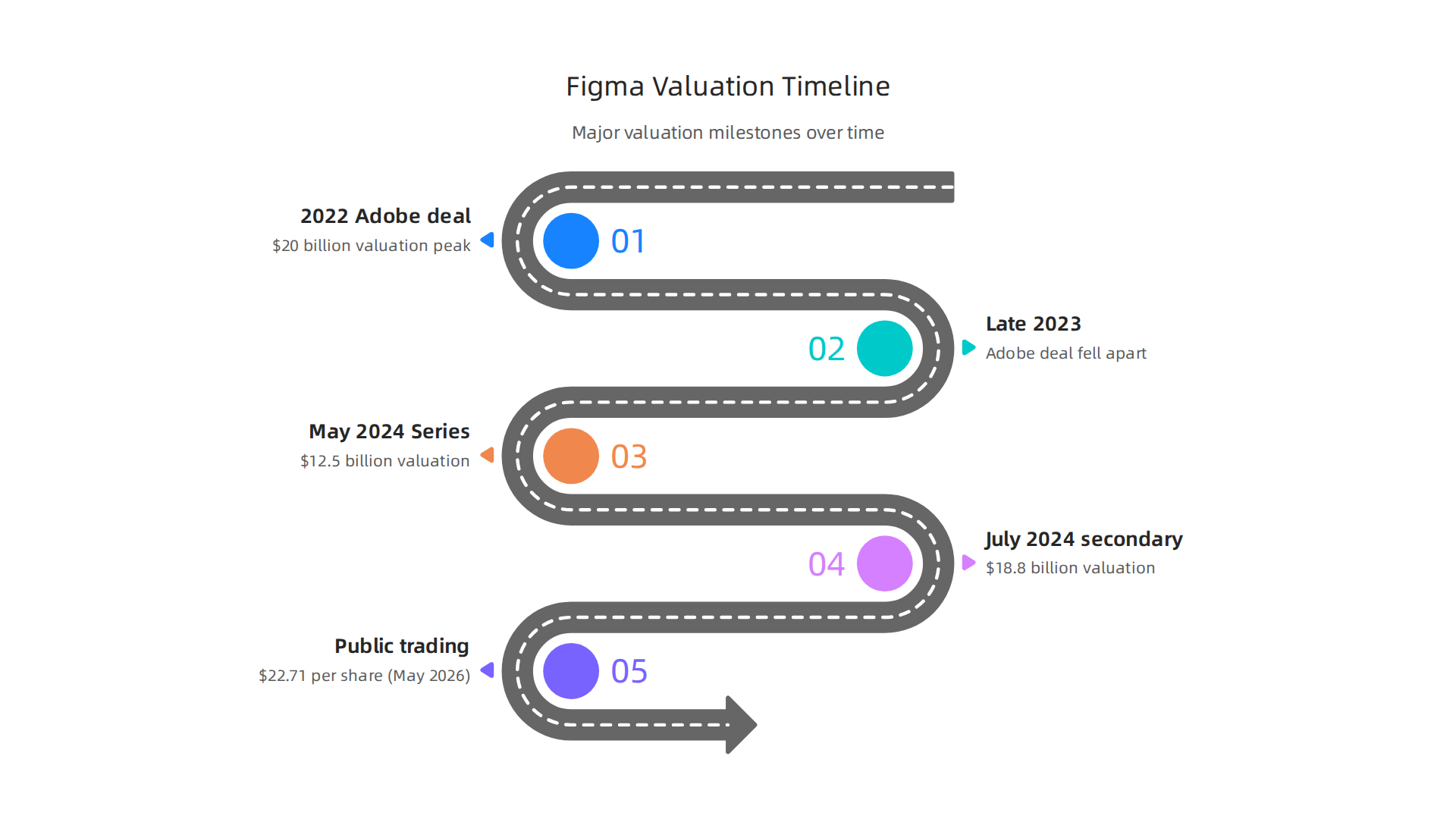
Because understanding this history helps you see why analysts still cannot agree on what Figma is worth today.
The $20 billion peak that almost was
In 2022, Adobe announced it would buy Figma for $20 billion. That was huge. The deal valued Figma at roughly 50 times its annual recurring revenue. Investors went wild. Early employees and venture backers thought they had hit the jackpot.
But then regulators stepped in. The deal faced intense scrutiny in Europe and the UK. By late 2023, Adobe and Figma walked away. The collapse sent shockwaves through the market.
According to Contrary Research, Figma had raised a $400 million Series C in January 2022 at a $17.5 billion valuation, led by ICONIQ. That was the peak. After the Adobe deal fell apart, the perceived value dropped fast.
The recovery through funding rounds
Figma did not sit still. It kept growing revenue and raising money. In May 2024, the company raised $415.7 million in a Series F round at a $12.5 billion valuation, as reported by Electro IQ. That was a big drop from $20 billion, but still a massive number for a private company.
Then in July 2024, things got interesting again. Figma raised $700 million in a secondary market transaction that valued the company at $18.8 billion, according to Crunchbase. Almost back to the Adobe deal level. Investors like General Catalyst and Coatue led the round, as noted by Clay.
Revenue growth drove the rebound
What caused this rebound? Simple. Revenue. Figma was posting incredible numbers. According to Sacra, in 2025 the company hit quarterly revenue of $228.2 million in Q1, then $249.6 million in Q2, $274.2 million in Q3, and $303.8 million in Q4. That is 38% to 46% year-over-year growth. Not many public companies can match that, and you can see the difference when you look at a more mature holding like IBM stock in 2026.
What Figma is worth today
Here is where it gets messy. Now that Figma is public and trading at around $22.71 per share, analysts still cannot agree. You will see estimates ranging from $10 billion to $25 billion. Why the huge gap?
Because Figma is still growing fast but faces tough competition from Canva and Adobe.

Its profit margins are improving but not fully proven. And the broader tech market has been volatile.
The company files regular updates on its investor relations page, so you can track the numbers yourself. But the wide range of opinions tells you something: even the experts are guessing.
The bottom line?
Figma’s valuation story is a roller coaster. From a $16 million seed round in 2013, as shared by Forge Global, to a $20 billion acquisition target, to an $18.8 billion private valuation, to a public listing with a split analyst consensus. The only certainty is that figma stock will keep moving.
Want to stay on top of these changes? Sign up for our newsletter at cut through the noise with futures news for big tech.
Figma vs. Public Peers: A Side-by-Side Valuation Comparison
You have seen how figma stock went from a private unicorn to a public company on the new york stock exchange. But how does it really stack up against the companies it competes with every day? That is what we will break down here.
Investors often compare figma stock to other well-known names like capital one stock or disney stock to get a feel for different sectors. And if you browse sofi stock reddit threads, you will see retail traders debating which high-growth tech bets are worth the risk. But the most useful comparisons for Figma are its direct peers in design and collaboration software.
Let me show you the numbers side by side.
The growth leader is clear
The biggest difference between Figma and its public peers is how fast revenue is growing. According to Figma’s first quarter 2026 financial results, the company posted $333.4 million in revenue for Q1 2026, up 46% year over year. That is blazing fast for a company already generating over $1.3 billion in annual revenue.
Now look at Monday.com, the closest public peer in the collaboration space. Monday.com reported $333.9 million in revenue for Q4 2025, growing 25% year over year, as shared in its Q4 2025 earnings release. That is solid growth, but Figma is growing nearly twice as fast.
Asana, another work management rival, is falling behind. According to a SaaStr analysis, Asana’s Q1 2026 revenue came in at $187.3 million with just 9% growth. That is a huge gap.
Then there is Adobe. The creative cloud giant is much larger, but its growth is much slower. Adobe also announced layoffs in 2026, which shows the company is cutting costs rather than expanding fast.
Customer loyalty tells the story
Revenue growth is important, but net dollar retention (NDR) shows how well a company keeps and expands existing customers. Figma’s NDR hit 139% in Q1 2026, as reported in its first quarter results. That means existing customers are spending 39% more each year.
Monday.com reported 110% NDR in Q4 2025, according to a comparison on Tech Insider. That is good for a mature SaaS company, but it does not compare to Figma’s expansion.
For context, a typical SaaS company with enterprise customers sees median NDR around 102%, as noted by SaaS Capital. Figma is blowing past that.
What does this mean for valuation?
Valuation multiples (like enterprise value divided by revenue) help investors compare companies regardless of size. Figma’s private valuation was around $18.8 billion in mid-2024, and its public market cap is still being discovered. Monday.com trades at a multiple of roughly 10 times revenue. Given Figma’s faster growth and higher NDR, it deserves a premium multiple.
But Canva, the private design rival, is still a threat. Its valuation is around $40 billion, but it does not have Figma’s collaboration focus. And Adobe’s slowdown opens the door for Figma to capture more market share.
The takeaway
When you line up figma stock against its peers, the growth and retention numbers are hard to ignore. No other public company in the space comes close to 46% revenue growth with 139% NDR. That is why analysts are still fighting over what Figma is worth.
Want to track how Figma performs against other big tech names? Check out our list of the biggest movers today in big tech stocks to stay ahead of the market.
The Role of Secondary Markets in Figma Stock Price Discovery
Before figma stock hit the new york stock exchange in July 2025, you could not just pull up a price on any trading app. There was no "FIG" ticker to follow. So how did early investors, employees, and insiders know what their shares were actually worth? They relied on the secondary market.
What is a secondary market anyway?
Think of the secondary market as a private marketplace where existing shareholders sell their company shares to outside investors. The company itself does not issue new stock or raise money from these trades. Instead, shares are privately exchanged between two parties.
Platforms like Forge Global and EquityZen make this possible.
As UpMarket explains, trades happen between individual buyers and sellers, not on a public exchange. This gives us real time pricing data that official company updates simply cannot provide.
How secondary markets revealed Figma’s true value
Before the IPO, figma stock traded on secondary platforms at prices that reflected real investor sentiment. When growth looked strong, prices climbed. When concerns about competition or market slowdown surfaced, prices dropped. This kind of movement is invisible in company press releases.
One detailed analysis on TIKR noted that Figma shares fell as much as 85% from their peak in secondary trading before rebounding. That volatility showed just how much uncertainty surrounded the company’s valuation ahead of its public debut.
The IPO changed everything
The biggest secondary market event for any private company is its initial public offering. When Figma completed its IPO on July 21, 2025, as tracked by Nasdaq Private Market, the entire game shifted. Suddenly, anyone could buy or sell shares at a transparent, public price.
As of May 25, 2026, figma stock (FIG) traded at $22.71 per share, according to Investing.com. You can also check the official stock info page from Figma’s investor relations for daily updates on price and volume.
Why this still matters
Now that Figma is public, the secondary market is less important for everyday trading. But understanding how those private prices moved before the IPO gives you a much better picture of the full story. The journey from private trades to the NYSE shaped investor expectations along the way.
If you want to track how Figma and other big tech names are moving right now, you can cut through the noise with futures news for big tech. That will help you spot trends before they hit the mainstream headlines.
Key Financial Metrics to Watch for Figma Stock Performance
Now that Figma trades on the new york stock exchange under the ticker FIG, you can finally check its price any day. But the price alone does not tell you if figma stock is a good buy. To really understand the company’s health and future, you need to look at a handful of key financial metrics.
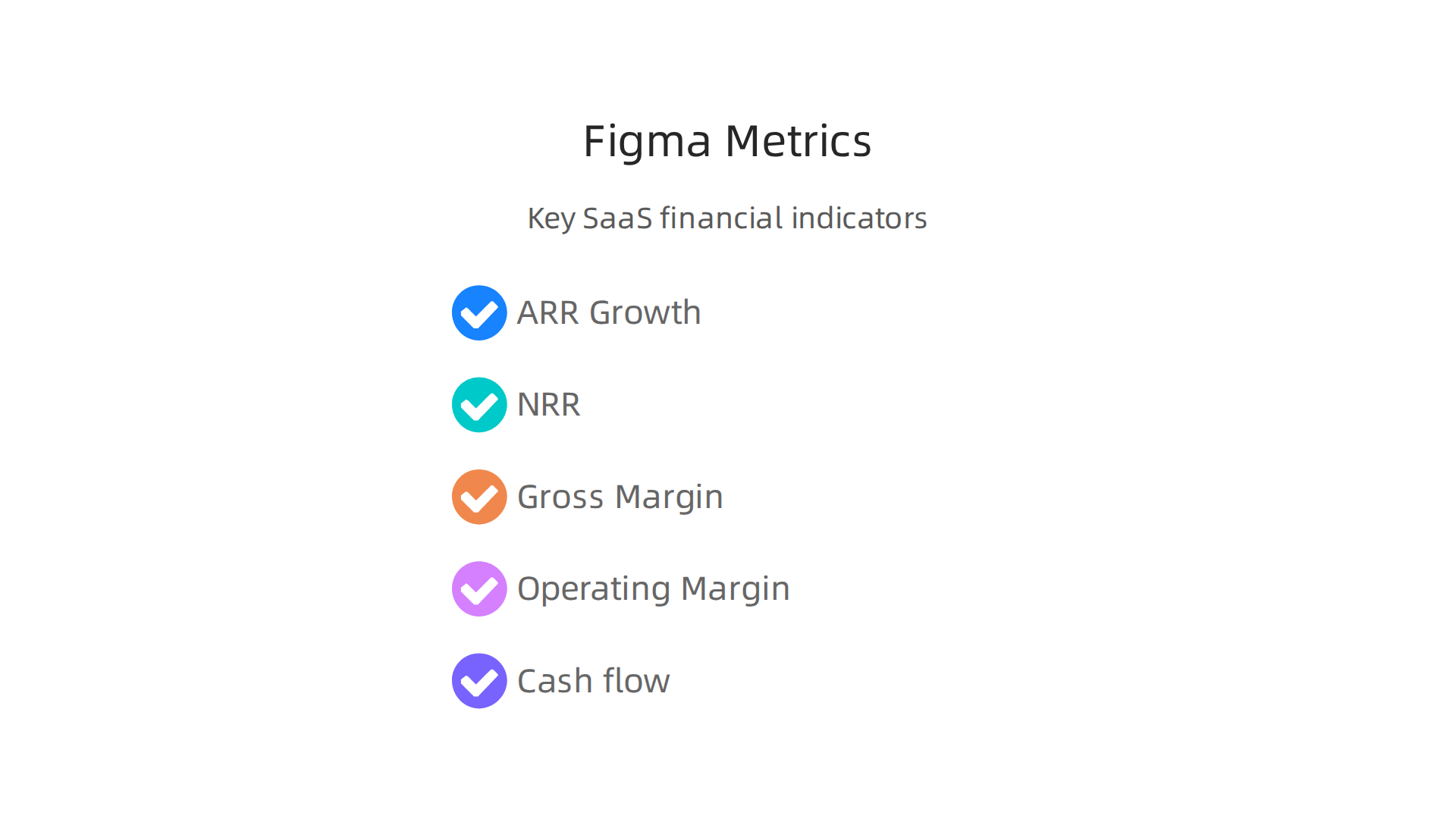
These numbers reveal how the business is actually performing behind the headlines.
Annual Recurring Revenue (ARR) Growth
ARR is the most important metric for any software-as-a-service company. It shows the predictable, repeatable revenue the company earns each year from subscriptions. When ARR grows fast, it means more customers are signing up and existing ones are spending more.
Before its IPO, Figma reported an ARR of $912 million with 46% year-over-year growth, according to an S1 breakdown from Mostly Metrics. That growth continued after going public. In Q1 2026, Figma posted revenue of $333.4 million, up 46% from the same quarter last year, as stated in their first quarter 2026 financial results.
A 46% growth rate is rare for a company of Figma’s size. It tells investors that the product is still winning new customers and expanding its reach. If that growth slows down in future quarters, it could signal that competition is catching up or the market is saturating.
Net Revenue Retention (NRR)
NRR measures how much revenue the company keeps and grows from its existing customer base. The magic number here is 100%. Anything above 100% means customers are spending more over time, which is a strong sign of product stickiness and satisfaction.
Figma’s NRR was 132% at the time of its IPO. By Q4 2025, it had climbed to 136%, and by Q1 2026, it hit 139%, according to the company’s Q1 2026 earnings release. That is an incredible number. For comparison, a recent analysis of SaaS companies shows that median net revenue retention for firms with annual contract values between $25,000 and $50,000 is only 102%, as noted by SaaS Capital. Figma is far above that.
A high NRR means Figma’s customers are not just staying. They are upgrading, adding seats, and buying new features. This is a huge driver of long-term figma stock value.
Gross Margin and Operating Margins
Gross margin tells you how much money the company keeps after paying for the direct costs of delivering its software. For SaaS companies, good gross margins are usually above 70%. Figma hit an impressive 88% gross margin in 2024, according to the Mostly Metrics S1 breakdown. That means almost every dollar of revenue goes toward profit and growth spending.
Operating margin shows whether the company is profitable after all expenses, including sales, marketing, and research. Figma reported a net income of $45 million in Q1 2025, up from $14 million the year before, as noted in the Mostly Metrics article. That profitability, combined with strong cash flow from operations, gives the company room to invest in AI features and new products without needing to raise money.
Cash flow is the final piece. Positive free cash flow means Figma generates more cash than it spends, which is a sign of financial health. All these metrics together show that Figma has excellent unit economics.
Putting It All Together
When you follow figma stock, do not just watch the daily price moves. Keep an eye on quarterly earnings reports for ARR growth, NRR, gross margin, and operating margins. If those numbers stay strong, the stock has solid ground to stand on.
To track how Figma and other big tech names are performing right now, you can check the biggest movers today in big tech stocks for 2026. That page helps you see which stocks are gaining or losing momentum each day.
Risk Factors Impacting Figma Stock Value
Every investment comes with risks. Figma stock is no different. Even with strong financial metrics, a few big threats could hurt the company’s value.

Here are the main ones to watch.
Regulatory and Legal Risks
Figma’s path to the new york stock exchange was not smooth. The company faced a tough antitrust review when Adobe tried to buy it. That deal fell apart. Now as a public company, Figma must deal with changing SEC rules and possible new regulations.
One big question is how the government will treat AI features in design tools. If regulators decide that AI tools need special oversight, Figma could face new compliance costs. These costs would eat into profits and slow down growth. For investors eyeing figma stock, regulatory headlines matter just as much as earnings reports.
Competitive Pressure from All Sides
Here is the thing about the design software market. It is getting more crowded every month.
Adobe is still the 800-pound gorilla. It has deep pockets and a huge customer base. Canva keeps adding features and winning over casual users. And then there are the new AI design tools popping up all the time. As one analyst notes, valuations for tech companies are still driven by growth rates. But with growth rates slowing across the industry, competition gets even fiercer for every new customer, as discussed in this analysis of SaaS valuation threats.
Figma needs to keep innovating to stay ahead. If it falls behind on AI features or fails to match what competitors offer, customer growth could stall. That would put pressure on figma stock over time.
Macroeconomic Headwinds
The economy in 2026 is not giving SaaS companies an easy ride. Interest rates are still high compared to a few years ago. When rates go up, growth stocks like Figma tend to drop in value. That is because investors prefer safer returns from bonds instead of betting on risky tech stocks.
In fact, SaaS valuations hit decade-plus lows in Q1 2026 as markets weighed the risks of AI disruption, according to the SaaS Capital trends report. The median valuation multiple for SaaS companies is now at 3.4x revenue, as shown in this SaaS valuation multiples analysis. That means even great companies trade for less than they would have a few years ago.
If a recession hits or companies cut their software budgets, Figma could see slower growth. Enterprise customers might delay upgrades or reduce the number of seats they pay for. That would show up as lower ARR growth in future earnings reports.
What This Means for You
These risks do not mean figma stock is a bad investment. But they do mean you need to stay informed. Watch quarterly earnings for signs of slowing growth or rising competition. And keep an eye on the broader market too.
To track how Figma and other tech names are moving day to day, check out our page on the biggest movers today in big tech stocks for 2026. It helps you spot trends early and make smarter decisions about your portfolio.
How to Track Figma Stock: Tools, Data Sources, and Analyst Reports
So you understand the risks. Now you want to actually track figma stock. But here is the problem: Figma is not listed on the new york stock exchange like disney stock or capital one stock. Those companies trade publicly every day. Figma remains private. So how do you follow its value and make informed decisions?
You need different tools. Let me walk you through the best ways to track figma stock in 2026.
Secondary Market Platforms
Private company shares change hands on special marketplaces. These platforms give you real price data and volume trends.
Forge Global is one of the leaders. It offers actionable views of share prices and valuations. You can set alerts when prices move. Another solid option is EquityZen. Their Private Market Map gives educational resources and market insights. You can see recent trades and understand what investors are paying for figma stock.
Carta also provides tools for tracking private capital. While it focuses more on companies managing their cap tables, investors can use it to see ownership data and secondary transactions.
The key here is to sign up for push notifications. When a large block of Figma shares trades, prices can shift quickly.
Analyst Reports and Independent Research
Public stocks like capital one stock get covered by every analyst on Wall Street. Private stocks require more digging.
Some investment banks and independent research firms now cover late-stage private tech. Morningstar offers stock analysis and ratings for public companies, but they also track private valuations through their equity research reports. You can find analysis that references figma stock by subscribing to their private market coverage.
Independent researchers also publish reports. They look at Figma’s revenue growth, user numbers, and competitive position against Adobe and Canva. These reports are not free, but they give you the same kind of data you would get for a public stock.
Official Channels and Community Insights
Figma does have an investor relations page. Even private companies sometimes share press releases about funding rounds, acquisitions, or major product launches. Bookmark that page.
Do not overlook community discussions either. Platforms like Reddit have active investor communities. The sofi stock reddit community is famous for sharing trading ideas. Similar subreddits exist for private company investing. You can find real talk about figma stock there, but always verify the facts.
Putting It All Together
Tracking a private stock takes more work than checking the new york stock exchange ticker. But with the right platforms, analyst reports, and community insights, you can stay informed.
To get a broader view of the tech market that influences Figma, check out our guide on cutting through the noise with futures news for big tech companies. It helps you spot macroeconomic trends that affect private valuations.
Expert Predictions: Figma IPO Timeline and Future Stock Outlook
So when will you finally see figma stock trading on the new york stock exchange? That is the million dollar question. Based on everything we know in 2026, the pieces are lining up for an initial public offering sooner rather than later.
Most analysts predict Figma will go public within the next 12 to 18 months. That window would put the IPO sometime in late 2026 or early 2027. There are strong reasons behind that timeline.
First, Figma is already acting like a public company. It has an investor relations page where it shares earnings calls and financial results. The company reported full-year 2025 revenue of over $820 million, according to GetLatka. Quarterly revenue grew about 40% year over year through all four quarters of 2025, as Sacra details. That kind of growth attracts Wall Street.
Second, the company has already tested the waters. In July 2024, Figma raised $700 million in a secondary transaction that valued the company at $18.8 billion, per Crunchbase News. That is up from the $12.5 billion valuation in its Series F round just two months earlier. The jump shows strong investor demand.
In fact, Crunchbase also reported that Figma boosted its IPO range and is targeting a listing on the New York Stock Exchange. That is a clear signal the company is preparing to go public.
An IPO would unlock liquidity for early investors and employees. Right now, you can only buy figma stock on secondary markets like Forge Global. Once the company lists, anyone can trade it just like disney stock or capital one stock. The valuation would also align with public company multiples, which could mean a higher price per share.
But what if the IPO takes longer than expected? Even without a public listing, the secondary market is getting deeper. More buyers and sellers means better pricing and more transparency. You can track the daily action on platforms like EquityZen. The market for private figma stock already shows healthy volume.
One thing to watch is the broader tech market. Public tech stocks have been volatile in 2026. A strong market helps IPO pricing. A downturn could delay plans. Our guide on the biggest movers today in big tech stocks can help you see which sectors are driving sentiment.
The bottom line: Figma is on a clear path to an IPO. The revenue numbers are solid. The investor interest is real. Whether you buy now on a secondary platform or wait for the NYSE debut, the outlook for figma stock looks promising.
Summary
This article explains the full story behind Figma stock, from its years on private secondary markets to its public listing and how investors should evaluate it today. It reviews the dramatic valuation swings—peaking around the proposed Adobe deal, sliding after regulatory scrutiny, then rebounding through secondary financings—and shows how revenue and retention fueled the recovery. You’ll learn the differences between private-share trading and public stock behavior, which key SaaS metrics (ARR, net revenue retention, gross margins) matter most, and how Figma compares to peers like Monday.com, Asana, Adobe, and Canva. The piece also outlines the main risks—regulation, competition, and macroeconomic pressure—and practical tools and platforms for tracking or buying FIG. Finally, it discusses how the IPO changed liquidity and what to watch next for Figma’s ongoing valuation and stock performance.