
Introduction: Why US Stock Futures Matter for Big Tech Investors
Picture this: it’s 6 AM, and the stock market hasn’t opened yet. But you already have a good idea of whether Apple, Microsoft, or Nvidia will rise or fall today.

How? US stock futures.
These are contracts that let investors trade major indexes like the Nasdaq-100 before the regular session starts. They start moving as early as 6 PM ET the night before. For anyone tracking mega-cap tech stocks, those early moves are like a sneak peek at the day ahead.
Here’s why that matters. If futures are dropping sharply before the bell, it often means bad news is priced in. Maybe a surprise interest rate hike, a disappointing earnings report, or a geopolitical shock. If they are climbing, confidence is building. That’s valuable information when you hold shares in companies where a single day’s swing can move billions.
Take the Nasdaq-100, which is packed with the biggest tech names. The E-mini Nasdaq-100 futures contract tracks that index directly. It is designed to help investors manage exposure to the 100 leading non-financial U.S. large-cap companies, according to the CME Group’s E-mini Nasdaq-100 futures overview. So when those futures move, they reflect what professional traders think about the very stocks you care about.
But here’s the challenge. With so much noise online, it is easy to get distracted by flashy headlines or late-breaking chatter. You need a clear, data-backed way to connect futures movements to your actual holdings. That is exactly what this article delivers.
In the sections ahead, we will break down how US stock futures link to major positions, how to read them without the hype, and what to watch for during earnings season and macro shocks. Whether you track Apple, Nvidia, or even Berkshire Hathaway stock, this framework helps you stay ahead.
Want to stay ahead even faster? Get clear daily AI updates that move markets by checking out The AI Newsletter Worth Reading. It’s a great way to cut through the noise and focus on what actually matters for big tech investors.
First up, let’s look at what US stock futures really tell you before the opening bell. We already have a guide on how to cut through the noise with futures news for big tech to get you started.
What Are US Stock Futures? Mechanics and Key Data Sources
US stock futures are contracts that let you bet on where major indexes like the S&P 500, Nasdaq-100, and Dow Jones will open in the next session. They are not the indexes themselves. They are agreements to buy or sell the index at a future price. That small difference matters a lot when you are trying to read market direction before the regular trading day begins.
Here is how they work.
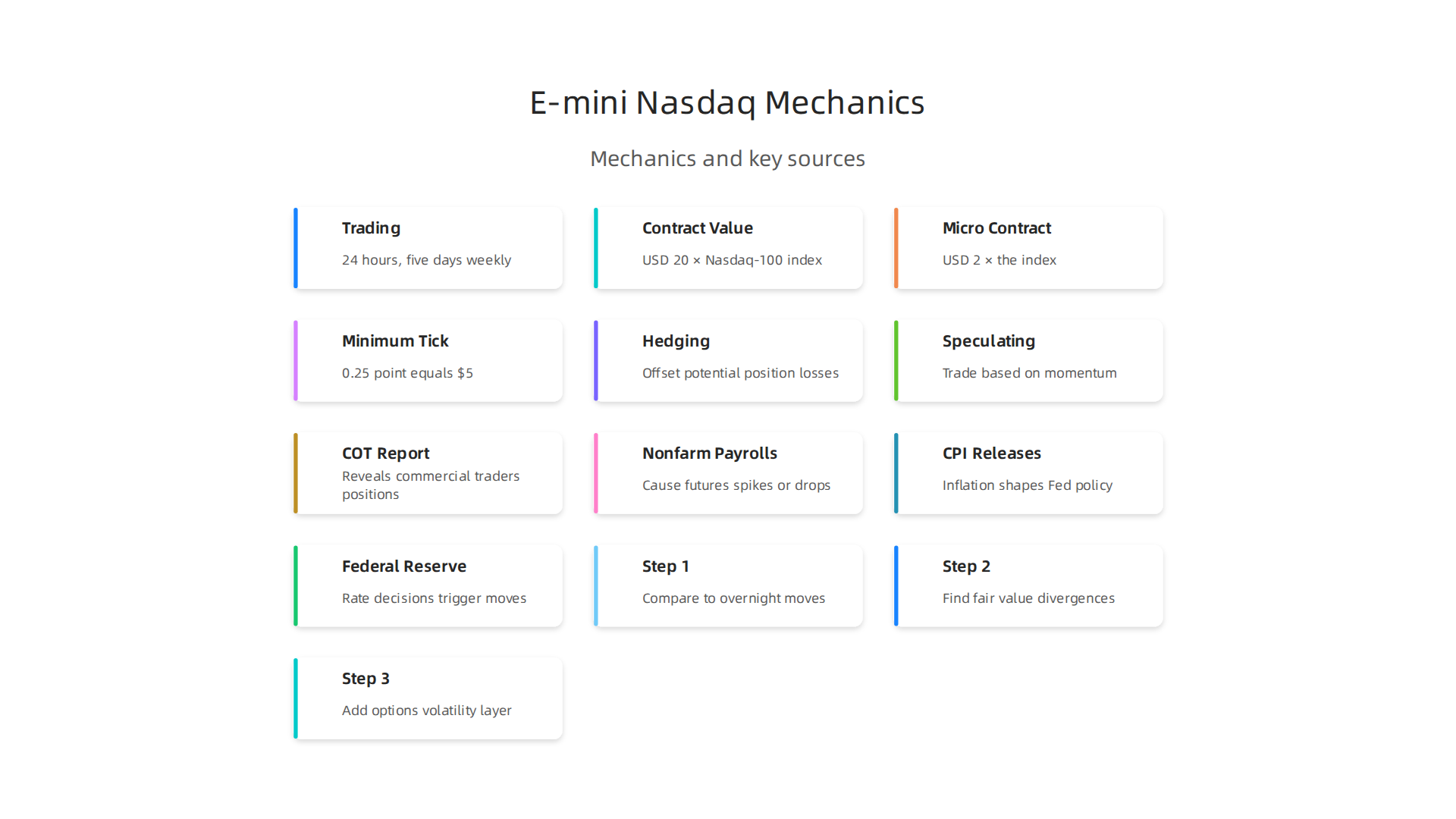
These futures trade on the CME Globex platform nearly 24 hours a day, five days a week. Trading starts Sunday at 6 PM ET and runs until Friday at 5 PM ET, with a short daily maintenance break. That means you can track big tech sentiment almost any time, even when the regular stock market is closed. If news breaks overnight, the futures move immediately.
The most watched contracts for tech investors are the E-mini Nasdaq-100 futures. Each contract represents $20 times the Nasdaq-100 index. So if the index sits at 20,000, one contract is worth about $400,000. That is serious money, which is why professional traders use them to hedge or speculate. For smaller investors, the Micro E-mini Nasdaq-100 contract exists at one-tenth the size, or $2 times the index.
The key detail to understand is the minimum tick. Each 0.25 index point move equals $5.00 per contract. That comes straight from the E-mini Nasdaq futures contract specifications on Schwab. That small increment adds up fast when you are tracking big moves.
Where do you get the data? The main source is CME Group, which operates the exchange. You can view live prices and open interest on their E-mini Nasdaq-100 futures quotes page. That gives you official settlement prices, trading volume, and contract calendars.
Beyond CME, you have trading platforms and news terminals. Bloomberg and Reuters offer deep data but cost a lot. For individual investors, broker platforms like TD Ameritrade, Interactive Brokers, and Charles Schwab provide futures data in their trading apps. Free sites like TradingView and MarketWatch also show real-time or delayed quotes. And if you follow bill ackman news or warren buffett berkshire hathaway moves, you can often see those narratives show up in futures pricing before the open.
If you want to sharpen how you track markets, you can learn to filter Yahoo Finance news for big tech market insights. It helps you separate useful futures signals from the daily noise.
The real power of understanding these mechanics is this. When you see the Nasdaq-100 futures dropping sharply before the bell, you know roughly how mega-cap stocks like Apple, Microsoft, or Nvidia are likely to open. That head start gives you time to decide whether to adjust your positions, watch for buying opportunities, or simply stay patient.
The Correlation Between Stock Futures and Big Tech Holdings
Now that you understand how US stock futures work, here is why they matter most for big tech investors. It comes down to concentration.
The Nasdaq-100 and S&P 500 are not balanced. A handful of stocks pull the entire index. Nvidia, Apple, Microsoft, Alphabet, Amazon, and Meta make up a huge share of the weight. In fact, almost 100% of the Nasdaq-100’s gains in the first half of 2026 came from just ten stocks, according to a MarketWatch report on the Nasdaq-100’s concentrated gains in early 2026. That means when you look at Nasdaq futures, you are really looking at a bet on those few mega-cap names.
That tight link gives futures their predictive power. When US stock futures move overnight, especially the E-mini Nasdaq contracts, they tend to set the tone for how Nvidia, Apple, and their peers will open. The Barchart analysis of Nasdaq year-end correlations and seasonal Q4 patterns shows that futures movements have historically tracked closely with the actual open of tech ETFs. If futures drop 1% before the bell, there is a strong chance the big tech stocks will open lower by a similar amount.
But the relationship is not perfect. Sometimes news about sector rotation or fears of an AI bubble can cause a gap. For example, if investors suddenly shift money out of tech and into energy stocks, the Nasdaq futures might fall while a specific stock like Microsoft holds up better. Those divergences create a useful signal. If you see the futures dropping but your favorite big tech stock is flat in premarket trading, it could mean the selling is broad and not targeted. That can help you decide whether to hold or adjust.
To stay on top of these signals, you need a clean view of futures news without the noise. You can learn to cut through the noise with futures news for big tech and build a sharper routine.
The bottom line is this. Watch the futures. Watch the top holdings. When they move together, trust the signal. When they split, look for the opportunity.
If you want to take your tech market awareness even further, consider a resource that delivers clear daily insights. The AI Newsletter Worth Reading offers straightforward AI updates that help you connect the dots between big tech news and market moves.
How Institutional Investors Use Futures to Hedge and Speculate on Tech Positions
Imagine you manage a large portfolio stuffed with Nvidia and Microsoft shares. Earnings season is coming, and you want to protect yourself if the numbers disappoint. You do not want to sell your core holdings because you believe in the long-term story. So what do you do? You use micro or mini S&P futures to hedge.
This is standard practice for big money managers. They buy or sell futures contracts to offset potential losses in their concentrated tech positions. The 2026 hedge fund outlook confirms that hedge funds continue to prove their value as risk-mitigation tools, especially during volatile periods. By shorting E-mini Nasdaq futures before an earnings release, an institution can lock in gains or limit downside without triggering a taxable sale. It is a clean, efficient way to sleep better at night.
On the other side of the trade sit the speculators. Commodity Trading Advisors, or CTA funds, trade futures based on momentum and sentiment. When us stock futures rise overnight, CTAs pile on, buying more contracts and pushing prices higher. This can amplify moves in big tech stocks, creating a feedback loop. If you are watching from the sidelines, you might see a stock jump 3% in the first hour only because futures triggered a wave of algorithmic buying. Understanding this dynamic helps you separate real news from noise.
Another powerful tool is the Commitment of Traders (COT) report. Published weekly by the CFTC, it reveals the positioning of commercial traders (hedgers like Berkshire Hathaway or other institutions) versus non-commercial traders (speculators and hedge funds). When commercials are heavily short and speculators are heavily long, it can signal a turning point. Many professional traders use this data to gauge whether tech exposure is overcrowded. Even activist investors like Bill Ackman reportedly track these numbers to time their moves.
Bloomberg terminals give institutional clients real-time access to futures order flow and COT data. That is the kind of edge that separates pros from retail traders.
To deepen your understanding of how the biggest players operate, check out this breakdown of Renaissance Technologies’ quant strategies and their use of futures in tech stocks. It shows you exactly how the quants think.
The bottom line is that us stock futures are not just for day traders. They are the primary tool institutions use to hedge risk and speculate on direction. By watching the same data they watch, you can sharpen your own big tech strategy.
Key Economic Indicators That Move US Stock Futures – and Their Impact on Tech
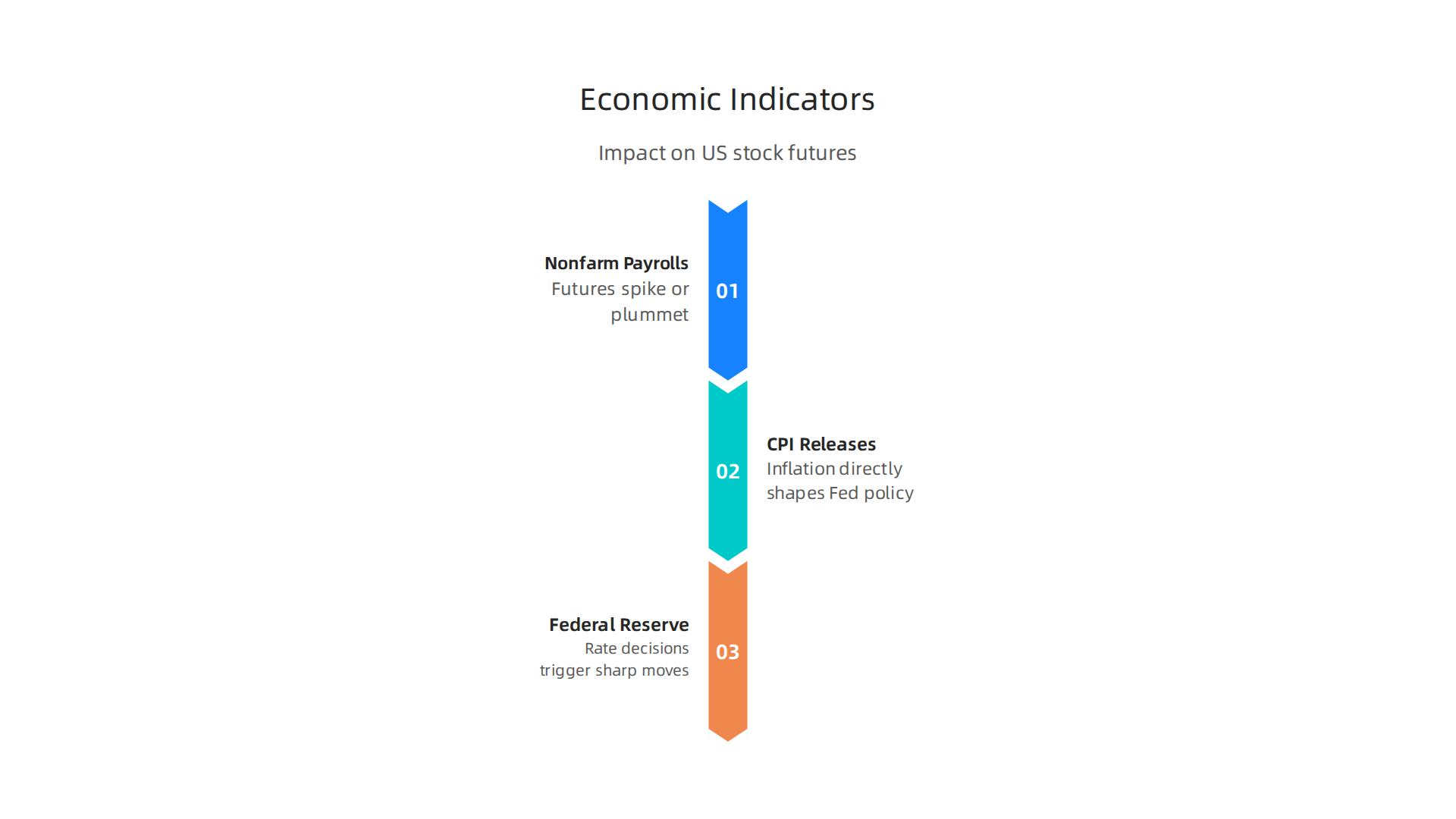
Picture this: It is 8:30 AM Eastern on a Friday. You have your coffee in hand and your screen split between Bloomberg and your brokerage account. The nonfarm payrolls number hits. Within seconds, us stock futures spike or plummet. The Nasdaq-100 might swing 200 points before you finish your sip.
This happens every month. Events like Nonfarm Payrolls, CPI releases, and Federal Reserve rate decisions trigger sharp moves in futures that often overshoot the eventual cash market reaction. The reason is simple. Algos and high-frequency traders process the data in milliseconds. If the number is hotter than expected, they buy (or sell) first and ask questions later. That initial lurch can be exaggerated because liquidity is thinner before the regular session opens. But that exaggeration creates opportunities for patient investors. When futures overreact to a nonfarm payrolls miss, you can often buy quality tech stocks at a discount and hold through the recovery.
The key is understanding which indicator matters most at any given time. In 2026, the sensitivity of Nasdaq futures changes depending on the rate environment. When rates are rising or staying high, CPI data hits harder because inflation directly shapes Fed policy. When rates are falling or flat, employment numbers take center stage because the market is more worried about growth than inflation. Traders who only watch one number get caught flat-footed. You need to update your mental model based on where the macro cycle sits.
Research shows that heavy hitters like Nonfarm Payrolls, CPI, and FOMC announcements drive the biggest moves across all futures contracts. The market’s initial reaction often looks dramatic, but the real trend takes hours or days to develop.
To sharpen your edge in reading these signals, check out this guide on futures news for big tech. It walks you through separating actionable signals from noise.
If you want to stay ahead of how every CPI print and Fed decision reshapes the tech landscape, get clear daily AI updates from The Deep View Newsletter. It delivers the context you need to interpret macro data and its ripple effects on your portfolio.
AI and Machine Learning in Futures Analysis: Smarter Signals for Tech Investors
Now that you know which economic indicators move the market, the next question is: How do you spot those moves before everyone else? This is where AI and machine learning enter the picture.
Quantitative hedge funds and retail platforms alike now use machine learning models to predict short-term direction for us stock futures from order book data and news sentiment. A 2025 study proposed a hybrid Random Forest–Long Short‑Term Memory (LSTM) framework for forecasting the S&P 500 and found that combining feature selection with deep learning significantly improved accuracy over traditional models. You can read the full results in this analysis on Impact of global indices on forecasting the S&P 500 index. The takeaway: ML models can catch patterns human traders miss, especially when order book flows shift seconds after a CPI or jobs number drops.
Another powerful technique is sentiment analysis of tech earnings call transcripts. By scanning the tone of executives’ language during Q&A sessions, models can flag whether the team is confident or hedging. When you pair that sentiment signal with concurrent futures movements, swing traders can generate alpha. For instance, a cautious tone from a major AI hardware maker might correlate with a drop in Nasdaq futures before the regular session even opens.
Free tools like Google Trends and ChatGPT plugins offer basic predictive signals. You can check search interest for “AI chips” or ask a large language model to summarize recent news sentiment. But professional quants go deeper. They use proprietary models with multi‑factor inputs — everything from satellite imagery of factory parking lots to central bank speech text — to build an edge. To understand how the biggest quant firms operate, check out this breakdown of the quant strategies behind major tech stocks.
Whether you are a retail trader or a seasoned investor, adding even a simple ML signal to your futures workflow can help you separate the noise from real opportunity.

And to stay on top of how AI itself is reshaping the entire tech landscape, The AI Newsletter Worth Reading delivers clear daily updates that connect the dots between machine learning breakthroughs and market moves.
Practical Playbook: Interpreting US Stock Futures for Tech Portfolio Decisions
You see the futures flashing red before the market opens. Should you sell your tech stocks or wait? Here is a practical three-step framework to turn pre-market noise into clear decisions for your portfolio.
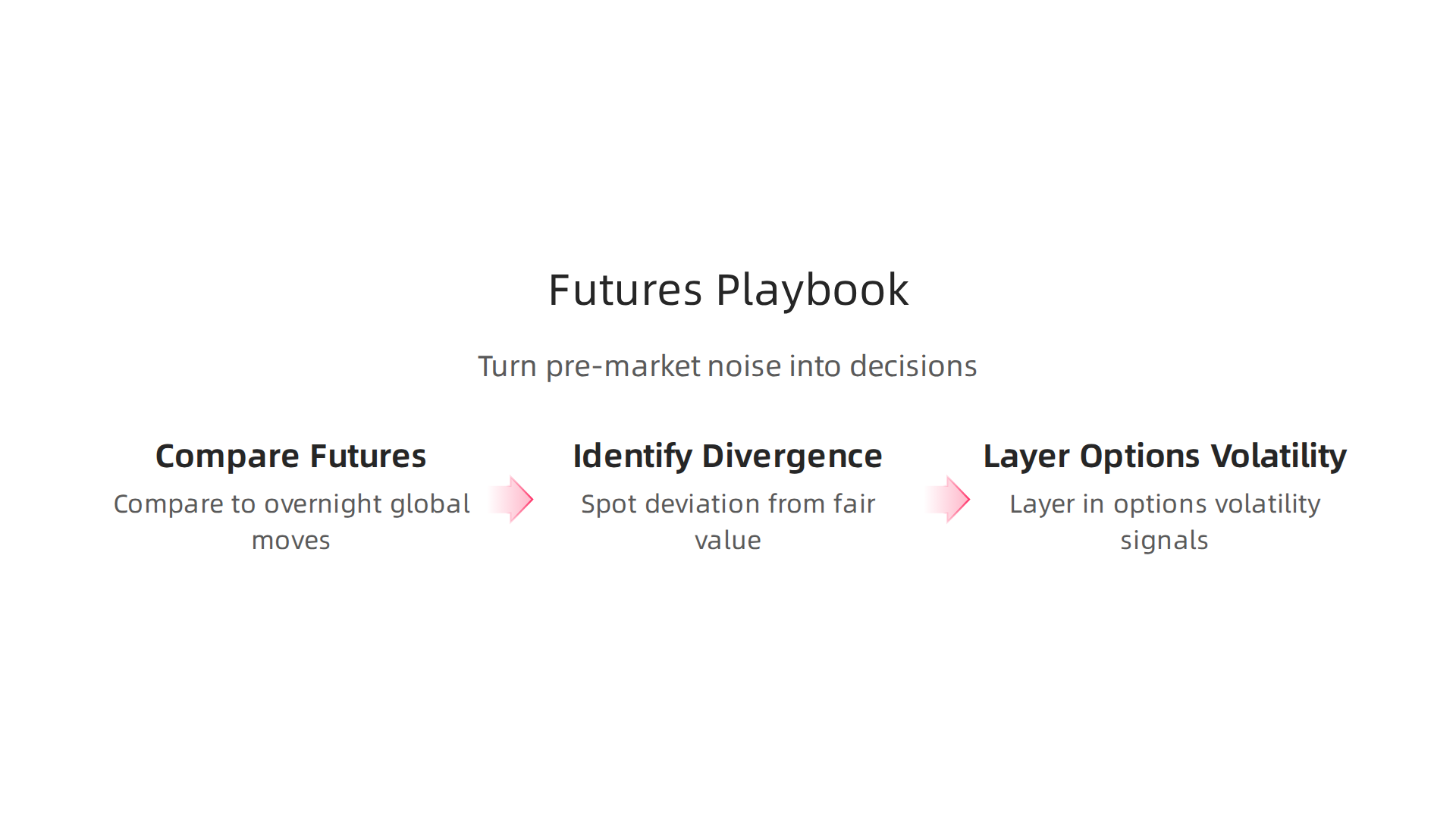
Step 1: Compare Futures to Overnight Global Moves
Start by looking at where S&P 500 and Nasdaq 100 futures are trading relative to fair value. Then check what happened overnight in Asia and Europe. If Japanese tech stocks dropped 2% but US futures are only down 0.5%, that gap tells you the US market is holding up better than global peers. That could signal a buying opportunity if the weakness is local to Asia. On the flip side, if European markets rallied but US futures stay flat, it may point to tech-specific headwinds at home. According to the 2026 market outlook from Morgan Stanley, the bull market is expected to continue, but geopolitical risks make global comparisons critical. Bloomberg ownership of data terminals gives institutional traders an edge in tracking real-time futures flows, but you can get enough data from free broker platforms or TradingView.
Step 2: Identify Divergence from Fair Value in Mega-Cap Tech
Futures divergence from fair value is one of the simplest signals for overbought or oversold conditions. If Apple, Microsoft, and Nvidia are all up big in pre-market but futures are only slightly above fair value, the rally may not hold. Conversely, if futures are deeply negative but your favorite mega-cap tech stock reports strong earnings, the fear might be overdone. This is where you combine futures data with individual stock catalysts. News about major investors like Warren Buffett’s Berkshire Hathaway stock moves or Bill Ackman’s latest holdings can also create futures ripples before the regular session opens. A product launch from a leading AI chipmaker could push Nasdaq futures higher even if the broader market is cautious.
Step 3: Layer in Options Volatility for Tail Risk
Futures alone do not tell the full story. You also need to check options implied volatility. The VIX measures overall market fear, while the SKEW index shows the perceived risk of a rare tail event. If futures are pointing lower and the VIX is spiking above 30, your concentrated tech holdings face serious downside risk. The SKEW reading tells you if that risk is a normal pullback or a potential crash. For example, when SKEW rises above 150, options markets are pricing in an unusually high chance of a 2%+ drop. That is a signal to reduce position size or buy protective puts. For a deeper look at how volatility measures work with futures, check out this guide on how the VIX stock became a big tech volatility index.
Using this playbook, you can turn the chaos of pre-market futures into a repeatable decision process. The key is to never rely on futures alone. Always compare with global markets, check divergence from fair value, and layer in volatility data to protect your tech portfolio from unexpected shocks.
Summary
This article explains how US stock futures—especially E‑mini and Micro E‑mini Nasdaq‑100 contracts—give investors an early read on how mega‑cap tech stocks may open and trade. It covers the mechanics of futures trading, where to get real‑time data, and why the Nasdaq‑100’s concentration in a few names makes futures a powerful indicator for Apple, Nvidia, Microsoft and peers. You’ll learn how institutions use futures to hedge or speculate, how macro releases like CPI and nonfarm payrolls drive premarket moves, and how AI and ML models can improve short‑term signals. The piece gives a practical three‑step playbook for interpreting divergence, comparing global markets, and adding options volatility to manage risk. Throughout, it emphasizes cutting through headline noise and using clean, repeatable checks to turn premarket futures quotes into actionable portfolio decisions.