
Introduction: The Noise Problem and the Promise of Context-Rich Futures News
You open your news feed and feel it right away. Headlines flying past. Alerts buzzing every few minutes. Stock market updates blending into AI announcements and earnings reports. It is a lot. Actually, it is too much.

The intersection of Big Tech and financial markets in 2026 is more volatile than ever. AI is reshaping entire industries overnight. Companies like IBM are racing to adapt, and the ripple effects hit everything from dow futures to international finance. As PwC notes, more firms are adopting enterprise-wide AI strategies at a rapid pace. Meanwhile, Deloitte reports that technology innovation is accelerating, and organizations are moving from experimentation to real impact.
Here is the problem. Traditional news feeds overwhelm you with superficial updates. You get the what but not the why. You see a price move but not the story behind it. That is where futures news comes in. When properly contextualized, futures news gives you a forward-looking lens. It helps you anticipate moves instead of just reacting to them.
But here is the thing. Not all futures news is useful. You need a way to separate signal from noise. You need a repeatable workflow that prioritizes the indicators that truly matter for your decisions.
This article gives you exactly that. We provide a research-backed framework to cut through the clutter. You will learn how to spot high-impact signals, ignore the distractions, and build a daily routine that keeps you ahead.
Stay ahead of the noise. Subscribe Free to The Deep View Newsletter and get clear daily AI and market insights delivered to your inbox.
The New Frontier: Why Futures News Matters More Than Ever for Big Tech Stakeholders
The game has changed. In 2026, futures markets don’t just watch earnings reports anymore. They now price in AI product cycles, regulatory shifts, and geopolitical risks that hit tech companies fast. According to PwC, more firms are adopting enterprise-wide AI strategies, and that shift directly moves stock prices before the bell rings. Meanwhile, Deloitte reports that technology innovation is accelerating from experimentation to real impact, which means the window to react keeps shrinking.
Here is the real shift. The speed of information has compressed decision timelines. A single AI launch or a surprise policy change can swing dow futures in minutes. That is why pre-market signals, like the kind tracked in daily playbooks, act as a critical early warning system. You cannot afford to wait until the open.
But here is the catch. Not every futures move matters. You need a structured analytical lens to separate signal from noise. For instance, the interplay between AI strategy and stock performance is clear when you look at IBM’s stock trajectory in 2026.
Understanding the distinction between a temporary blip and a genuine trend is what separates reactive decisions from smart ones.
Want to cut through the clutter faster? Subscribe Free to The Deep View Newsletter and get clear daily signals delivered straight to your inbox.
From Market Sentiment to Strategic Input: How Forward-Looking Data Informs Decision-Making
So how do you turn raw futures news into a real strategic advantage? It starts by looking beyond just the price. Smart analysts also track volume, open interest, and implied volatility to gauge the strength behind a move.
Executives then use these refined signals to calibrate major decisions, like capital expenditure or product launch timing. Understanding these macro shifts helps them stay ahead of the curve.

As EY points out in their 2026 Megatrends analysis, leaders need a structured framework to turn foresight into real resilience and growth.
For a real world example, look at how strategic planning around AI and cloud is shaping IBM’s stock trajectory in 2026. This shows how forward-looking data connects directly to company performance.
Adoption of this data driven planning is growing fast, but it is still uneven. Smaller firms often lack the tools to compete with the giants on pure analytical firepower. This is exactly where a steady stream of clear, strategic insight levels the playing field. Subscribe Free to The Deep View Newsletter and get these strategic signals delivered daily.
The Information Overload Trap: Filtering 100,000 Headlines to Find One Insight
Here is the problem. Every day, the financial world pumps out well over 100,000 news articles. Only a tiny sliver of that noise contains real, durable signal. When you scroll through endless futures news without a clear filter, two things happen. Confirmation bias makes you latch onto headlines that simply agree with what you already believe. Recency effect tricks you into thinking the last big move in dow futures is the only one that matters. Before you know it, you are frozen by too much data.
The smartest players do not try to read everything. They rely on curated, context-rich analysis to cut through the clutter. As IBM explains in its 2026 tech trends report, understanding which shifts are actually durable is the key to turning information overload into strategic clarity. For a real example, our deep dive on IBM’s stock trajectory in 2026 shows how filtering for high-signal developments like AI and cloud adoption reveals the real story behind the price action.
You do not need to drown in headlines to stay ahead. You need the right lens. Get Free Updates from The Deep View Newsletter and let our team do the filtering for you.
Key Economic Indicators Driving Futures Markets in 2026
So which data points actually move the needle? If you want to stop guessing and start reading futures news with confidence, focus on the three pillars that drive dow futures in 2026.
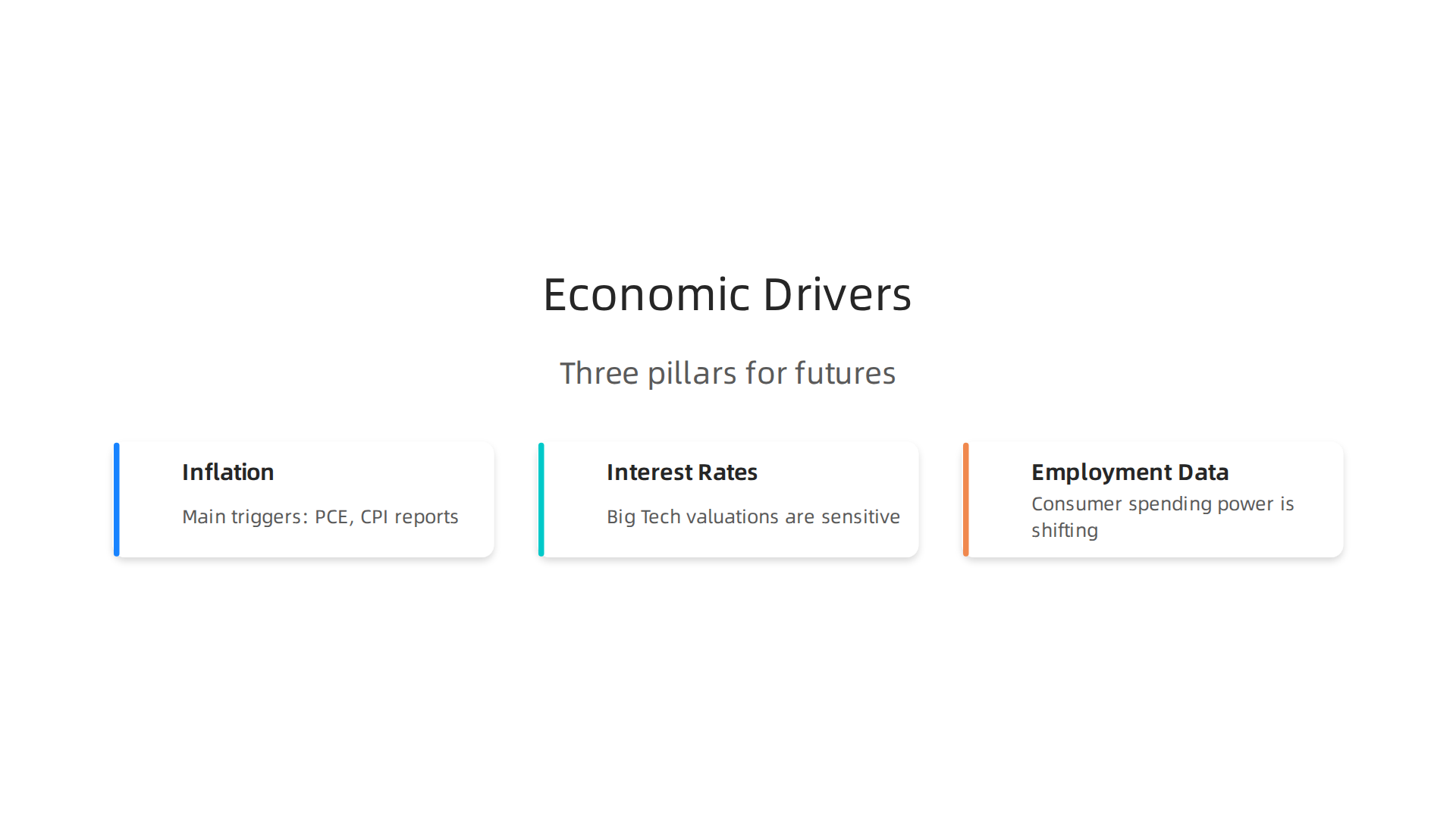
Inflation, interest rates, and employment data remain the bedrock. According to the 2026 market outlook from Ameriprise Financial, understanding how Fed policy interacts with inflation trends is essential for any investor.
The Indiana Business Research Center expects the federal funds rate to settle between 3.0% and 3.5% by the end of 2026, which directly shapes every futures contract on the board.
Here is the thing most people miss. Big Tech valuations are disproportionately sensitive to interest rate expectations. These companies carry high future cash flow weightings, meaning a quarter-point rate shift can swing their stock price by billions. That is why tracking international finance flows and rate decisions from the Federal Reserve (PracticeCFO analysis) matters more than watching daily price noise.
Consumer spending power is shifting too. As Mercer’s 2026 outlook notes, global inflation is stabilizing around central bank targets, but regional variation creates winners and losers. When consumers tighten wallets, ad revenue and subscription models for platform companies feel the pain first.
Want to see how these indicators played out for one major player? Our analysis of IBM’s stock trajectory in 2026 tracks exactly how AI and cloud adoption insulated a legacy tech giant from rate volatility.
Stop drowning in noise and start trading on signal. Subscribe Free and let The Deep View Newsletter deliver the economic context you actually need.
Inflation, Interest Rates, and Big Tech Valuations
Let’s get specific about why futures news reacts so strongly to just a few data points. The Personal Consumption Expenditures (PCE) price index and the Consumer Price Index (CPI) are the main triggers. According to the Fed Policy analysis from PracticeCFO, swings in these reports create instant volatility in Nasdaq futures.
What makes 2026 different is the expected rate environment. The Indiana Business Research Center sees the federal funds rate settling between 3.0% and 3.5% by year end. Any hint of a pause or a cut shifts valuations quickly.
This is especially true for the most rate-sensitive sector: long-duration Big Tech stocks. Their future profits are heavily weighted, making them move faster than the rest of the market. See how one company navigated this in our analysis of IBM’s stock trajectory in 2026.
Stop guessing and start understanding. Subscribe Free for daily context from The Deep View Newsletter.
Platform-Specific Futures: Decrypting Earnings and Product Announcements
Earnings season is like a weather front for big tech stocks. One minute the sun is shining on dow futures, and the next a single miss on AI spending sends shares tumbling.
In 2026, the volatility around these reports is sharper than ever. Pre-earnings whisper numbers, which are just unofficial guesses from traders, often clash with official guidance. This gap makes futures news a must-watch for anyone following companies like Apple, Google, or Microsoft.
Product launch cycles add another layer. When a company like Apple hints at a new AI feature, futures news can swing before the product even hits shelves. The market pricing of AI expectations is real. According to a CEPR analysis, AI innovations have fueled huge stock price gains for US tech firms. So a single announcement can move the needle more than a whole quarter of steady business. That is why you need to follow financial times and other trusted sources to separate hype from real signals.
Regulatory headline risk is the third big factor. Antitrust rulings, data privacy laws, and AI governance debates now create sudden shocks to international finance markets. One morning a new regulation might target how Google handles user data, and by afternoon the stock has dropped 3%. The Fidelity guide on AI bubbles points out that valuations remain above historical averages, making these headlines even more dangerous. You cannot just check stock prices once a day anymore. You need a dedicated process to watch for these policy shifts.
Want to stay ahead of every twist in futures news for big tech? Join thousands of professionals who get clear daily updates. Subscribe Free to The Deep View Newsletter and never miss the story behind the market moves.
AI-Related Futures: The Rise of AI Commodities and Derivatives
A new asset class emerged in 2025 and 2026. Futures contracts now track GPU computing power, AI training costs, and data center utilization. Unlike traditional dow futures, these instruments let investors hedge directly against the AI supply chain. Early data shows a strong correlation with Big Tech stocks, making futures news essential for anyone following international finance. The Bank of England has even warned about financial stability risks if AI asset prices drop. For context on how legacy tech firms are adapting, read our analysis of IBM stock in 2026. Stay ahead of the curve. Subscribe Free to The Deep View Newsletter for daily AI insights.
Regulatory Headlines and Their Immediate Market Impact
Regulatory news can shake up markets fast. In 2026, antitrust announcements and AI Act amendments often trigger sharp moves in AI futures. The market has gotten better at predicting these events, but surprise headlines still cause outsized volatility. That is why watching AI bubble signs helps you separate real risk from short-term noise.
A smart best practice is building a regulatory calendar that lines up with futures expiry dates. When you know when key decisions are coming, you can plan your trades around them. For context on how legacy tech firms handle these shifts, read our analysis of IBM stock in 2026.
Staying ahead of regulatory surprises takes work. Get clear daily AI updates that help you navigate the noise. Subscribe Free.
Delivering Depth: How to Cut Through Bias and Opinion with Data-Driven Futures Analysis
You open your futures news feed and see two headlines about the same market move. One says "panic selling ahead." The other says "healthy correction." Who do you believe? This happens every day with dow futures and other indices. The problem is that many sources embed editorial bias or speculative narratives into their reporting.
To trade smarter, you need a different approach. Look for data, not hot takes. The Wharton School’s Media Bias Detector uses artificial intelligence to analyze articles from major publishers.

It tags articles by topic and detects slants in real time. That same kind of thinking can guide your own analysis.
Peer-reviewed research gives you frameworks for objectivity. A study in Frontiers in Physics shows how reproducible statistical models can predict behavior better than gut feel. Instead of reacting to one opinion, build your own checks. Use anomaly detection. Compare moves across time frames. Ask if a headline matches actual volume and price data.
The goal is to separate signal from noise. That matters whether you are watching international finance news or scanning financial times columns. Data-driven methods do not guarantee perfect calls, but they reduce the risk of following a herd that is wrong.
For a deeper look at how one legacy tech firm is navigating these dynamics, read our analysis of IBM’s steady growth in 2026. It shows how data and strategy matter more than short-term sentiment.
Want to cut through the noise every morning? Subscribe Free and get daily AI updates from The Deep View Newsletter.
The Role of Verified Statistics and Survey Data
You have learned to question headlines. Now, where do you find numbers you can actually trust? Government surveys from the Census Bureau and Bureau of Labor Statistics give you stable baselines for economic data used in futures models. They move slowly but reliably.
Private surveys like the PMI, NFIB, and University of Michigan index add timeliness. But they come with built-in biases. A recent study in PMC warns about the risks of relying on big data black box algorithms without understanding their limits. The fix is simple: triangulate. Combine government stats, private surveys, and live price data. That way one flawed source cannot lead you astray.
For a real world example of data-driven strategy at a top tech firm, read our analysis of IBM’s steady growth in 2026.
Want to sharpen your data skills every morning? Get Free Updates from The Deep View Newsletter.
Case Studies: When Futures News Misled (and How to Avoid It)
Real examples show why trusting futures news blindly can cost you. In 2023, models missed the Silicon Valley Bank collapse because they relied on historical data, not the speed of social media-driven withdrawals. A year later, the AI hype cycle pushed Dow futures to inflated levels, leading many to overweight tech stocks before the correction.
Both cases are false signals. How do you build better filters? Start by cross-checking futures news with on-the-ground reporting. Tools like Wharton’s Media Bias Detector help you spot narrative shifts in real time. Transparency about these limits is the hallmark of trustworthy international finance analysis. For a deeper look at data-driven strategy, see our coverage of IBM’s steady growth in 2026.
Get Free Updates from The Deep View Newsletter to sharpen your signal every morning.
Building Your Futures News Workflow: A Framework for Time-Constrained Executives
You know the feeling. Markets move fast, and you only have minutes to decide whether a dip in Dow futures is a real warning or just noise. Here is a simple system built for busy leaders.
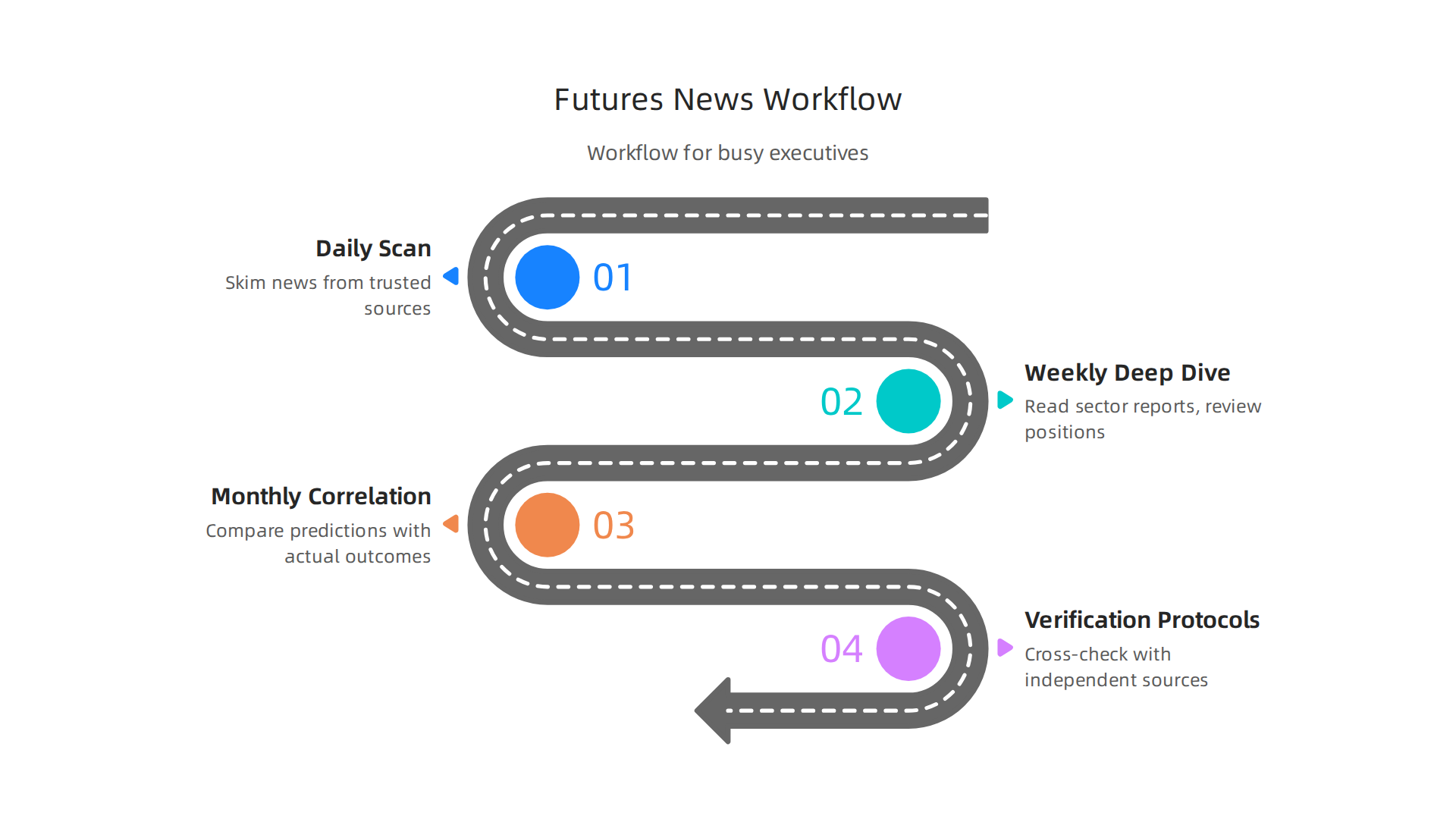

Daily scan (15 minutes). Each morning, skim futures news from two or three trusted sources. Use an AI summarizer or news aggregator to cut through the clutter. As the Future of Work 2026 analysis points out, professionals are shifting from time management to energy management. Tools that automate the first pass save your energy for what matters.
Weekly deep dive (one hour). Pick one day to go deeper. Read sector reports, check Financial Times commentary, and review your positions. For example, see how IBM’s steady growth in 2026 connects to longer tech trends.
Monthly cross-correlation (30 minutes). Compare what futures news predicted with what actually happened. Ask: Which source overreacted? Which story had real legs? This builds your own radar for false signals.
Verification protocols. Before acting, cross-check any alert with at least two independent sources. Add historical context (has this pattern happened before?). And overlay expert judgment. According to leadership trends for 2026, AI is reshaping how leaders make decisions, but careful human judgment still wins.
This framework automates about 60% of the work. The rest is about staying curious and disciplined.
Subscribe Free to The Deep View Newsletter for daily signals that cut through the noise.
Curation Strategies and Tools
To supercharge your workflow, start with smart curation tools. Link RSS feeds and API dashboards from Morningstar or Seeking Alpha into one hub for a unified view of Dow futures and NASDAQ futures.
Add AI tools for de-duplication and relevance scoring. As AI trends for 2026 show, smart filtering cuts manual sorting by up to 70%. The same AI powering IBM’s growth through AI and cloud transformation drives these tools.
Finally, set custom alerts for keywords like ‘Fed’ or ‘CPI’. When Financial Times or international finance sources move, you know instantly.
Subscribe Free to The Deep View Newsletter for daily signals.
Key Sources and Verification Protocols
Now that you have the right curation tools, you need to know which sources to trust. Not all futures news is equal. Primary sources like exchange data from the CME or official government economic releases should be your foundation. Secondary commentary from blogs or analysts can add context but often carries bias.
Build a quick verification checklist before acting on any noise: check the data date, the methodology used, sample sizes, and any conflicts of interest. As leadership trends for 2026 show, leaders who verify before acting make smarter calls in a fast-moving market.
Stick with a trusted source list. That includes reliable places like Big Tech News Today’s analysis of IBM stock for tech-driven market moves. This reduces mental overload and keeps your signal strong.
Want verified signals delivered daily? Subscribe Free to The Deep View Newsletter for curated futures news you can use.
Anticipating the Next Curve: Using Futures News to Predict Tech Cycles
Once you have verified sources, the real power of futures news comes into focus. You can start using it to see around corners in the tech world. The key is knowing which signals matter and how to read them together.
Leading indicators often flash warning signs months before the broad market moves. For example, semiconductor orders and AI patent filings act like early smoke signals. When these data points slow down, it often hints at trouble ahead for tech stocks. Reports from early 2026 already pointed to converging cycles that may signal a shift lower in certain sectors.
Geopolitical risk is now baked into futures pricing. That means you need to map specific events to the right asset classes. A trade policy change might hit dow futures hard while leaving gold untouched. At the same time, political uncertainty in 2026 has stretched market expectations thin, making it easier for surprises to rattle prices.
Here is the thing though. Cycle prediction is probabilistic, not deterministic. You cannot know exactly what happens next. What you can do is use scenario planning with futures data to reduce surprise. Tools like the StreetStats Market Cycle Indicator help you track where the market sits in real time.
By watching leading signals like AI investment trends and company earnings forecasts, you can position smarter. For a closer look at how one major tech player is navigating these shifts, check out our analysis of IBM’s growth through AI and cloud transformation.
Want to stay ahead of the next cycle without the noise? Get Free Updates from The Deep View Newsletter for daily futures news that cuts through the clutter.
Leading vs. Lagging Indicators for Tech Stocks
Once you start using futures news to watch for cycle shifts, it helps to know which signals give you the earliest heads up. Leading indicators move before the rest of the market. Think new orders for capital goods, AI startup funding rounds, and developer activity metrics. These dry up months before a downturn hits. Lagging indicators like earnings reports, tech employment, and market cap concentration only confirm what already happened. They are useful, but they won’t save you from a surprise.
The real edge comes from using both. For example, the StreetStats Market Cycle Indicator reads a mix of leading and lagging data to show where we stand today. Currently it signals a mild mid cycle expansion. Combine that with early signals from AI investment trends and you get a clearer picture.
See how one big tech company is navigating these cycles in our analysis of IBM’s growth through AI and cloud transformation.
Want to spot these leading signals before they hit the headlines? Subscribe Free to The Deep View Newsletter for daily futures news that cuts through the noise.
Geopolitical Events and Futures Correlation
Here’s where things get really interesting. Geopolitical news moves faster than most investors realize. Tariff announcements, semiconductor export controls, and sanctions can shift futures in tech-linked commodities within minutes. According to a recent outlook from Morgan Stanley, political risks are a key concern for 2026 markets. That means you need to reassess your supply chain and demand assumptions quickly.
Futures markets often react before equity markets do. They serve as early barometers for what’s coming next. With J.P. Morgan forecasting a 35% probability of a US recession in 2026, staying on top of dow futures and international finance news makes a real difference.
Want to catch these moves before your peers do? Subscribe Free to The Deep View Newsletter for daily futures news that cuts through the noise.
Conclusion: From Information Overload to Strategic Advantage
Reading futures news is the easy part. Turning it into a real edge for navigating Big Tech takes discipline. That is where most investors lose their way.

Here is a simple framework to cut through the noise.
Start with curated sources. Do not try to read everything in the Financial Times or chase every international finance headline. Pick three trusted outlets and stick with them.
Focus on verified indicators. The dow futures will jump around all day. What matters is the sustained move, not the five minute spike. Look for confirmation across markets.
Check your bias. Every news source has a point of view. Technology adoption is accelerating fast in 2026, and Deloitte experts note that objective analysis is more valuable than ever. Understanding the source helps you see the full picture.
Build a repeatable workflow. Spend 15 minutes each morning scanning your key signals. A calm, consistent routine beats a frantic reaction every time.
And here is the most important part. Be honest about uncertainty. No framework predicts the future perfectly. The goal is to face fewer surprises, not to eliminate risk entirely. That is why we always cite our sources and invite your questions.
Your next step
You already have the tools to make better decisions. But you do not have to build this system from scratch alone.
For a practical example of putting this disciplined lens to work, check out our analysis of IBM Stock in 2026. It shows how a clear framework helps you cut through the hype and focus on what actually matters.
If you want daily help separating the signal from the noise, we have you covered.
Subscribe Free to The Deep View Newsletter for curated futures news that gives you a clear strategic advantage.
Summary
This article explains why context-rich futures news matters more than ever for Big Tech stakeholders and offers a research-backed framework to turn noisy headlines into actionable insight. It covers which economic indicators (inflation, interest rates, employment) and market signals (volume, open interest, implied volatility) actually move futures, how AI and regulatory news amplify volatility, and why not all futures moves are meaningful. The piece walks readers through a practical workflow—15‑minute daily scans, weekly deep dives, and monthly reviews—plus curation tools, verification checklists, and examples showing how firms like IBM navigated 2026’s AI-driven market shifts. You will learn how to filter bias and false signals, build repeatable routines, and use leading indicators to anticipate tech cycles, so you can act thoughtfully rather than react to noise.